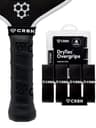
The verdict first. If your hands sweat, buy Tourna Grip — the original dry-feel overgrip — and buy the ten-wrap pack. It is the one product here whose maker positions it specifically as absorbent rather than tacky, which is the correct category for a sweating hand, and the large pack makes the per-wrap cost the lowest of anything on this page. If a dry grip feels too abrasive on thin or sensitive skin, the CRBN Drytec is the gentler dry option and the one to try second.
Now the part that makes this an older player’s problem rather than a comfort preference. A handle that slips does not make you drop the paddle. It makes you grip harder — unconsciously, on every single shot. And grip force is the mechanism behind two of the most common complaints in this sport after 55. The research on lateral epicondylitis identifies repetitive gripping and wrist extension as the loading pattern that irritates the tendon attachment at the elbow. And AAOS, writing about base-of-thumb arthritis, names “doing jobs or activities that involve a lot of gripping, pinching, or heavy lifting” among its risk factors, and lists “pain at the base of the thumb, especially with gripping, pinching, or turning activities” as the leading symptom.
So a two-dollar wrap sits upstream of a problem that otherwise costs you a brace, a course of physiotherapy, or a season. That is the honest case for taking it seriously.
Dry versus tacky: get this right first
Overgrips come in two families and they fail in opposite ways. Choosing the wrong family is why people conclude that “overgrips don’t work for me”.
- Dry / absorbent grips feel slightly chalky and powdery. They wick moisture away, so they get better as your hand warms up and they are the right answer in heat and humidity. The trade is that they feel thin and a little rough at first, and they need replacing more often.
- Tacky grips feel sticky and slightly cushioned. They give a secure hold on a dry hand and are more comfortable against sensitive skin. The trade is the one that matters here: once they are wet, the tack turns slick, and a slick tacky grip is more slippery than a damp dry grip.
If your problem is sweat, start in the dry family. Tacky grips earn their place on this page for the two readers who need them anyway — the player whose grip is too small, and the player whose grip strength is the limiting factor — and we say so in each case.
Four wraps follow. Every spec is read from the listing; where a maker does not publish a thickness, we print “Not published” rather than estimate one.
The four, side by side
| Overgrip | Surface | Wraps per pack | Published thickness |
|---|
| Tourna Grip | Dry feel (absorbent) | 10 | Not published |
|---|
| CRBN Drytec | Dry feel (Drytec) | 4 | Not published |
|---|
| Gamma Supreme | Tacky | 3 | Not published |
|---|
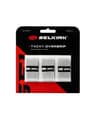
| Selkirk grip tape | Tacky, non-slip (per listing) | 3 | Not published |
|---|
Not one of the four publishes a thickness in millimetres, which is a shame, because thickness is what decides whether a wrap also changes your grip size. Treat the pack count as the more useful number: a dry grip is a consumable and you will replace it several times a season, so ten wraps in a box is a materially different proposition from three.
How to wrap one so it actually holds
Most of the complaints about overgrips are complaints about application. Four minutes, done sitting down:
- Leave the factory grip on. An overgrip goes over the original. Stripping the base grip changes the handle size and loses the cushioning underneath.
- Start at the butt end, with the tapered end of the wrap, and work toward the paddle face. Going the other way means your hand pushes against the overlapping edge and peels it.
- Pull gently taut and overlap by about a sixteenth of an inch. Stretching hard makes it thin and short; leaving gaps makes it bunch.
- Finish with the supplied tape at the top, and trim rather than doubling back.
- Replace it on feel, not on a calendar. The moment you notice yourself regripping between points, it is done. That is the whole early warning system.
If opening a packet and wrapping a handle is itself painful, that is worth noticing rather than pushing through — it is the same hand problem that arthritis gloves and our thumb pain guide deal with. Ask at a pro shop; most will wrap a paddle for you in a couple of minutes.
Things to try before and alongside a new grip
- A towel on the fence and a second one in your bag. Free, and more effective in genuine humidity than any wrap. Dry the handle at every changeover.
- Check your grip size before you blame the sweat.A handle that is too small for your hand feels insecure even when bone dry, and the response is the same — squeezing. Our grip size guide has the measurement, and a tacky wrap like the Gamma Supreme is the cheapest way to add about a size.
- Rotate two paddles on a hot day if you own two, so one grip dries while you use the other.
- Do not use rosin or spray tack. It builds a sticky film that collects grit, and the gritty residue is harder on sensitive skin than any dry grip.
How this page differs from our general overgrip ranking
Our main pickleball overgripspage ranks the whole category for every reason you might replace a grip — building a small handle up, cushioning an arthritic palm, adding tack for a weak grip. This page answers one question only: what to wrap a handle with when your hands sweat. That is why the order is different, why the dry family leads, and why the Gamma Honeycomb cushioned grip, which is our pick for arthritic hands over there, does not appear here — a cushioned tacky grip is the wrong tool for a wet palm.
If sweat is only one of several reasons your hand is unhappy on the handle, read them together with paddles for tennis elbow, which attacks the same grip-force problem from the paddle end, and how to hold a pickleball paddle, which is about reducing the force itself rather than improving the friction.
A note on what this page is not. We do not own these grips, we have not tested them, and there are no scores here — the surface descriptions are the makers’ own words and the pack counts are from the listings. Prices come from an automated daily check and carry the date they were read. Our methodology is here.