Kitchen & Court

Graphite vs Carbon Fiber Pickleball Paddles: Is There Actually a Difference?

Graphite is carbon. The words describe two eras of paddle face, not two materials - here is what each one actually means on a spec sheet, and which matters to an older arm.

By Stephen V.Last updated How we research

The verdict, before the chemistry lesson: graphite and carbon fiber are the same element, and on a paddle spec sheet the words describe two different generations of face rather than two different materials.“Graphite” almost always means a thin, smooth, painted carbon-composite skin — the lightweight face that defined paddles for a decade. “Raw carbon” or “T700” means a thicker, unpainted, deliberately gritty carbon weave built for spin. If you want one recommendation out of this page: for a player over 55 whose contact is not always perfect, a raw carbon face over a thick core is the more forgiving modern combination, and the Selkirk SLK Atlas Max is the one we would buy.

Here is why the terminology is such a mess. Graphite is a crystalline form of carbon. Carbon fiber is made of carbon filaments. There is no definition anywhere that says a “graphite paddle” must be made differently from a “carbon fiber paddle”, and no rule requires a maker to explain which it means — USA Pickleball approves a specific paddle model after testing it, not a material name. So the words have drifted into marketing shorthand, and the shorthand is genuinely useful once you know it:

  • “Graphite”→ usually a thin carbon-composite sheet over the core, painted and relatively smooth. Light, stiff, fast in the hand, cheaper to make, and low on grip — the ball slides off rather than biting.
  • “Carbon fiber” / “raw carbon” / “T700” → a thicker unpainted weave, left textured on purpose. More spin, a bigger and softer-feeling response area, usually heavier and more expensive. T700 is Toray’s grade designation for the fibre, not a performance claim in itself — though it does at least tell you the maker knows what it bought.
  • “Fiberglass” / “composite”→ a different material entirely: softer, livelier, more pop, less spin, cheaper. Not a worse choice — see carbon vs fiberglass for that comparison, which is the one that actually changes how a paddle plays.

What each face does on court

  • Spin. The clearest real difference. A raw, textured carbon face grips the ball; a smooth painted graphite face does not, to anything like the same degree. If you have never put spin on a ball, this matters less than the internet thinks.
  • Feel.Thin graphite is crisp and fast, which flatters quick hands and punishes a mis-hit. Thicker raw carbon feels slightly muted and more consistent across the face — more of the paddle answers the same way.
  • Weight. Graphite faces are lighter, which is why so many older paddles are. That is a genuine advantage if a sore shoulder is your constraint.
  • Durability. Raw carbon faces are textured by design and the texture wears, taking spin with it over a season or two. Painted graphite loses paint instead. Neither is a reason to choose.
  • Price. Graphite is the cheaper construction and raw carbon is where the money went. That is most of why the words carry the connotations they do.

Four paddles we list that publish their face material follow — one of each kind — and then the part most of these comparisons get wrong.

How this is funded: we earn a commission if you buy through our links, at no extra cost to you. It never changes which product we recommend, and we’ll tell you plainly when to skip one. Full disclosure.

Quick picks

Ranked on published specs, grip and build, and honest buyer fit. Select a row to jump to the full write-up. We have not lab-tested these — here is exactly what we do instead.

#ProductBest forPrice
1
Selkirk SLK Atlas Max

Selkirk SLK Atlas Max

The paddle that makes the sub-$100 argument all by itself. A carbon-fiber face over a 16mm polymer honeycomb core is the same recipe premium comfort paddles use, and Selkirk publishes the whole spec sheet - weight range, grip circumference, handle length - which almost nothing else at this price will do. If you want one paddle under $100 and you want it to feel muted rather than tinny, start here.

Raw carbon - best overall for an older arm
$63.99 · View on Amazon

$79.9920% off

Price as of October 5, 2026. #ad How we’re funded

2
Onix Graphite Z5 MOD

Onix Graphite Z5 MOD

The widebody. At 8.125 inches across it has the broadest face here, which is simply more paddle to hit the ball with - the most forgiving shape on the list for anyone whose contact has become less reliable. It is also the one with the firmest core, so it suits a player chasing forgiveness more than a player chasing softness.

Graphite - the classic light, forgiving shape
$76.49 · View on Amazon

Price as of October 5, 2026. #ad How we’re funded

3
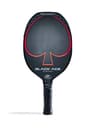
ProKennex Black Ace Ovation

ProKennex Black Ace Ovation

The most affordable way into ProKennex's comfort-first design. It carries the Toray carbon face and Comfort Pro grip at a price closer to a mainstream paddle, so it's the one to pick if the brand appeals but the flagship prices don't.

Toray T700 - carbon with a comfort-built frame
$104.99 · View on Amazon

Price as of October 5, 2026. #ad How we’re funded

4
Gamma Obsidian 13

Gamma Obsidian 13

The standout for hands that hurt: Gamma gives this one a molded foam handle instead of a hard wrapped grip, plus a system that lets you add handle weight to balance the paddle. Softer to hold and easier to customize is exactly what an arthritic grip wants.

Carbon - thin core, for a healthy arm that wants pop
$129.99 · View on Amazon

$159.9919% off

Price as of October 5, 2026. #ad How we’re funded

The picks in full

#1Raw carbon - best overall for an older arm

Selkirk SLK Atlas Max

The paddle that makes the sub-$100 argument all by itself. A carbon-fiber face over a 16mm polymer honeycomb core is the same recipe premium comfort paddles use, and Selkirk publishes the whole spec sheet - weight range, grip circumference, handle length - which almost nothing else at this price will do. If you want one paddle under $100 and you want it to feel muted rather than tinny, start here.

Easier on the joints: A 16 mm core is the thickest, softest construction in common use, and it does the single most important job for a sore elbow: it slows the impact down. Pair that with a carbon face, which returns a duller, more predictable ball than fiberglass, and you get about the least jarring feel available under $100.

What we like

  • 16 mm Rev-Control polymer honeycomb core - the thick, soft kind that muffles impact
  • Carbon-fiber face gives a muted, predictable response instead of a lively fiberglass ping
  • Selkirk publishes weight, grip circumference and handle length - rare at this price

Skip it if

  • The 4.85-inch handle is short - no room for a two-handed backhand and little to choke up on
  • Selkirk's own product page does not state USA Pickleball approval, so we do not claim it
  • The 4.25-inch grip is fine for most hands but on the small side for arthritic fingers
Face materialRaw carbon fiber (Raw Spin Technology)
Core16 mm Rev-Control polymer honeycomb
Weight7.6-8.1 oz (published range)
Grip circumference4.25 in
Handle length4.85 in
ShapeMax (widebody)
Dimensions16 x 7.85 in
Edge guardEdgeSentry (low-profile)
USA Pickleball approvedNot published

Specs read from the product listing, on September 15, 2026. “Not published” means the maker does not state that figure.

#2Graphite - the classic light, forgiving shape

Onix Graphite Z5 MOD

The widebody. At 8.125 inches across it has the broadest face here, which is simply more paddle to hit the ball with - the most forgiving shape on the list for anyone whose contact has become less reliable. It is also the one with the firmest core, so it suits a player chasing forgiveness more than a player chasing softness.

Easier on the joints: A wider face means more centered hits, and a centered hit sends far less jarring shock up your arm than a mis-hit off the edge. The trade is the Nomex core, which is stiffer than polymer - so this is the forgiving-shape pick rather than the soft-feel pick.

What we like

  • 8.125-inch widebody face - the largest hitting area of any pick here
  • Onix publishes the full spec sheet and states USA Pickleball approval
  • Perforated cushion grip fitted from the factory

Skip it if

  • Nomex core is the hardest, loudest core type here - more feedback into the arm than polymer
  • 4-inch grip circumference is the smallest on this list, so arthritic hands will want an overgrip or two
  • The wide shape trades reach for forgiveness - less help stretching for a ball at the kitchen line
Face materialGraphite
CoreNomex honeycomb
Weight7.5-8.2 oz (published range)
Grip circumference4 in
Handle length5 in
Dimensions15.5 x 8.125 in (widebody)
USA Pickleball approvedYes

Specs read from the product listing, on August 24, 2026. “Not published” means the maker does not state that figure.

#3Toray T700 - carbon with a comfort-built frame

ProKennex Black Ace Ovation

The most affordable way into ProKennex's comfort-first design. It carries the Toray carbon face and Comfort Pro grip at a price closer to a mainstream paddle, so it's the one to pick if the brand appeals but the flagship prices don't.

Easier on the joints: Same comfort recipe as the flagship ProKennex paddles — carbon face, cushioned grip — for players who want the arm-friendly feel on a smaller budget.

What we like

  • ProKennex comfort design at a mid-market price
  • Toray carbon face and cushioned Comfort Pro grip
  • Good bridge from a beginner paddle to a comfort-focused one

Skip it if

  • Fewer published specs than the pricier ProKennex models
  • Still costs more than a budget fiberglass paddle
Face materialToray 700 carbon fiber
CoreNot published
GripComfort Pro (cushioned)
WeightNot published
USA Pickleball approvedNot published

Specs read from the product listing, on July 22, 2026. “Not published” means the maker does not state that figure.

#4Carbon - thin core, for a healthy arm that wants pop

Gamma Obsidian 13

The standout for hands that hurt: Gamma gives this one a molded foam handle instead of a hard wrapped grip, plus a system that lets you add handle weight to balance the paddle. Softer to hold and easier to customize is exactly what an arthritic grip wants.

Easier on the joints: The molded foam handle spreads pressure across your palm instead of concentrating it, and the weight system lets you keep the paddle light — both directly reduce hand and wrist strain.

What we like

  • Molded foam handle is genuinely softer to grip than a standard wrap
  • Customizable handle-weight system lets you tune the balance
  • 13mm carbon-fiber build for a controlled, forgiving feel

Skip it if

  • Foam handle is a love-it-or-not feel — try before committing if you can
  • Exact weight isn't published
Face materialCarbon fiber
Core thickness13 mm
GripMolded foam handle
WeightNot published (adjustable via weight system)
USA Pickleball approvedNot published

Specs read from the product listing, on July 22, 2026. “Not published” means the maker does not state that figure.

The thing these comparisons get wrong

The face material is the least important of the three specs that decide how a paddle feels. In order of effect:

  • 1. Core thickness.13 mm versus 16 mm changes power, sweet spot and how much shock reaches your hand far more than any face does. Pickleball Studio’s testing-based guide is explicit that thinner paddles “usually provide more vibration and worse off-center shot performance”. See 13mm vs 16mm and best 16 mm paddles.
  • 2. Grip circumference. A grip that is too small makes you squeeze, and squeezing is what loads forearm tendons. More sore elbows come from a 4 in grip than from a face material. Grip size.
  • 3. Weight and shape.Mass on a lever — what your shoulder actually pays. Paddle weight and paddle shapes.
  • 4. Then face material. Real, but a refinement rather than a decision.

Here is the concrete illustration from the four paddles above. The Onix Graphite Z5 MOD and the Selkirk SLK Atlas Max are a graphite face and a raw carbon face, and they feel completely different — but almost none of that difference is the face. Onix publishes a Nomex coreon the Z5 MOD, which is a hard, resin-impregnated honeycomb that gives a loud, firm, powerful response, against Selkirk’s 16 mm polymer Rev-Control core, which is soft and absorbent. That core difference is doing nearly all the work. Swap the faces between them and you would still be able to tell them apart instantly.

So which should a player over 55 buy?

Our honest answer, in three cases:

  • If your arm is fine and you want a light, fast paddle— graphite is a perfectly good and usually cheaper choice, and the Onix Z5 MOD is the forgiving-shape version of it at a published 15.5 x 8.125 in, the widest face we list.
  • If your elbow, wrist or hand notices the game— a raw carbon face over a 16 mm polymer core, which is the Atlas Max. The texture also buys you spin you may not have had, and spin is how you keep the ball low without hitting it hard.
  • If comfort is the entire reason you are shopping— the face is not where to look at all. ProKennex builds its Kinetic frames around a shock-management system rather than around the face material, which is why those paddles keep appearing on our tennis elbow and low-vibration pages regardless of what their faces are called.

How to read a spec sheet without being sold to

  • “Graphite” with no further detail usually means a thin painted composite face. That is fine. It is not a premium claim.
  • “Raw”, “unpainted”, “textured”, “grit”are the words that signal the modern spin-oriented face — more informative than the word carbon on its own.
  • “T700”, “T300”, “18K”, “3K” are fibre grades and weave counts. They tell you the maker is specifying its material, which is mildly reassuring, and nothing about whether you will enjoy the paddle.
  • “Carbon fiber” on a $40 paddle is usually a thin composite layer, closer to what everyone else calls graphite. Not dishonest, but do not expect a raw-carbon spin face at that price.
  • A face claim with no core thickness anywhere is the real warning sign. The core is the spec that matters most, and a maker that advertises its face while hiding its core has told you something.

The same principle applies to approval: USA Pickleball tests and approves individual paddle models against its equipment standards, so “carbon fiber” on a box says nothing about legality for sanctioned play. Check the model.

How we wrote this

We own none of these paddles and have tested none of them. Every face and core description above is read from a manufacturer or retailer spec sheet on the date recorded in that product’s own table — Onix’s own page for the Z5 MOD, Selkirk’s for the Atlas Max, ProKennex’s for the Black Ace. Where a maker does not state something, the table says “Not published” rather than filling the gap, and on this topic those blanks are informative: several paddle brands will tell you a face is “carbon” and decline to say what the core is made of or how thick it is. Here is exactly what we do.

If what you actually want is a shortlist rather than an explanation, start with best carbon fiber paddles for the face, or best paddles for seniors for the whole decision made for you.

Frequently asked questions

Is graphite the same as carbon fiber in a pickleball paddle?

Chemically, yes - graphite is a crystalline form of carbon and carbon fiber is made of carbon filaments. In paddle marketing they describe two generations of face. 'Graphite' usually means a thin, painted, relatively smooth carbon-composite skin; 'raw carbon' or 'T700' means a thicker unpainted weave left textured for spin. No rule requires makers to define either word, so read the construction rather than the label.

Which is better, graphite or carbon fiber?

Neither, in the abstract. A raw carbon face grips the ball for more spin and feels more consistent across the face; a graphite face is lighter, crisper and cheaper. For a player over 55 whose contact is not always central, raw carbon over a thick polymer core is the more forgiving combination. For a light, fast paddle on a healthy arm, graphite is a perfectly good choice.

Do carbon fiber paddles give more spin?

Raw, unpainted, textured carbon faces do - that is what the texture is for. A smooth painted graphite face grips the ball far less. The words that actually signal spin on a spec sheet are 'raw', 'unpainted', 'textured' and 'grit', not the word carbon on its own. Note also that the texture wears over a season or two and takes some of the spin with it.

Is a graphite paddle good for tennis elbow?

The face is the wrong place to look. Core thickness, grip circumference and paddle weight all affect how much load reaches a sore arm far more than face material does - a thin stiff core sends more shock up the handle whatever is bonded to the outside of it. If comfort is the reason you are shopping, look at 16 mm cores, a grip large enough that you are not squeezing, and frames built around shock management.

What does T700 mean on a pickleball paddle?

It is Toray's grade designation for a particular carbon fibre, not a performance rating. It tells you the maker is specifying the material it buys, which is mildly reassuring, and nothing about whether the finished paddle suits you. The same goes for weave counts like 3K and 18K - they describe the cloth, not how the paddle plays.

Are graphite paddles cheaper?

Generally yes. A thin painted composite face is a cheaper construction than a thick raw carbon weave, which is most of why the two words carry the connotations they do. That makes graphite a sensible choice on a budget - and it is worth knowing that 'carbon fiber' printed on a very cheap paddle usually describes a thin composite layer closer to what everyone else calls graphite.

Sources

  • USA Pickleball — Equipment Standards Manual — The manufacturing specifications and testing (including the PBCoR power test) paddles must meet to be approved (accessed July 22, 2026)
  • Pickleball Studio — How Thick Should Your Pickleball Paddle Be? (Chris Olson, Aug 31, 2022) — Thicker cores (16 mm and above) are for control: 'less power but usually improves your blocks, resets, and drop shots', 'helps absorb more of the pace from the ball', and they 'usually feel like they have a better sweet spot'. Thinner cores (13 mm and below) 'feel stiffer when the ball hits the paddle', the core 'doesn't absorb as much energy, so the ball comes off faster', and 'thinner paddles usually provide more vibration and worse off-center shot performance'. Recommendation: 'If you are a new player up to about 3.5, I would usually tell you to opt for a thicker paddle.' The article does not address arm pain or older players specifically (accessed September 18, 2026)
  • Onix - Graphite Z5 MOD product page (manufacturer specifications) — Onix publishes a complete spec sheet, re-read in full on October 4, 2026 and unchanged from our August reading: graphite face, Nomex core, 7.5-8.2 oz weight range, 4 in grip circumference, 5 in handle length, 15.5 in length, 8.125 in face width, 'Meets USAPA requirements: Yes', and a 'Tennis Handle' grip shape Onix describes as mimicking a flared wood handle. Listed at $89.99 on the page (accessed October 4, 2026)
  • Selkirk Sport — SLK Atlas Max product page (manufacturer specifications) — Selkirk publishes a full spec sheet: premium carbon fiber face with Raw Spin Technology, 16 mm Rev-Control polymer honeycomb core, 7.6-8.1 oz weight range, 4.25 in grip circumference, 4.85 in handle length, 16 in x 7.85 in, EdgeSentry low-profile edge guard, SLK Ultra-Comfort grip, skill level beginner-intermediate, 1-year limited warranty, designed and quality controlled in the USA and manufactured in China. No USA Pickleball approval statement appears anywhere on the page (accessed September 15, 2026)
  • ProKennex — Black Ace Ovation product page (manufacturer) — Read 2026-09-13: listed at $100.00 against a $250.00 original price, marked 'Final Sale' (no returns or exchanges), with no seasonal promotion named — an example of a brand clearing a prior-generation paddle outside the holiday window (accessed September 13, 2026)
  • USA Pickleball — Approved Paddles list — The searchable database of paddles that have passed USA Pickleball certification testing (accessed July 22, 2026)

Keep reading