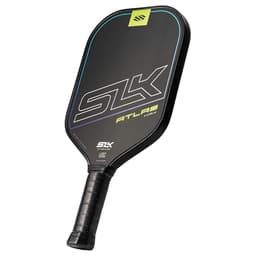
The spec sheet is the story
Start with what is unusual about this paddle, because it is not the carbon and it is not the core. Both of those have become common under $100. What is still rare is a manufacturer willing to print the numbers.
Selkirk states a weight range of 7.6 to 8.1 oz, a grip circumference of 4.25 inches, a handle length of 4.85 inches and dimensions of 16 by 7.85 inches. Read those four figures together and you know, before you buy, roughly how heavy the paddle will feel, whether your hand will have to squeeze to hold it, whether a two-handed backhand will fit, and how much hitting surface you get. Four of our six sub-$100 picks publish that much. Most of the market does not, and the blank cells in a spec table are a finding rather than a gap in our research: a brand that will not state a weight is telling you something about how tightly it controls one.
A weight rangeis still a range, and it is worth being clear-eyed about what that means. Half an ounce of spread is real — two paddles of the same model can land at either end of it, and the one you receive may not match the one your playing partner has. That is the honest limit of budget manufacturing, and it applies everywhere at this price. Our paddle weight guideworks through what the number means in your hand, and why a published range still beats silence. What Selkirk does not publish at all is a balance point or a swing weight, so nobody — us included — can tell you in advance exactly how head-heavy your particular unit will feel.
The 16mm core is doing the real work
If you take one thing from this review, take this: the most joint-relevant number on the sheet is the core thickness, and 16mm is the thick end of what is commonly made.
A paddle core is a honeycomb sandwiched between two faces, and it behaves like a crumple zone. When the ball arrives, a thicker, softer core compresses more and spreads the impact over a slightly longer moment, so the peak force reaching your hand and forearm is lower for the same shot. Selkirk calls its version Rev-Control polymer honeycomb and markets it for vibration dampening and a soft touch. Strip the branding away and it is a thick polymer core, which is the construction that does the most to keep shock out of a sore elbow.
That matters more than it sounds for a player over 55. Tennis elbow is not an injury you sustain in a moment — it is an overuse tendinopathy that accumulates from thousands of small loads. Anything that lowers the load per shot lowers the total, and a thick soft core is the cheapest way to do it. It is why a 16mm core appears on nearly every pick in our paddles for tennis elbow roundup, and why we put a paddle with one at the top of the under-$100 list rather than a lighter or flashier paddle with a thin core.
Be honest about the ceiling, though. A thick core is passive damping. It is not the engineered vibration control a brand like ProKennex builds into the frame itself, and no amount of core thickness gets you there. If your elbow is already a diagnosed problem rather than an occasional ache, read our low-vibration paddle picks before you decide that under $100 is enough paddle for you.
Raw carbon, and what it actually changes
The face is raw carbon fiber with what Selkirk calls Raw Spin Technology — a textured, unpainted surface meant to grip the ball. Two things follow from that, one of which is sold hard and one of which is barely mentioned.
The advertised one is spin. A gritty face bites the ball and lets you brush up the back of it, which is genuinely useful for a topspin drive or a heavier third-shot drop. The quieter benefit is the one that matters more at 55+: carbon returns a duller, more predictable ball than fiberglass does. Fiberglass is lively — it springs back and sends more of the collision into your arm. Carbon flexes less and feels muted, and muted is comfortable. Our carbon vs fiberglass guide takes that apart in full, and the carbon-fiber roundup is where this paddle sits alongside the alternatives.
One practical caveat applies to any raw face: the texture is a wear item. The grit is the surface itself rather than a coating on top of it, so it smooths down over months of play and takes some of the spin with it. Nothing is wrong with the paddle when that happens — it is how raw carbon ages, on an inexpensive paddle and a premium one alike. Our paddle care guide covers what slows it down.
Max is the widebody. XL is the elongated one.
This is the point buyers get wrong most often, partly because “Max” sounds like it ought to mean longer. It does not. The Atlas comes in two shapes and they pull in opposite directions, and picking the wrong one is the likeliest way to be disappointed by an otherwise sensible paddle.
| Published spec | Atlas Max | Atlas XL |
|---|
| Dimensions | 16 x 7.85 in | 16.4 x 7.4 in |
| Handle length | 4.85 in | 5.75 in |
| Weight range | 7.6–8.1 oz | 7.6–8.1 oz |
| Grip circumference | 4.25 in | 4.25 in |
| Core and face | 16mm Rev-Control, raw carbon | 16mm Rev-Control, raw carbon |
Same core, same face, same weight range, same grip — and two genuinely different paddles in the hand. The Max is the widebody: shorter and wider, with the largest hitting surface in the line and its mass kept closer to your hand. The XL is elongated: about four tenths of an inch longer, nearly half an inch narrower, with most of the extra length going into a handle almost a full inch longer.
For the reader this site is written for, the Max is usually the better of the two, for two reasons. The first is the wide face. A bigger hitting surface means more of your shots land somewhere reasonable, and the jarring hits — the ones you feel in your elbow the next morning — are the off-center ones. Forgiveness is a comfort feature. The second is where the weight sits. Stretching a paddle into an elongated shape pushes mass away from your hand, and mass out at the tip is what a weak or sore wrist feels on every swing. The widebody keeps it closer in.
The XL earns its place if you want reach at the kitchen line, or if you hit a two-handed backhand. That second one is not a preference, it is a fit problem: 4.85 inches is not enough handle to get two hands onto comfortably, and liking the paddle does not change that. Selkirk’s own answer to it is the XL, with its 5.75-inch handle.
Where it falls short
Three honest problems, in the order they are likely to affect you.
The 4.25-inch grip is small for an arthritic hand.This is the real limitation of the paddle for part of our audience. A grip that is too small forces your fingers to curl further and clamp harder, and that sustained clamping is exactly what aggravates arthritic finger joints and feeds tennis elbow. Grip circumferences run from about 4 to 4.5 inches; 4.25 sits in the middle, which is fine for an average hand and slim for a large or a painful one. The fix is cheap and well established — an overgrip adds roughly an eighth of an inch per wrap, so two wraps take this handle to about 4.5 — but it is a fix you have to remember to buy, and it uses up some of an already short handle. If squeezing is your main complaint, read our grip size guide first, and look at the larger-gripped options in our paddles for arthritis roundup before you commit.
Selkirk does not state USA Pickleball approval.We read Selkirk’s own product pages for both the Max and the XL, and neither one says the paddle is approved for sanctioned play. Plenty of third-party writeups assert that it is. We are not willing to pass along a compliance claim the manufacturer itself does not make, so the spec table above reads “Not published” and it will keep reading that until Selkirk says otherwise. If you play in a league, a club ladder or anything sanctioned, check the model against USA Pickleball’s official approved-paddle database, linked in the sources below, before you buy. For casual and recreational play the question does not arise.
The handle is short. Beyond ruling out a two-handed backhand, 4.85 inches leaves little room to choke up for extra control at the net, and less room for the overgrip fix above. If you came to pickleball from tennis and are used to having plenty of handle to work with, you will notice this immediately.
One thing we will nottell you is how it plays. We have not hit a ball with this paddle. Everything above is what its published construction means for a buyer, not a report from a court — and a review that describes a pop or a feel it has never experienced is inventing the most persuasive part of the page.
Who should buy it
- The player who wants one good paddle under $100 and is done shopping. Thick soft core, muted carbon face, and a spec sheet you can check against your own hand. There is not much left to want at this price.
- Anyone whose elbow or shoulder is the reason they are shopping. The 16mm core is the feature that matters most, and it is here.
- Players who mishit and feel it. The widebody is the most forgiving shape in the line, and forgiveness translates directly into fewer jarring contacts.
- Beginners and improvers who do not want to replace it in a season. Selkirk positions the Atlas for beginner-to-intermediate play, which is an honest description rather than a limitation.
Skip it if you hit a two-handed backhand, if you want reach above all else — the XL is the same paddle stretched for both — or if your hands need a genuinely large grip straight out of the box.
How it compares
Against Selkirk’s own SLK Halo Power XL, the Atlas Max is the shorter, wider, more forgiving shape and the Halo is the elongated, more powered one — reach and drive against surface area and comfort. For a sore arm, the Atlas Max is the more sensible of the two.
Against the other sub-$100 picks, the trade is grip size. The Franklin Signature Series Pro publishes a 4.5-inch circumference — the largest we found under $100 — and if arthritic hands are your problem, that single number outranks everything the Atlas Max does better. Everywhere else, the Selkirk’s carbon face and fuller spec sheet win.
Against paddles over $100, what you are still missing is engineered damping and tighter unit-to-unit consistency. Both are real, neither is available at this price, and our honest answer on expensive paddles walks through when the upgrade is worth it and when it stops buying you anything. If budget is not the constraint, our best paddles for seniors list covers the same comfort priorities without the price ceiling.
The verdict
The SLK Atlas Max is the paddle we point most sub-$100 buyers at, and the reason is boring rather than exciting: it does the comfort fundamentals properly and it shows its work. A 16mm Rev-Control core keeps impact out of your arm, a raw carbon face returns a duller ball than fiberglass, the widebody shape forgives the mishits that hurt, and Selkirk publishes enough of the sheet that you can match it to your hand before you spend a dollar. The two things that would send you elsewhere are specific and easy to check against yourself: a two-handed backhand, which the 4.85-inch handle cannot accommodate, and hands that need more than 4.25 inches of grip, which two overgrips will fix for a few dollars if you remember to buy them. For an older recreational player with an average hand and a one-handed backhand, this is as much paddle as $100 needs to buy.