ASTM F803 vs ANSI Z87.1 — the difference that matters here
Both are real standards and both mean a lens has been impact-tested. They were written for different threats, and for an over-the-glasses purchase the distinction is sharper than usual.
ASTM F803is the racket-sport standard. It is tested with a ball at sport speeds and it specifies coverage — the frame has to keep the projectile out of the eye socket, not merely survive the hit. AAO advises eye protectors that meet an ASTM standard for sport.
ANSI Z87.1 is the US industrial standard, written for workshops and job sites. It is a serious specification and Z87.1+ gear is genuinely impact-rated. What it does not promise is the specific coverage geometry a racket sport needs.
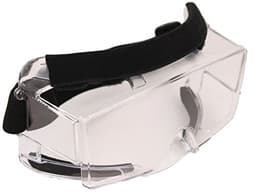
Of our two over-the-glasses picks, the Python claims ASTM F803-97 and the Uvex claims ANSI Z87.1+ 2015 and CSA Z94.3. Both are protective. Only one of them is claiming the standard AAO points racket-sport players at. That is the whole reason the order on this page is what it is, and it is not a judgement about build quality.
The fogging problem, and the honest warning about the cheap pair
Put a protective shell an inch in front of your own glasses and you create a pocket of still, warm, humid air between two lens surfaces. On a cool morning it fogs. This is the practical reason OTG eyewear gets abandoned, and it is worth more attention than the price difference.
The Python publishes anti-fog and scratch resistance, and the frame is vented, which is the structural half of the fix. The Uvex Ultra-spec 2001 OTG publishes an Ultra-dura anti-scratch hardcoat and no anti-fog coating at all. It does have vented side shields. We would still buy it as a bag backup at its price, and we would not buy it as the pair you wear every session in a cool gym. That is the kind of missing spec we would rather print than skip over — an empty cell is information.
Three things that help whichever pair you buy: let the eyewear reach court temperature before you put it on, do not wipe the inside of an anti-fog coating with a dry cloth because you will abrade the coating off, and rinse with water and air-dry rather than polishing.
Progressives, bifocals and the net
This is the part nobody warns you about, and it has nothing to do with protection.
A progressive or bifocal lens puts your reading correction at the bottom of the lens. In normal life you drop your eyes to use it. On a pickleball court you spend a lot of time looking downat a low ball near your feet at the kitchen line — straight through the reading segment, at an object four feet away. The ball goes soft and its distance reads wrong. Players describe it as the dink that is always slightly further away than it looked.
The fixes, in order of cost: tip your head down rather than your eyes, so you look through the distance portion — it feels unnatural for a week and then it does not. Ask your optician about a single-vision distance pair for sport, which is usually the cheapest lens they sell. Or use contacts for play if you tolerate them.
Worth knowing too: depth perception is binocular, so anything that disadvantages one eye — a cataract that has progressed further on one side, an old injury, a dirty or scratched lens on one side only — costs you more on a fast-moving ball than it does in daily life. If your tracking has changed noticeably, that is an eye appointment rather than an equipment purchase.
Can I just wear my regular glasses?
You can, and plenty of people do, so here is what you are accepting rather than a lecture. Everyday lenses, unless you specifically asked for polycarbonate or Trivex, are not impact-rated. Everyday frames have no side coverage, so a ball arriving from an angle gets in anyway. And AAO’s specific warning is that ordinary glasses “can make an injury worse if they shatter” — the failure mode is not the ball reaching your eye, it is your own lens doing it.
If you are going to do it anyway: ask your optician whether your current lenses are polycarbonate, which many modern ones are, and if you are due a new pair, ask for polycarbonate in a frame that sits close to your face. That is strictly better than nothing and strictly worse than a rated eyeguard over the top.
What we would buy, in one paragraph
If you wear glasses and want to be protected this week: the Python Overglasses, over your own frames, because it is the one OTG option here claiming the racket-sport standard and it publishes anti-fog. If you want a cheap pair that permanently lives in the bag and you accept that it will fog in a cold hall: the Uvex Ultra-spec 2001 OTG. If you would rather have one clean pair than two stacked ones and you do not mind a trip to the optician: the Tourna Specs, whose maker sells a prescription adapter separately. And if you can wear contacts for play, skip the whole problem and buy the HEAD Pro Elite, which is the only eyewear we list claiming both ASTM F803 and ANSI Z87.1 with an adjustable nosepiece and strap. Our full ranking of protective eyewear is at best pickleball eye protection for seniors. Nothing here was tested by us and nothing here is medical advice. Our methodology is here.