Why this order, and not the order you expected
Almost every senior pickleball shopping list starts with the paddle, because a paddle is the fun purchase. The injury data puts it last. Here is what the published research actually says about players in this age group, and it is worth reading before you decide where your money goes.
A study of pickleball-related geriatric fractures found adults 60 and over accounted for 74.1% of pickleball emergency-department visits, were 1.6× more likely to fracture than younger players, and that 56.1% of geriatric pickleball injuries were ground-level falls. Women had roughly three times the fracture odds. Separately, a decade of US emergency-department data on players 60 and over found strains and sprains at 31.0% and fractures at 30.4%, with the wristthe single most-injured body part at 13.2% — which is what happens when you fall and put a hand out.
Read those numbers together and the shopping order writes itself. The dominant mechanism is falling over, and the dominant consequence is a broken bone. So the first thing to buy is the thing that keeps your foot where you put it. The paddle is the last, because no paddle has ever prevented a fall.
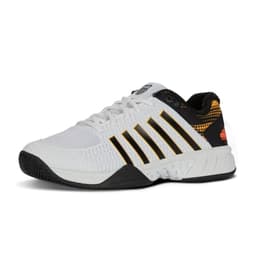
1. Falls: court shoes, and this is not optional
A running shoe is built to roll you forward: tall heel, soft midsole, narrow base. Every one of those features is a liability the moment you step sideways, which in pickleball is most steps. A court shoe is lower, wider and firmer through the midfoot, and its outsole is tuned to bite and release on a court surface instead of sliding on it. That is the entire difference, and for a 60+ player it is the highest-leverage forty dollars in the sport.
Two things to actually check when you buy. First, grip— and then keep checking it, because a court outsole goes slick long before it looks worn, and a flattened sole is the fall you have not had yet. If your tread has gone smooth, that shoe is finished regardless of how much life the upper has left. Second, fit: a shoe that pinches gets worn loose or gets taken off, and a shoe you are not wearing protects nothing. If you need width, buy width — several of the shoes we recommend come in a true wide, and our women’s roundup flags the ones linked in an actual W.
Full comparison: best pickleball shoes for seniors. If running shoes still sound fine to you, read why they are not first — it is the single most common and most expensive gear mistake we see. And if your heel hurts most on the first steps out of bed, that is a different problem with a different shoe answer: shoes for plantar fasciitis.
One addition if your ankles already have a history: a shoe holds the whole foot, but an ankle brace holds the specific joint, and about nine in ten ankle sprains are the same inward roll a figure-eight strap is built to resist. It is the cheapest item on this list after the eyewear, and the only one that targets the joint this sport pivots on.
2. Knees: a sleeve is not a brace, and most people want the sleeve
This is the category where people most often buy the wrong thing, usually by buying too much. A compression sleeveis a stretchy tube: it adds warmth, mild support and a lot of proprioceptive feedback — the sense of where your knee is — and it costs about twenty dollars. A hinged brace mechanically limits how far the joint can travel, costs several times more, and is what you wear around a diagnosed instability or after an injury. For an achy-but-stable knee that grumbles in the third game, the sleeve is the right tool and the brace is overkill.
What a sleeve will not do is fix anything. It makes a session more comfortable and it makes you a bit more aware of the joint; it does not repair cartilage and it is not a substitute for the leg strength that actually protects a knee. Bracing a healthy joint “just in case” is not preventive either. Match the support to an actual complaint.
Full comparisons: knee compression sleeves and knee braces. If you are genuinely unsure which you need, we wrote the sleeve-versus-brace comparison for exactly that decision, and do braces actually help covers the honest limits.
3. Eyes: the cheapest catastrophic-injury insurance there is
This is the category almost nobody buys and the one with the least excuse. A 2025 study in JAMA Ophthalmologycounted an estimated 3,112 pickleball-related eye injuries arriving at US emergency departments between 2005 and 2024 — roughly 1,262 of them in 2024 alone, with more cases in patients aged 50 and over than under 50. The mechanisms were a ball to the eye, a paddle to the eye, and falls. The severe outcomes included retinal detachment and orbital fracture.
The American Academy of Ophthalmology recommends polycarbonate protection with front and side coverage, and notes that a pickleball crosses the court faster than you can blink at it. USA Pickleball’s own safety guidance says proper eye protection is highly recommended for all players — a recommendation, not a rule, which is exactly why so few people wear any. One thing the Academy is blunt about and worth repeating here: ordinary prescription eyeglasses are not eye protection. They are not impact-tested and a shattered lens makes an injury worse.
When you buy, check for a published impact standard — ideally ASTM F803, which is written for racket sports, or at minimum ANSI Z87.1. Plenty of things marketed as “pickleball glasses” publish neither, and the lens-free frames you see everywhere publish nothing at all. Full comparison, including the over-the-glasses option: best pickleball eye protection.
4. Elbow and arm: the only place the paddle matters
Tennis elbow is an overuse tendinopathy of the forearm extensors, and the conservative care that works is rest, a counterforce strap and graduated loading — not a purchase. But the paddle is the one piece of gear that genuinely changes the load, because every ball you hit sends shock up the handle into your hand, wrist and elbow, several hundred times a morning.
Two honest caveats. First, the effect is cumulative and modest per shot; a paddle swap is not a treatment. Second, the biggest self-inflicted cause of arm pain in this sport is not the paddle at all — it is a grip that is a size too small, which makes you clench for two hours. That fix costs a couple of dollars and ten minutes, and you should do it before you spend a hundred and sixty: how to check your grip size and the overgrips that build a thin handle up.
Full comparisons: paddles for tennis elbow, low-vibration paddles, and the general senior paddle roundup. If your elbow already hurts, a counterforce strap is the cheaper first move and this guide covers what is actually going on.
What we would spend, in order, and what we would skip
If you are starting from nothing: court shoes, then eye protection, then a knee sleeve if a knee actually complains, then an overgrip, and only then a paddle. That order follows the injury data rather than the fun. Shoes and eyewear together are under a hundred and thirty dollars at the prices showing today, and between them they address the dominant injury mechanism and the worst-case outcome.
What we would skip: bracing a joint that does not hurt, anything sold as “preventive” for a healthy body part, and lens-free eyewear bought in the belief that it is equivalent to a rated protector. And the thing that does more than any of this and costs nothing — the behavior half: a five-minute warm-up, never backpedaling for a lob, and some leg and balance work twice a week. That is the companion guide, and if you only have time for one of the two pages, honestly, read that one.
None of this is medical advice and we own none of these products — every spec on this page is read from the maker’s published material and every price comes from a live daily check. If something already hurts, see a doctor or a physical therapist rather than a shopping list.