Kitchen & Court

Best Ankle Braces for Pickleball

The ankle is the joint this sport actually asks the most of, and about nine in ten sprains are the same inward roll. Four braces whose makers publish what they do - matched to whether your ankle aches, swells, or genuinely gives way.

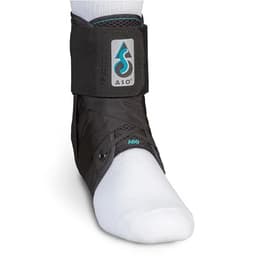
Med Spec ASO Ankle Stabilizer

Our pick

Med Spec ASO Ankle Stabilizer

Med Spec’s ASO is the lace-up-and-figure-eight design trainers have used for decades, and it is the only brace here that is bilateral— one unit fits either foot, so there is no side to order wrong. One honest caveat: laces plus two straps is a three-step routine, and if your ankle aches rather than wobbles the much cheaper Mueller below is the smarter first buy.

$28.16 · View on Amazon

$44.9537% off

Price as of October 4, 2026. #ad How we’re funded

Read the full write-up
By Stephen V.Last updated How we research

Of the joints pickleball tests, the ankle is the one the sport is actually built around. Every dink exchange ends in a plant-and-push, every ball to the sideline is a lateral cut, and the AAOS lists “high-risk sports that require cutting or jumping actions” as a leading cause of ankle sprains — naming tennis among them. About 90% of those sprains are the same injury: an inversion roll that overstretches the ligaments on the outside of the ankle.

The problem for a player over 55 is what happens next. A stretched ligament does not shrink back, so the first rolled ankle quietly raises the odds of the second, and an ankle that has been through this a few times starts turning on nothing at all. That is the gap a brace fills — and the reason this page exists separately from our best shoes for ankle support roundup. A shoe holds your whole foot; a brace holds the specific joint. If your ankle is the thing you worry about, you want both, and you want the brace matched to what is actually wrong. The four below are the ones whose makers publish what their brace is for, in writing, which in this category rules out most of the market.

How this is funded: we earn a commission if you buy through our links, at no extra cost to you. It never changes which product we recommend, and we’ll tell you plainly when to skip one. Full disclosure.

Quick picks

Ranked on published specs, grip and build, and honest buyer fit. Select a row to jump to the full write-up. We have not lab-tested these — here is exactly what we do instead.

#ProductBest forPrice
1
Med Spec ASO Ankle Stabilizer

Med Spec ASO Ankle Stabilizer

The one to buy first. Med Spec's ASO is the lace-up-plus-figure-eight design athletic trainers have strapped on for decades, and it is the only brace here that is bilateral - one unit fits either foot, so you cannot order the wrong side. Med Spec publishes what it is for in clinical terms (inversion and eversion sprains, medial or lateral instability, subtalar instability), and it is built to be worn inside a shoe, which is the test any brace has to pass before it is any use to you on a Tuesday morning.

Best overall - bilateral, clinical design
$28.16 · View on Amazon

$44.9537% off

Price as of October 4, 2026. #ad How we’re funded

2
Mueller Adjustable Ankle Stabilizer

Mueller Adjustable Ankle Stabilizer

The cheapest honest answer, and the right first purchase if your ankle aches rather than wobbles. It is a neoprene wrap with a figure-eight strapping system, one size fits most, bilateral - and Mueller names arthritic ankles in its own stated indications, which almost nothing else in this category does. It will not hold a genuinely unstable ankle, and Mueller does not claim it will.

Best budget pick - start here
$11.97 · View on Amazon

$16.9529% off

Price as of October 4, 2026. #ad How we’re funded

3
Bauerfeind MalleoTrain

Bauerfeind MalleoTrain

The arthritis answer, from the same maker as our top knee pick. The MalleoTrain is a knitted compression support with viscoelastic pads sitting behind each ankle bone, and Bauerfeind lists osteoarthritis and joint effusions among its indications alongside sprains. Critically it has 'no rigid parts' - it supports and de-swells rather than restricting, so it is the one brace here you could wear all morning. It is also by far the most expensive and the fussiest to size.

Best for arthritis and swelling
$119.90 · View on Amazon

Price as of October 4, 2026. #ad How we’re funded

4
Zamst A2-DX

Zamst A2-DX

The most brace on this page. Zamst rates the A2-DX at its 'Strong' support level and builds it around protective guards plus a dual X-strap stabilizer giving three-way (anterior, lateral, medial) support, and it applies from the rear so you are not threading laces. It is specified for Grade III high ankle sprains and chronic ankle instability - which is more than a recreational player needs unless that description is you.

Most support - chronic instability
$80.00 · View on Amazon

Price as of October 4, 2026. #ad How we’re funded

The picks in full

#1Best overall - bilateral, clinical design

Med Spec ASO Ankle Stabilizer

The one to buy first. Med Spec's ASO is the lace-up-plus-figure-eight design athletic trainers have strapped on for decades, and it is the only brace here that is bilateral - one unit fits either foot, so you cannot order the wrong side. Med Spec publishes what it is for in clinical terms (inversion and eversion sprains, medial or lateral instability, subtalar instability), and it is built to be worn inside a shoe, which is the test any brace has to pass before it is any use to you on a Tuesday morning.

Easier on the joints: A sprain is a ligament injury, and a stretched ligament does not tighten back up on its own - which is why one rolled ankle makes the next one likelier. The figure-eight strap does the job the ligament stopped doing: it resists the inward roll at the moment you plant and change direction, which on a pickleball court is every third shot.

What we like

  • Bilateral - the same brace fits your left or right foot, so there is no side to get wrong
  • Angled straps that 'form a complete figure-eight', the strapping pattern that resists the roll
  • Eight published sizes, from XX-Small (9-10 in ankle circumference) up to 3X-Large (16 in+)
  • Med Spec states the clinical indications outright, including subtalar joint instability

Skip it if

  • Laces plus two straps plus an elastic cuff is a three-step routine every time you play
  • Low-profile but not invisible - you will want a roomier shoe, or the next size up
  • The listing we link is one size (MD); check the size chart against your own ankle first
TypeLace-up ankle stabilizing orthosis
Support levelFigure-eight straps + circumferential elastic cuff
FitsBilateral - either left or right foot
Sizing8 sizes, XX-Small (9-10 in) to 3X-Large (16 in+)
MaterialsCoolFlex padding with spandex; spacer mesh tongue and Achilles panel
Indicated forInversion/eversion sprains, medial or lateral instability, subtalar instability

Specs read from the product listing, on October 4, 2026. “Not published” means the maker does not state that figure.

#2Best budget pick - start here

Mueller Adjustable Ankle Stabilizer

The cheapest honest answer, and the right first purchase if your ankle aches rather than wobbles. It is a neoprene wrap with a figure-eight strapping system, one size fits most, bilateral - and Mueller names arthritic ankles in its own stated indications, which almost nothing else in this category does. It will not hold a genuinely unstable ankle, and Mueller does not claim it will.

Easier on the joints: Compression and warmth are the whole mechanism here, and for an arthritic ankle that is often enough - the same reason we send people to a compression sleeve before a hinged brace for a sore knee. Start here; if it does nothing, you have learned something cheaply and the ASO is the next step up.

What we like

  • The least you can spend to find out whether a support helps your ankle at all
  • One size fits most - Mueller publishes US Men's 3-13 / Women's 4-14 / Euro 36-46
  • Bilateral, so there is no left/right decision to get wrong
  • A neoprene blend retains body heat, which is what a stiff arthritic joint actually wants

Skip it if

  • Mild support only - this is not a brace for an ankle that gives way
  • Neoprene is warm by design, which is a drawback on a hot outdoor court
  • A wrap-and-strap design loosens over a long session and needs re-tightening
TypeNeoprene wrap with figure-eight strapping
Support levelMild - 'firm and even support' per Mueller
FitsBilateral - either foot
SizingOne size fits most (US M 3-13 / W 4-14, Euro 36-46)
MaterialsNeoprene 53%, nylon 21%, PE 12%, natural rubber 8%, polyester 4%, spandex 2%
Indicated for'Sore, weak, sprained, strained, and arthritic ankles'

Specs read from the product listing, on October 4, 2026. “Not published” means the maker does not state that figure.

#3Best for arthritis and swelling

Bauerfeind MalleoTrain

The arthritis answer, from the same maker as our top knee pick. The MalleoTrain is a knitted compression support with viscoelastic pads sitting behind each ankle bone, and Bauerfeind lists osteoarthritis and joint effusions among its indications alongside sprains. Critically it has 'no rigid parts' - it supports and de-swells rather than restricting, so it is the one brace here you could wear all morning. It is also by far the most expensive and the fussiest to size.

Easier on the joints: For an arthritic ankle the enemy is swelling and stiffness, not instability - and a rigid brace makes both worse by taking away the movement that keeps the joint lubricated. Bauerfeind's pads massage the joint as you move while the knit holds compression, which is the opposite approach and the right one for an aching rather than a wobbling ankle.

What we like

  • Bauerfeind names osteoarthritis, arthritis, joint effusions and swelling in its own indications
  • A 'contoured viscoelastic cushion' with soft pads behind each ankle bone to reduce pain and swelling
  • 'No rigid parts - comfortable to wear and allows full range of motion'
  • A breathable three-dimensional knit, so it is the least sweaty option here

Skip it if

  • The most expensive support on this page by a wide margin
  • Left/right specific and sized 1-6 by ankle measurement (17-29 cm) - you must measure first
  • Compression and de-swelling, NOT mechanical stability: it will not stop a bad roll
  • The linked ASIN is one side in one size; check Bauerfeind's chart before ordering
TypeKnitted active support with viscoelastic pads
Support levelMedical compression, no rigid parts
PadsContoured viscoelastic cushion behind each ankle bone
FitsLeft/right specific
Sizing6 sizes, ankle circumference 17-29 cm (measure first)
Indicated forOsteoarthritis, arthritis, ligament insufficiency, joint effusions, sprain, swelling

Specs read from the product listing, on October 4, 2026. “Not published” means the maker does not state that figure.

#4Most support - chronic instability

Zamst A2-DX

The most brace on this page. Zamst rates the A2-DX at its 'Strong' support level and builds it around protective guards plus a dual X-strap stabilizer giving three-way (anterior, lateral, medial) support, and it applies from the rear so you are not threading laces. It is specified for Grade III high ankle sprains and chronic ankle instability - which is more than a recreational player needs unless that description is you.

Easier on the joints: Chronic ankle instability is the state an untreated sprain leaves behind - an ankle that rolls on nothing. This is the brace that mechanically stops the roll rather than reminding you about it, and the honest trade is bulk, price and having to order the correct side.

What we like

  • Zamst's own 'Strong' support rating - the highest tier in its ankle range
  • Protective guards that 'prevent excessive inward and outward movements' of the high ankle
  • A dual X-strap giving three-way support: anterior, lateral and medial
  • Rear application 'enables easy application and adjustment' - no lace threading

Skip it if

  • Left and right specific AND size specific, so the linked ASIN is one side in one size
  • Specified for Grade III sprains and chronic instability - overkill for a merely achy ankle
  • Costs several times the ASO and is the bulkiest fit inside a court shoe
  • Zamst markets it for basketball and quick-turnaround sports; it publishes no pickleball guidance
TypeGuarded ankle brace, rear application
Support level'Strong' (Zamst's own rating)
StabilizersProtective guards + dual X-strap (anterior/lateral/medial)
FitsLeft/right specific design
SizingSmall, Medium, Large, Extra Large
Indicated forHigh ankle sprains (Grade III) and chronic ankle instability

Specs read from the product listing, on October 4, 2026. “Not published” means the maker does not state that figure.

Start with what is actually wrong

Almost everyone shopping for an ankle brace buys too much brace. The three complaints people arrive with need three different products, and buying the strongest one “to be safe” is how you end up with a $120 support in a drawer:

  • It aches or feels stiff, especially first thing. That is usually arthritis or wear, not instability. Warmth and compression are what help, and a rigid brace makes it worse by taking away the movement that keeps the joint moving freely. Buy the Mueller wrap to test the idea for a few dollars, or the Bauerfeind MalleoTrain if you have decided you want the proper version.
  • It swells after you play. Swelling responds to graduated compression and to pads that work the joint as you move. The MalleoTrain is designed around exactly that; Bauerfeind names joint effusions and swelling in its own published indications.
  • It has rolled before, or it feels like it might.Now you want mechanical restraint — something that physically resists the inward roll. That is the ASO, and for an ankle that turns on flat ground, the Zamst A2-DX.

If you are between the first and the third — an ankle that achesandfeels unreliable — buy the ASO. It is the only one of the four that is genuinely a general-purpose answer, and at this price being wrong about it is cheap.

What to look for, in the order that matters

  • Figure-eight strapping.This is the one feature that separates a brace from a sleeve. Two straps crossing under the heel and over the instep reproduce what an athletic trainer’s tape job does: they resist inversion at the moment of the plant. Med Spec states that its angled straps “form a complete figure-eight”; Mueller publishes a figure-eight strapping system too, in a softer neoprene form. A brace without one is a compression sleeve with ambitions.
  • Whether it is bilateral.Underrated, and the reason the ASO wins here. Med Spec publishes that the brace “is bilateral and fits either the left or right foot”; Mueller publishes “Fits: Bilateral”. Zamst and Bauerfeind are both left/right specific, which means the ASIN you click is one side in one size — and the wrong side of a premium brace is an annoying return.
  • Whether it fits in your court shoe.A brace you cannot lace a shoe over is a brace you will not wear. The ASO is built low-profile to go inside footwear and the MalleoTrain is a thin knit, but all of them take up room. The practical answer is usually a shoe with volume to spare — which is why we send people to the wide-fit court shoes list when they tell us they brace an ankle.
  • Published sizing, and a published range.The ASO has eight sizes against a stated ankle circumference (9–10 in up to 16 in+), the MalleoTrain six against a 17–29 cm measurement. Those numbers mean you can get this right before you order. The Mueller sidesteps the issue entirely with one size fits most, published against US shoe sizes.
  • Stated indications — in the maker’s words.This is the honesty filter we actually used to build the page. Med Spec names inversion and eversion sprains, medial and lateral instability, and subtalar instability. Bauerfeind names osteoarthritis and joint effusions. Zamst names Grade III high ankle sprains and chronic instability. A listing that says “ankle pain relief” and nothing else is telling you the maker has not committed to what the product does.

A brace is the second-best fix, and we should say so

Every one of the products on this page is a workaround. The AAOS’s own prevention advice for ankle sprains is not a brace at all — it is warming up properly before you play, strengthening exercises for ankle stability, choosing footwear with appropriate support for the activity, and balance (proprioception) training, often on a balance board. A brace supports the joint; those four things make the joint better at supporting itself, and the second is the one that lasts.

So the honest sequencing is: do the warm-up, work on balance, play in a shoe built for lateral movement rather than a running shoe, and use a brace for the games themselves while you do all that. Plenty of players over 55 wear one indefinitely and are right to; just do not let it be the only thing you do. Our do braces actually help guide goes through the evidence, including the parts that are less flattering to braces than the marketing suggests.

And the obvious one that is not obvious to everybody: if your ankle is swollen, painful to put weight on, or has given way recently, that is a conversation with a doctor, not a purchase. A support is for a joint you have had looked at and been cleared to play on. Nothing on this page is a diagnosis and we have examined nobody — here is exactly what we do and do not do.

Side and size: the mistake that costs the most here

Ankle braces are the one support category where you can order the correct product and still get it wrong. Two of the four here are built for a specific foot. Zamst publishes a “Left and Right Specific Design” and sells four sizes; Bauerfeind sells six sizes per side, measured on ankle circumference, with the tie-break rule printed on its own page: “Between two sizes? Take the smaller one — a support needs to sit snug.” The buy buttons here go to one listing variant, so the step we cannot do for you is checking the dropdown says your side and your measurement before you pay.

The flip side is why the ASO and the Mueller rank where they do. Bilateral means one decision fewer, and if you have two ankles with a history — which, after a few decades of sport, plenty of people do — it also means a second brace is the same purchase rather than a mirror-image one.

How we ranked these four

We own none of these braces and we have tested none of them on a court. What we did instead is a sourcing filter: each product here has a manufacturer page that states its construction, its sizing and its clinical indications, and every spec row in the tables above was read off that page on October 4, 2026 — not from the Amazon bullet points, not from a reseller. Those four pages are linked in the Sources section below, so you can check any figure we quote against the maker.

That filter is also why there are four picks and not eight. Ankle bracing on Amazon is dominated by unbranded listings whose only specification is marketing copy; a page built from those would have looked more comprehensive and been worth less. Two specific candidates we checked and dropped: McDavid’s lace-up braces, where the in-stock listings do not state which model number ships and the one that does name the 195 was down to its last units, and the generic ankle compression sleeves, which are cheap and genuinely popular but have no maker spec page behind them at all. Ranking reflects how many players each brace is right for, not price — which is why the $120 Bauerfeind sits third and a bilateral mid-price lace-up is first.
Frequently asked questions

Should I wear an ankle brace for pickleball?

If your ankle has rolled before, feels unstable, or aches through a session, a brace is a reasonable thing to play in. Pickleball is built on lateral cuts and plant-and-push movement, and the AAOS names cutting sports as a leading cause of ankle sprains - about 90% of which are the same inward roll. If your ankles have never given you trouble, a brace is not something you need preventively; spend the effort on a proper warm-up, balance work and a court shoe built for side-to-side movement instead.

What kind of ankle brace is best for pickleball?

A lace-up brace with figure-eight straps, for most players. That design resists the inward roll that causes the large majority of sprains, and it is low-profile enough to wear inside a court shoe. Our top pick, Med Spec's ASO, is that design and is bilateral - one unit fits either foot. If your complaint is an aching or swollen arthritic ankle rather than an unstable one, a compression-style support like Bauerfeind's MalleoTrain is the better match, because it supports without restricting the movement a stiff joint needs.

Will an ankle brace fit inside my pickleball shoes?

Usually, but it takes up room. Lace-up braces like the ASO are built low-profile to be worn inside footwear, and a knitted support like the MalleoTrain is thinner still - but a guarded brace such as the Zamst A2-DX is bulkier. The practical fix is a shoe with volume to spare: either go up a half size or choose a wide-fit court shoe. It is worth sorting out before you buy the brace, because a brace you cannot get a shoe over is a brace you will not wear.

Do ankle braces weaken your ankle over time?

This is the common worry and the honest answer is that a brace is not a substitute for a stronger ankle. The AAOS's prevention advice for ankle sprains is warming up, strengthening exercises for ankle stability, appropriate footwear, and balance training - a brace does none of those things, it just restrains the joint while you play. Wear one for games if it helps, but do the strengthening and balance work alongside it rather than instead of it.

Is an ankle brace or a compression sleeve better for an arthritic ankle?

For arthritis, compression and warmth usually beat restraint. A rigid brace limits the movement that keeps a stiff joint comfortable, while compression supports the joint and helps with swelling. Bauerfeind names osteoarthritis, arthritis and joint effusions in the MalleoTrain's published indications, and Mueller names arthritic ankles in its Adjustable Ankle Stabilizer's. Start with the cheap Mueller wrap to find out whether a support helps your ankle at all; step up to the MalleoTrain if it does.

Do I need to order a left or a right ankle brace?

It depends on the brace, and getting it wrong is the expensive mistake in this category. The Med Spec ASO and the Mueller Adjustable are both bilateral - the maker states one unit fits either foot. The Zamst A2-DX has a left/right specific design, and the Bauerfeind MalleoTrain is both side-specific and sized 1-6 by ankle circumference. For those two, check the listing dropdown says your side and your measurement before you order; Bauerfeind's own rule if you are between sizes is to take the smaller one.

Sources

  • American Academy of Orthopaedic Surgeons (OrthoInfo) — Sprained Ankle — An ankle sprain is 'an injury to one or more of the ligaments that stabilize the ankle'; about 90% are inversion injuries to the lateral ligaments (ATFL and CFL). Causes named: walking or exercising on an uneven surface, falling or tripping, and 'high-risk sports that require cutting or jumping actions, such as trail running, basketball, tennis, football, and soccer'. Footwear risk factors: 'wearing shoes that do not provide enough foot and ankle support' and 'shoes with slippery soles'. Prevention: 'warm up thoroughly before exercise and physical activity', strengthening exercises for ankle stability, 'choose footwear with appropriate support for your activity', and balance (proprioception) training, often on a balance board (accessed September 18, 2026)
  • Med Spec - ASO Ankle Stabilizer product page (manufacturer specifications) — Med Spec publishes: an 'ankle stabilizing orthosis' with 'angled stabilizing straps' that 'form a complete figure-eight', plus a 'circumferential woven elastic cuff' and a lace closure; 'CoolFlex' padding with spandex fiber and 'spacer mesh fabric' in the tongue and along the Achilles tendon area; the brace 'is bilateral and fits either the left or right foot'; eight sizes from XX-Small (9-10 in ankle circumference) through 3X-Large (16 in+); an 'invisible seam' at the rear boot and a shoe lace 'attached to the tongue to ensure lace is always centered'. Published indications: 'inversion or eversion ankle sprains', 'medial or lateral ankle instability' and 'subtalar joint instability'. PDAC Verified HCPCS code L1902 (accessed October 4, 2026)
  • Mueller Sports Medicine - Adjustable Ankle Stabilizer, SKU 6518 (manufacturer specifications) — Mueller publishes: 'The patented strapping system provides firm and even support to your ankle'; a 'soft neoprene blend' with composition neoprene 53%, nylon 21%, PE 12%, natural rubber 8%, polyester 4%, spandex 2%; one size fits most, accommodating US Men's 3-13, US Women's 4-14 and Euro 36-46; 'Fits: Bilateral'. Stated indications: to 'help support and protect sore, weak, sprained, strained, and arthritic ankles' and to 'provide support and protection to weak, injured, or arthritic ankles' (accessed October 4, 2026)
  • Bauerfeind - MalleoTrain Ankle Support product page (manufacturer specifications) — Bauerfeind publishes: a 'contoured viscoelastic cushion' whose 'soft pads behind each ankle bone helps to reduce pain and swelling'; a 'breathable Train active knit', 'gentle on the skin and extremely comfortable to wear', with a 'three-dimensional knit' that conforms to the ankle; six sizes covering ankle measurements from 17-29 cm, with the guidance 'Between two sizes? Take the smaller one - a support needs to sit snug'; left/right specific (side selected at order). Listed indications: osteoarthritis, arthritis, ligament insufficiency, joint effusions, irritation, ankle sprain, swelling, supination prophylaxis and 'prophylaxis against relapses'. Construction note: 'No rigid parts - comfortable to wear and allows full range of motion' (accessed October 4, 2026)
  • Zamst - A2-DX Ankle Brace product page (manufacturer specifications) — Zamst publishes a 'Strong' support level for the A2-DX, built around 'Protective Guards' that 'prevent excessive inward and outward movements' plus a 'Dual X-Strap Stabilizer' offering 'three-way support (Anterior, Lateral, Medial)'; 'Rear Application' that 'enables easy application and adjustment'; 'low-profile material with excellent breathability and anti-microbial properties'; sizes Small, Medium, Large and Extra Large; a 'Left and Right Specific Design' to 'provide a better fit'. Indications: 'For high ankle sprains (Grade III) & chronic ankle instability' and 'Reduces inversion & eversion movements'. Zamst recommends it for basketball and sports requiring quick turnaround movements; it publishes no pickleball-specific guidance (accessed October 4, 2026)
  • CDC — About Physical Activity and Arthritis — CDC: regular physical activity reduces arthritis pain and improves function, mood and quality of life; low-impact activity is recommended (accessed July 22, 2026)

Keep reading