Kitchen & Court

Zamst A2-DX Review

The most brace we list, and the easiest one to order wrong. Zamst rates it 'Strong', builds it left-and-right specific in four sizes, and writes down exactly who it is for.

Zamst A2-DX

Our verdict

Zamst A2-DX

Buy it if your ankle has already rolled badly and keeps giving way — that is the exact use Zamst publishes for it. Order carefully: this brace is left-and-right specific as well as size specific, so there are eight ways to get it wrong and one way to get it right.

$80.00 · View on Amazon

Price as of October 20, 2026. #ad How we’re funded

Read the full write-up
By Stephen V.Last updated How we research

Most ankle braces are vague about who they are for. Zamst is not. The company rates the A2-DX at its “Strong”support level — the top tier of its own ankle range — and states the indication in writing: high ankle sprains (Grade III) and chronic ankle instability. That is an unusually specific claim for this category, and it is the most useful thing about the product, because it lets you work out in thirty seconds whether you are the buyer.

Most pickleball players are not. This review is as much about talking you out of the A2-DX as into it. We own no units and have tested nothing (here is how we research); every figure below is read from Zamst’s own published product page, and the clinical framing comes from the American Academy of Orthopaedic Surgeons rather than from us.

How this is funded: we earn a commission if you buy through our links, at no extra cost to you. It never changes which product we recommend, and we’ll tell you plainly when to skip one. Full disclosure.

Zamst A2-DX

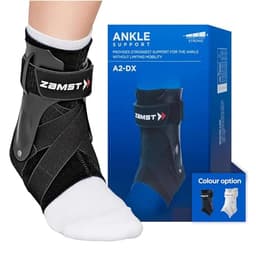
The most brace on this page. Zamst rates the A2-DX at its 'Strong' support level and builds it around protective guards plus a dual X-strap stabilizer giving three-way (anterior, lateral, medial) support, and it applies from the rear so you are not threading laces. It is specified for Grade III high ankle sprains and chronic ankle instability - which is more than a recreational player needs unless that description is you.

Easier on the joints: Chronic ankle instability is the state an untreated sprain leaves behind - an ankle that rolls on nothing. This is the brace that mechanically stops the roll rather than reminding you about it, and the honest trade is bulk, price and having to order the correct side.

What we like

  • Zamst's own 'Strong' support rating - the highest tier in its ankle range
  • Protective guards that 'prevent excessive inward and outward movements' of the high ankle
  • A dual X-strap giving three-way support: anterior, lateral and medial
  • Rear application 'enables easy application and adjustment' - no lace threading

Skip it if

  • Left and right specific AND size specific, so the linked ASIN is one side in one size
  • Specified for Grade III sprains and chronic instability - overkill for a merely achy ankle
  • Costs several times the ASO and is the bulkiest fit inside a court shoe
  • Zamst markets it for basketball and quick-turnaround sports; it publishes no pickleball guidance
TypeGuarded ankle brace, rear application
Support level'Strong' (Zamst's own rating)
StabilizersProtective guards + dual X-strap (anterior/lateral/medial)
FitsLeft/right specific design
SizingSmall, Medium, Large, Extra Large
Indicated forHigh ankle sprains (Grade III) and chronic ankle instability

Specs read from the product listing, on October 4, 2026. “Not published” means the maker does not state that figure.

What Zamst actually publishes

Four things, and all four are on the maker’s page rather than inferred from a listing photo:

  • Protective guardsthat, in Zamst’s words, “prevent excessive inward and outward movements” of the ankle. These are the rigid elements; they are what make this a guarded brace rather than a sleeve.
  • A Dual X-Strap Stabilizergiving what Zamst calls “three-way support (Anterior, Lateral, Medial)”. Most braces in this category resist the sideways roll only. This one also addresses the front of the joint.
  • Rear application, which Zamst says “enables easy application and adjustment”. In plain terms: it wraps on from behind rather than lacing up the front.
  • A left-and-right specific design, which the company says is there to “provide a better fit”, in four sizes — Small, Medium, Large and Extra Large.

It also publishes a “low-profile material with excellent breathability and anti-microbial properties”, and — importantly for this site — it recommends the brace for basketball and sports requiring quick turnaround movements. Zamst publishes no pickleball-specific guidance at all. We would rather tell you that than imply the brace was designed for your sport.

The ordering problem, which is the real review

If you take one thing from this page, take this. The A2-DX is both side-specific and size-specific. Four sizes multiplied by two sides is eight distinct products, and the Amazon listing we link is one of them. Buy the wrong side and the brace is useless; buy the wrong size and the support it is sold for will not be applied where it is supposed to be.

Before you order, do two things. Check which ankle you are bracing — it is a surprisingly easy thing to get wrong when you are ordering in the evening after a bad game — and measure your ankle circumference against Zamst’s size chart rather than guessing from shoe size. Then check the side and size on the actual listing page before you pay, because listings for individual variants change.

Compare that with the ASO Ankle Stabilizer, which is bilateral— the same unit fits either foot — and comes in eight published sizes keyed to a measured ankle circumference. For a first brace, that difference matters more than any feature on either product, and it is a large part of why the ASO is our default recommendation.

Who is actually the buyer

Zamst names the condition: chronic ankle instability. AAOS describes what that is and how you get there. An ankle sprain is an injury to one or more of the ligaments that stabilize the ankle, and about 90 percent of them are inversion injuries — the ankle rolling inward — affecting the lateral ligaments. A stretched ligament does not simply tighten back up, which is why one bad sprain makes the next one more likely, and why some ankles end up giving way on nothing at all.

That state — an ankle that rolls on a flat court, for no reason you can point to — is what the A2-DX is built for. If it describes you, the guards and the three-way strap are doing real mechanical work, and the price difference against a basic brace stops looking like a premium.

If it does not describe you, read the honest alternative list below. AAOS lists the risk factors most pickleball players actually have — uneven surfaces, footwear that does not provide enough support, shoes with slippery soles, cutting and jumping actions — and several of those are cheaper to fix than an $80 brace. Court shoes with a real outsole are the first one; we rank them for ankle support specifically and for outdoor courts. AAOS also names balance and proprioception training, which costs nothing — our balance guide for pickleball players covers it.

Will it fit inside a court shoe?

This is the question that decides whether any ankle brace gets worn, and the honest answer for the A2-DX is: it is the bulkiest option we list. Zamst describes the material as low-profile, and relative to other guarded braces it is — but guards are rigid plastic and rigid plastic takes up room.

Plan for it. Either wear the brace with a shoe you can loosen substantially, or buy your court shoes a half size up or in a wide fitting if the brace is going to live in them. Our wide-fit court shoe ranking is the place to start if you are buying both at once. Trying to force a guarded brace into a snug shoe is how a brace ends up in a drawer.

A related point on rear application: Zamst sells it as easier, and for someone with arthritic fingers it genuinely is — there are no laces to thread and pull tight. That is a real advantage over the lace-up ASO for a hand that struggles, and it is worth weighing if you also deal with arthritis in your hands.

Where it falls short

Four honest limits, and the first is the one we keep coming back to.

It is more brace than most players need.Zamst wrote down who it is for, and the description is a Grade III injury or an ankle that fails repeatedly. A brace that over-supports is not free: it restricts the motion you use to adjust your footing, and for a merely stiff or aching ankle that is the wrong direction entirely. For an arthritic ankle the better answer is compression and movement, not rigidity — which is the argument for the Bauerfeind MalleoTrain instead.

It costs several times what the ASO does. At the prices we last read, you could buy the ASO and a pair of decent court socks for the difference. The ASO is also the brace athletic trainers have used for decades and it is bilateral.

The side-and-size ordering risk, covered above.

No pickleball guidance from the maker.Zamst markets the A2-DX for basketball and quick-turnaround sports. The movement patterns overlap — pickleball involves plenty of planting and changing direction — but we are inferring that, and Zamst has not said it.

How it compares

Against the ASO Ankle Stabilizer: the ASO is bilateral, cheaper, lower-profile and comes in eight sizes rather than four. The Zamst gives you rigid guards, a three-way strap and a maker willing to rate its own support level. We have the full side-by-side in ASO vs Zamst A2-DX, and for most readers the ASO wins that argument.

Against the Bauerfeind MalleoTrain: completely different tools. The MalleoTrain is a knitted compression support with viscoelastic pads and, in Bauerfeind’s words, no rigid parts. It is for an ankle that aches and swells. The A2-DX is for an ankle that gives way. Buying the wrong one of those two is the commonest mistake in this category.

Against the Mueller Adjustable Ankle Stabilizer: the Mueller is a fraction of the price and fits either foot, and it is a reasonable first thing to try for a mildly unstable ankle. It is not in the same support class and does not claim to be.

The verdict

The A2-DX is a well-documented brace that does exactly what its maker says, and the documentation is the reason we list it: Zamst publishes a support rating, a strap configuration, a sizing range and a written indication, which is more than most of this category manages. If your ankle has rolled badly and now rolls easily, it is the strongest option we carry and the rear entry makes it the easiest strong brace to put on with stiff hands.

For everyone else — the ankle that aches after two hours, the one that twinged once last spring, the one you just want to feel safer on — buy the ASO, spend the difference on court shoes with a proper outsole, and do the balance work AAOS recommends. Nothing here was tested by us and nothing here is medical advice: if your ankle gives way repeatedly, that is a reason to see a clinician, not a reason to buy a stronger brace.
Frequently asked questions

Is the Zamst A2-DX good for pickleball?

It works on a pickleball court, but Zamst does not market it for pickleball - it recommends the brace for basketball and sports requiring quick turnaround movements, and publishes no pickleball guidance. More importantly, it is more brace than most pickleball players need. Zamst specifies the A2-DX for Grade III high ankle sprains and chronic ankle instability. If your ankle genuinely gives way, it is the strongest option we list. If it merely aches, a lace-up ASO or a knitted compression support is the better and much cheaper answer.

How do I size a Zamst A2-DX?

Zamst publishes four sizes - Small, Medium, Large and Extra Large - and the brace is also left-and-right specific, so there are eight distinct products and only one of them is yours. Measure your ankle circumference and check it against Zamst's own size chart rather than estimating from shoe size, then confirm both the side and the size on the listing page before you pay. The ASO Ankle Stabilizer, by contrast, is bilateral and comes in eight sizes keyed to a measured ankle circumference, which removes the side decision entirely.

Is the Zamst A2-DX left and right specific?

Yes. Zamst builds separate left and right versions and says the reason is to 'provide a better fit'. That is a genuine design decision rather than a marketing one, but it does mean the single commonest way to waste money on this brace is ordering the wrong foot. Check which ankle you are bracing and then check the listing variant, because individual side-and-size variants are listed separately.

Will the Zamst A2-DX fit in a court shoe?

It is the bulkiest brace we list. Zamst describes the material as low-profile and relative to other guarded braces it is, but guards are rigid and rigid takes up space. If the brace is going to live inside your court shoes, buy them a half size up or in a wide fitting, and expect to loosen the laces. A guarded brace forced into a snug shoe is a brace that stops being worn.

Zamst A2-DX or ASO - which should I buy?

The ASO for most people. It is bilateral so there is no side to get wrong, it comes in eight sizes rather than four, it is lower profile inside a shoe, and it costs a fraction as much while using the figure-eight strapping pattern that resists the inward roll causing roughly 90 percent of ankle sprains. Choose the Zamst when your ankle has already failed badly and keeps failing - that is the condition Zamst names on its own product page - or when stiff hands make lacing a brace genuinely difficult, since the A2-DX applies from the rear.

Can a brace prevent an ankle sprain?

A brace addresses one risk factor, not all of them. AAOS lists the main causes of ankle sprains as uneven surfaces, falls and trips, cutting and jumping actions, shoes that do not provide enough support, and shoes with slippery soles - and recommends warming up, ankle strengthening, appropriate footwear and balance training as prevention. A brace mechanically resists the roll, which is useful if a previous sprain has left the ligament lax. It does not replace the shoes or the balance work, and on a site aimed at players over 55 we would get those two right first.

Sources

  • Zamst - A2-DX Ankle Brace product page (manufacturer specifications) — Zamst publishes a 'Strong' support level for the A2-DX, built around 'Protective Guards' that 'prevent excessive inward and outward movements' plus a 'Dual X-Strap Stabilizer' offering 'three-way support (Anterior, Lateral, Medial)'; 'Rear Application' that 'enables easy application and adjustment'; 'low-profile material with excellent breathability and anti-microbial properties'; sizes Small, Medium, Large and Extra Large; a 'Left and Right Specific Design' to 'provide a better fit'. Indications: 'For high ankle sprains (Grade III) & chronic ankle instability' and 'Reduces inversion & eversion movements'. Zamst recommends it for basketball and sports requiring quick turnaround movements; it publishes no pickleball-specific guidance (accessed October 4, 2026)
  • Med Spec - ASO Ankle Stabilizer product page (manufacturer specifications) — Med Spec publishes: an 'ankle stabilizing orthosis' with 'angled stabilizing straps' that 'form a complete figure-eight', plus a 'circumferential woven elastic cuff' and a lace closure; 'CoolFlex' padding with spandex fiber and 'spacer mesh fabric' in the tongue and along the Achilles tendon area; the brace 'is bilateral and fits either the left or right foot'; eight sizes from XX-Small (9-10 in ankle circumference) through 3X-Large (16 in+); an 'invisible seam' at the rear boot and a shoe lace 'attached to the tongue to ensure lace is always centered'. Published indications: 'inversion or eversion ankle sprains', 'medial or lateral ankle instability' and 'subtalar joint instability'. PDAC Verified HCPCS code L1902 (accessed October 4, 2026)
  • American Academy of Orthopaedic Surgeons (OrthoInfo) — Sprained Ankle — An ankle sprain is 'an injury to one or more of the ligaments that stabilize the ankle'; about 90% are inversion injuries to the lateral ligaments (ATFL and CFL). Causes named: walking or exercising on an uneven surface, falling or tripping, and 'high-risk sports that require cutting or jumping actions, such as trail running, basketball, tennis, football, and soccer'. Footwear risk factors: 'wearing shoes that do not provide enough foot and ankle support' and 'shoes with slippery soles'. Prevention: 'warm up thoroughly before exercise and physical activity', strengthening exercises for ankle stability, 'choose footwear with appropriate support for your activity', and balance (proprioception) training, often on a balance board (accessed September 18, 2026)
  • Bauerfeind - MalleoTrain Ankle Support product page (manufacturer specifications) — Bauerfeind publishes: a 'contoured viscoelastic cushion' whose 'soft pads behind each ankle bone helps to reduce pain and swelling'; a 'breathable Train active knit', 'gentle on the skin and extremely comfortable to wear', with a 'three-dimensional knit' that conforms to the ankle; six sizes covering ankle measurements from 17-29 cm, with the guidance 'Between two sizes? Take the smaller one - a support needs to sit snug'; left/right specific (side selected at order). Listed indications: osteoarthritis, arthritis, ligament insufficiency, joint effusions, irritation, ankle sprain, swelling, supination prophylaxis and 'prophylaxis against relapses'. Construction note: 'No rigid parts - comfortable to wear and allows full range of motion' (accessed October 4, 2026)
  • Non-fatal senior pickleball and tennis injuries in US EDs, 2010–2019 — Injury Epidemiology (2021) — For players 60+: strains/sprains 31.0%, fractures 30.4%; the wrist is the single most-injured body part (13.2%); women 3.7x more likely to fracture (accessed July 22, 2026)

Keep reading