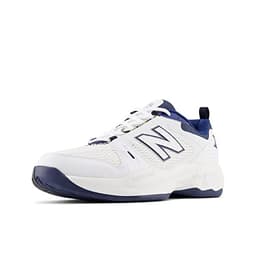
Wide width vs. wide toe box — they are not the same thing
This is the distinction that sends people home with the wrong shoe. A wide width (2E, 4E, W, or simply “Wide”) is a different last: the whole shoe is built on a broader footprint, so there is more room through the ball of the foot and the midfoot as well as at the toes. A wide toe box is a shape claim about the front of a standard-width shoe — more splay room for the toes, but the same width everywhere behind them. If your foot is genuinely wide, a roomy toe box on a medium last will still pinch across the ball of the foot, which is exactly where a bunion lives.
Makers publish widths. Almost none publish toe-box dimensions, which is why this page ranks on width and treats toe-box shape as something you check in person. The check is easy: pull the insole out, put it on the floor, and stand on it. If any part of your foot hangs over the edge of the insole, the shoe is too narrow there, no matter how it felt for thirty seconds in the store.
The picks, and what each one is actually for
New Balance 1007 in 4E. A 4E is two full widths beyond a standard 2E wide, and it is genuinely rare in a court shoe. This is the shoe for the player who has already tried “wide” and still feels the sides, or who has been told to wear a custom orthotic and cannot get it into anything else. Two honest caveats from the spec sheet: it is heavy at 15.6 oz in a size 10.5, and Tennis Warehouse describes it as a low-arch design — so on its own it gives little arch support, and for most people it is a shoe-plus-insert purchase. That is not a flaw for a wide-footed player who already owns an insert; it is the point. Our flat-feet roundup covers the insert half.
Skechers Viper Court Pro 2.0, men’s and women’s Wide. The most cushioned pickleball-specific shoe on the site, and Skechers lists both models in Medium and Wide. The removable Arch Fit insole means you can also drop your own orthotic in, and there is no break-in period, which matters when a bunion is already sore. Our full write-up is in the Viper Court Pro 2.0 review. If your foot is wide but not very wide, this is where most people should start.
K-Swiss Express Light, women’s W. The lighter, more agile option. K-Swiss does not publish a width for the men’s Express Light, which is why it is missing from this page even though it tops our general senior roundup; the women’s listing we link is a verified W. If you want a shoe that feels quick rather than plush, this is the one.
New Balance FuelCell 996 V6, women’s W. FuelCell cushioning on a stable tennis platform, and the linked women’s listing is a W width. One honest note that matters on this page: the standard-width V6 was widely criticized as narrow, and New Balance’s own successor, the 996v7, was redesigned with a roomier toe box and is offered in B, D and 2E. We only recommend the V6 here in the W listing, not the standard one, and our 996 review explains the correction.
Bunions: what a court shoe can and cannot do
A bunion is the big-toe joint drifting sideways and the bump that forms over it. AAOS notes it is more common in women, that up to 70% of people with one have a family history, and that narrow, pointed toe boxes push the toes into the position that aggravates it. No shoe fixes a bunion. What the right shoe does is stop pressing on it: a wide last so the ball of the foot is not squeezed, a soft upper over the joint rather than a stiff synthetic overlay, and enough depth that the toes are not forced down. AAOS also lists shoe stretchers, silicone pads and toe spacers as reasonable measures — a cobbler can stretch the bunion area of a wide shoe another few millimeters, which is often the difference between a shoe you tolerate and one you forget you are wearing.
What a court shoe cannot do is be soft everywhere. Pickleball is a sideways sport, and a shoe with no lateral structure lets your foot slide off the platform on every hard step to the sideline — the mechanism behind most of the ankle rolls and falls in the injury data for players over 60. The picks above are wide and stable. A soft, wide walking shoe is wide and not stable, and it is the wrong tool.
Swelling: buy for the end of the session, not the start
Feet swell with heat, with standing and with age, and by the third game a foot can be noticeably fuller than it was at the car. Try shoes on late in the day, in the socks you play in, and lace them the way you will lace them on court. A shoe that is merely comfortable when you are fresh will be tight when it counts. If you play in summer heat, treat the Wide as your default and the Medium as the exception.
What we could not verify, and why it is not here
- ASICS Gel-Renma, Gel-Dedicate and Gel-Resolution X: ASICS publishes no width option on any of the listings we link. Good shoes, and all three appear on other pages, but we will not call a shoe wide because it feels roomy to one person.
- K-Swiss Express Light (men’s) and Ultrashot 4: no published width. The Ultrashot in particular is a supportive shoe we recommend for heel pain, but a wide-footed player has to try it on and hope.
- Fila Volley Zone: no published width.
- K-Swiss Hypercourt Express 2 (women’s wide): listed in a wide, but the Amazon listing has had no buyable offer for some time, so we cannot honestly send you to it.
How to buy a wide court shoe without returning it
- Stand on the insole. Overhang anywhere means too narrow there.
- Check the lacing. If the eyelets nearly touch when the shoe is snug, the shoe is too narrow and you are compensating with lace tension; if they sit wide apart, you have the right last.
- Walk sideways. Shuffle across a hard floor. Your foot should not slide over the edge of the midsole. Wide and stable is the goal; wide and soft is a slipper.
- Keep your insert. If you use an orthotic, bring it and try the shoe with it in. A shoe with a removable liner and real depth — the New Balance and the Skechers here — is built for that; a shoe with a glued-in insole is not.
Every price on this page is checked daily and stamped with the date; every spec is read from the maker’s listing, and we own none of these shoes. If a foot problem is new, painful or one-sided, that is a podiatrist question rather than a shopping one.