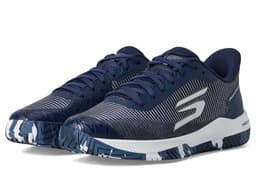
Yes, it is a real court shoe
The first thing to settle is a fair suspicion: Skechers makes a lot of soft, comfortable walking shoes, so is the Viper Court Pro just one of those in disguise? No. This is a purpose-built pickleball shoe, with the lateral support and grippy court outsole the sport requires — the same things that separate any court shoe from a running or walking shoe. That difference isn’t cosmetic. Walking and running shoes are built to move you forward and are tall and soft, which makes them roll under you on the quick sideways steps pickleball is full of; that roll is how ankles turn and knees get tweaked. The Viper Court Pro keeps your foot supported through those cuts and grips the court so your foot plants instead of sliding. So you get Skechers comfort on top of a genuine court platform — not comfort instead of one. If the court-versus-walking-shoe distinction is new to you, our shoe-support guideexplains why it’s the most important gear decision you make.
The outsole is the tell. A walking or lifestyle sneaker is built for the pavement and often has a smooth or softly rounded sole that slides on a polished indoor court; the Viper Court Pro uses a court-tuned tread designed to bite and release cleanly as you plant and pivot. That grip is what keeps your foot where you put it, and a foot that stays put is a foot that doesn’t slip out from under you — the sort of slip that, for an older player, can turn into a fall rather than a harmless stumble. Comfort is the headline here, but this grip is the quiet safety feature doing its work underneath it.
Comfort out of the box, and why it matters
Comfort isn’t a soft-sell nicety for an older player — it protects your body. A shoe that hurts changes the way you move: you shorten your stride, you favor the sore side, you limp a little without noticing. That altered gait pushes load onto your knees and hips that they weren’t meant to carry, which is how a blister becomes a knee ache. Skechers’s hallmark is cushioning that feels good on day one with little or no break-in, which means fewer blisters and hot spots and a stride that stays natural. Comfortable feet keep you walking and playing the way your body is built to, and that steadier, more natural movement is quietly one of the best things you can do for your joints — and for your balance, in a sport where ground-level falls are the most common serious injury for players over 60.
How it fits and feels
The Viper Court Pro feels plush and forgiving underfoot — cushioned and roomy rather than firm and racy. Players who step into it after years in stiff shoes often describe it as the first pair they didn’t have to suffer through. Underneath that softness is proper court support, so it doesn’t feel vague or unstable on a sideways move the way a pure walking shoe would. What it isn’t is a low, locked-in racing feel; it puts all-day comfort ahead of the last few percent of on-court precision. For the comfort-first buyer that’s exactly right. For an aggressive player who wants to feel welded to the court, it’ll feel a touch soft.
The feel is roomy and forgiving rather than tight and racy, which suits the shoe’s whole personality: this is a pair you can wear straight through a long morning of round-robin without your feet begging for mercy. If you’ve been putting off buying proper court shoes because the last stiff pair blistered you, this is the one most likely to change your mind. The comfort isn’t a gimmick — it’s the reason players who try a pair tend to buy the next pair without shopping around, and it’s why the shoe keeps turning up on the feet of the 55+ crowd at open play.
Who should buy it
- Comfort-first players who dread breaking shoes in. This is the core buyer. If you want a shoe that feels good the moment you lace it up, this is the easiest pick on our list.
- Players prone to blisters or with sensitive feet. The plush, no-break-in feel is kind to feet that stiffer shoes punish.
- Anyone who plays long sessions. All-day comfort is the whole design goal, and it shows in the third and fourth game when other shoes start to nag.
It sits high on both our senior picks and our best men’s court shoes, and there’s a women’s version too — see our women’s picks.
Where it falls short
The honest catch is lock-down. Because the Viper Court Pro is built around plush comfort, it isn’t as low and locked-in as a racing-style court shoe. Players who play aggressively — who want maximum lateral stiffness so the shoe feels like an extension of the foot on a hard cut — may find it a little soft for their taste. That’s a preference, not a flaw: the same softness a power player finds vague is exactly what a comfort-first player is buying it for. Just know which of the two you are before you choose. One correction to an earlier version of this review, which said Skechers publishes no width or cushioning spec for this shoe: it does. Skechers’ own product page names the Arch Fit insole, the ULTRA GO midsole, the Goodyear Gold outsole and both a Medium and a Wide width, so those cells now carry real values instead of “Not published.” The one figure still genuinely missing is a heel-to-toe drop, which Skechers does not state for any of its court shoes.
Sizing and width: the part that decides it for most older players
This is the section we would have wanted first, so here it is plainly. Skechers lists the Viper Court Pro 2.0 in a Medium and a Wide, which is not something you can take for granted — court shoes are cut narrow as a rule, and a genuine Wide option is the single most useful thing on this shoe’s spec sheet if you have a broad forefoot, a bunion, or feet that swell over a long morning. Buy the Wide if you have ever taken your shoes off between games because your feet felt tight; that tightness is not something you play through at 65, it is something that changes how you move. If width is the whole question for you, our wide-feet roundup compares this Wide against the only other court shoes whose makers publish one.
Three more things worth knowing before you order:
- The insole comes out. Skechers states the Arch Fit EVA insole is removable. That matters more than it sounds: if you already wear a prescribed orthotic or an over-the-counter arch insert, this is a shoe you can actually fit it into, which a lot of court shoes with glued-in liners are not. It also means you can try the shoe both ways.
- The Arch Fit insole is the arch support.Skechers describes it as a podiatrist-certified shape developed from foot-scan data. That is the maker’s claim about its own design, not a clinical result we verified — but it is a real, contoured insole rather than the flat foam most shoes ship with, and it is the reason this shoe appears on our plantar fasciitis shortlist conversation at all. If your arches or heels are the problem, do not throw that insole away.
- No published heel-to-toe drop.Skechers gives a 1¼-inch heel height but no drop figure, and no court-shoe brand we have checked publishes one. If drop is your deciding spec, only a fitter measuring the actual shoe can answer it. We are not going to invent a number that decides a purchase.
Pro 2.0 or the cheaper Viper Court? An honest answer
Skechers sells more than one Viper Court, and the older Viper Court Smash tier is still on Amazon for roughly half what the Pro 2.0 costs. If you are standing in front of both wondering whether the Pro is worth double, this is the comparison that actually matters — and the answer is not automatically “buy the expensive one.”
What you are paying the difference for is two published features. The first is the removable Arch Fit insole: contoured arch support you can also take out and replace with your own orthotic. The second is the Goodyear Gold compound outsole, which is a grip specification — and grip, for a player over 60, is not a performance upgrade, it is fall insurance. Those are the two things we would not economize on if falls or arch pain are on your mind.
Now the honest other half. We could not verify the Smash’s specs at all: Skechers has retired its own product page for that model, and three retailers blocked or 404’d when we went looking for a spec table. So we print every one of its spec cells as “Not published,” because that is the truth, and a discontinued shoe whose maker no longer documents it is a thing you should know before choosing it to save forty dollars. What we can tell you is that it is a purpose-built pickleball shoe, it is cut roomy through the toes, and it is live and buyable today.
So: if you play a couple of times a month, indoors, on a grippy floor, and your feet never complain — the Smash is enough shoe and you should keep the forty dollars. If you play several times a week, play outdoors, have any history of heel or arch pain, or have ever felt a foot slide out from under you, buy the Pro 2.0 and do not think about it again.
How it compares
Within our list, the Viper Court Pro is the comfort specialist. If you want more of a light, planted, all-round feel, the K-Swiss Express Light is the more athletic pick; if your knees need maximum padding against the pounding, the ASICS Gel-Renma is built around GEL cushioning for exactly that. The Skechers wins on out-of-the-box plushness and all-day, no-break-in comfort, which for a great many players over 55 is the single thing that keeps them coming back to the court. Cross-shop it against our wider senior roundup to see where each shoe fits your priorities.
The verdict
For the comfort-first player — the one who dreads breaking in stiff shoes and wants a pair that feels good from the first game — the Skechers Viper Court Pro 2.0 is the easiest shoe on our list to love, and a deserved favorite of the 55+ crowd. It delivers Skechers’s signature plush, no-break-in comfort on top of a genuine court shoe, so you’re not trading safety for softness. It isn’t the pick if you want a low, locked-in racing feel for aggressive play — but if comfort is what keeps you playing, this is the shoe that will. And if you’re shopping for a woman, the same shoe comes in a women’s-specific cut. For the rest of your kit, our what-to-wear guide rounds things out.