The verdict first, and it is not a glove. The highest-value change for a painful thumb in this sport is a bigger grip on your paddle, because grip circumference decides how much force your thumb has to produce on every shot. AAOS names “doing jobs or activities that involve a lot of gripping, pinching, or heavy lifting” as a risk factor for base-of-thumb arthritis, and lists as its leading symptom “pain at the base of the thumb, especially with gripping, pinching, or turning activities”. Reduce the gripping and you are working on the cause. Of the paddles we list, only one publishes a 4 1/2 inch large grip— the Franklin Signature Series Pro 16mm — and that single spec outranks everything else on this page.
Compression gloves have a place, and we rank four of them below. But they are comfort and warmth, not mechanics, and we are not going to put them above a change that alters the load.
Two conditions, and how to tell them apart
Thumb CMC arthritis — at the base of the thumb, in the fleshy part
AAOS: “in the thumb, the most common site for arthritis to develop is the joint at the base of the thumb — also known as the thumb carpometacarpal (CMC) joint”, and the type that most often affects it is osteoarthritis, “degenerative, or wear-and-tear, arthritis”. The reason it is so common is the job the joint does: it “enables the thumb to swivel, pivot, and pinch so that you can grip things in your hand”, and AAOS adds that “this joint is highly vulnerable to arthritis as people age, and arthritis at the base of the thumb is very common”.
Its risk factors read like a description of this site’s readership: “being female: women are 2 to 3 times more likely”, “being over the age of 50”, family history, being overweight, a past injury to the thumb or wrist, loose joints, gripping or pinching activities, and smoking.
Symptoms AAOS lists:
- Pain at the base of the thumb with gripping, pinching or turning — “turning a key or opening a jar” are its examples
- Pain or aching after using the thumb for a long time
- Pain at night
- Weakness when gripping or pinching
- Swelling and tenderness at the base of the thumb
- A bump or bony growth at the base of the thumb
- Limited motion in the thumb
De Quervain’s tenosynovitis — along the thumb side of the wrist
A different structure and a different place. AAOS describes it as occurring when “the tendons that control thumb movement become irritated inside the narrow tunnel they pass through to get from the wrist to the thumb”, producing “pain and tenderness along the thumb side of the wrist”. The sheath thickens, “the tendons no longer fit well or glide freely inside the tunnel”, and the result is “increased friction and pain”.
The tell is the provoking movement. De Quervain’s is “especially noticeable when you move the thumb, make a fist, grasp or grip something, turn the wrist”, or lift something with the thumb pointed up while the wrist moves. AAOS notes it “is most common in people in their 40s and 50s” and “affects more females than males”.
The quick distinction:press on the fleshy base of the thumb where it meets the wrist — if that is the sore spot, think CMC arthritis. Run a finger along the thumb side of the wrist, an inch or two above the joint — if that cord-like area is tender and flares when you turn your wrist with the thumb up, think de Quervain’s. A bony bump at the base points to arthritis; a tender tunnel higher up points to the tendons.
What to change, in order of how much it helps
- Grip circumference.A handle too small for your hand forces a pinch grip. Measure it properly — our grip size guidehas the method — and if you are between sizes, go up.
- How hard you hold the paddle. Most recreational players grip far harder than the shot needs. How to hold a pickleball paddle covers the fix, and it is free.
- A grip that does not slip.Sweat makes you squeeze. A dry-feel overgrip removes the reflex — see overgrips for sweaty hands.
- Paddle weight. A lighter paddle is less to control, and less to control is less to hold. Lightweight paddles are ranked separately.
- Compression and warmth. Gloves, which is where the four picks below come in.
Three arthritis gloves and the one paddle with a published large grip follow. We own none of them and have tested none of them.
The splint we do not list, and why we are telling you
AAOS’s nonsurgical list for thumb CMC arthritis includes splinting, and it is specific about what kind: “a splint that supports the base of the thumb can reduce pain during activities or overnight”. That is a thumb spica — a splint with a channel for the thumb itself.
We do not list one.Our registry has compression gloves, wrist stabilizers and wrist wraps, and none of them is a thumb spica. A wrist stabilizer immobilises the wrist and leaves the thumb joint free, so it is not a substitute — it is a different product for a different problem. Rather than dress one up as the other, we are saying plainly that the item AAOS names is outside what we cover; a pharmacy or a hand therapist can point you at one, and if your pain is clearly at the base of the thumb it is worth asking about.
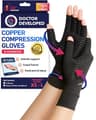
What a fingerless compression glove does do, honestly stated: mild compression and warmth across the palm and hand, with the fingers free so you can still hold a paddle. The iMAK entry we list publishes “mild” compression and open-finger coverage, and neither we nor the makers claim it treats arthritis. The full category is at best arthritis gloves for pickleball.
What AAOS recommends for the thumb joint
- Ice— “applying ice to the joint for 5 to 15 minutes several times a day”. Note the shorter window than the twenty-minute standard for larger joints.
- Activity modification— “avoid both activities that make symptoms worse and using tools and equipment” that do. For a player, that is the argument for the bigger grip rather than for stopping.
- Splinting at the base of the thumb, for activities or overnight.
- Exercises— “gentle exercises can improve the range of motion and strengthen the muscles of the thumb”, ideally with a hand therapist.
- Medication— NSAIDs, and specifically “a topical NSAID gel (such as diclofenac) applied directly to the joint”, which AAOS notes “may have fewer side effects than oral medications”. For a joint this close to the skin that is a genuinely useful option to raise with your doctor or pharmacist.
- Injections— a steroid shot into the joint, with the caveat that “the effect may wear off over time”.
And one point AAOS makes that we rarely see repeated, which is quietly reassuring: “some patients are reassured by knowing that this condition is not dangerous”; “some people have no symptoms despite X-rays that show advanced arthritis”; and some find that their thumbs “may be painful for some time but that with or without treatment, their pain may go away”. A painful thumb joint is not a countdown.
Check the rest of your hand while you are here
AAOS notes that doctors assessing thumb CMC arthritis “may also check for signs of carpal tunnel syndrome, since many people with thumb CMC arthritis have both”. Carpal tunnel is a nerve problem with a different signature — numbness and tingling in the thumb, index, middle and ring fingers, often waking you at night. If that is in your picture too, read pickleball and carpal tunnel, which covers the night splint that is the standard first move for it.
If the pain is further up the forearm rather than in the hand, the likelier culprit is the elbow: tennis elbow from pickleball shares a cause with everything on this page, because the irritant in both is repetitive gripping. And if the ache is across the wrist joint itself rather than the thumb side, pickleball wrist painis the page you want — the wrist is the single most-injured body part in players 60 and over, at 13.2% of injuries in the emergency department data.
Four things to do this week
- Measure your grip. Two minutes with a ruler. If the handle is under 4 1/4 inches and your thumb hurts, that is a lead.
- Add an overgrip. A tacky wrap builds a small handle up by roughly a size for a couple of dollars, which is the cheapest test of the theory. Our overgrip picks cover the options.
- Hold the paddle looser on purpose for one session and see whether the thumb is better that evening. Most people are surprised.
- Ice for 5 to 15 minutesafter playing, not twenty — AAOS’s window for this joint is shorter.
When to see someone
- A bony bump at the base of the thumb that is growing.
- Weakness that is affecting daily tasks — jars, keys, door handles.
- Pain at night that is waking you.
- Numbness or tingling in the fingers, which points at a nerve rather than a joint.
- Pain that has not improved after six weeks of a bigger grip, lighter gripping and ice.
- Any sudden loss of thumb movement or an inability to straighten the thumb.
Nothing here is medical advice; we have examined nobody, we own none of these products, and every medical statement is attributed to the AAOS pages in the sources below, read on the date shown. Product specs are the makers’ or the listings’ own, and prices come from an automated daily check that carries the date it was read. Our method is here.