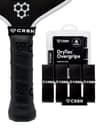
Building the handle up: the part nobody explains
Here is why this page is on a site about joints rather than on a technique blog. The circumference of your paddle handle decides how much force your hand has to produce to stop the paddle twisting on contact, and a handle too small for you is the most common self-inflicted cause of hand and elbow pain in this sport. Most paddles ship at roughly 4.125 to 4.25 inches, and most makers do not publish the figure at all.
You can change it with the thing you are already holding. There are three ways, in order of how much they add:
- One extra overgrip layer (about +1/16 in). Wrap your normal overgrip, then wrap a second one straight over it, same direction, same overlap. The simplest half-step.
- Tighter overlap (about +1/32 to +1/16 in).Increase the overlap from an eighth of an inch to a quarter and you are laying down nearly twice as much material per inch of handle. You will use more grip per wrap — buy the ten-pack.
- A cushioned replacement grip under an overgrip (about +1/8 in and the most padding). Strip the factory grip, fit a cushioned replacement like the Gamma Honeycomb, then one overgrip over the top for the surface you prefer. This is the best outcome for an arthritic hand and the most work.
An eighth of an inch of circumference is roughly half a conventional grip size. That sounds trivial and is not: it is often the difference between fingertips digging into your palm and a relaxed hold.
The ceiling.Built up too far, a handle you cannot close your fingers around makes you grip harder again, and it changes how the paddle rotates on an off-centre hit. Two layers over a stock grip is a sensible maximum. If you want more than that, buy a paddle with a published larger grip instead — see pickleball grip size for the index-finger sizing check, and best pickleball paddles for arthritis for the models that publish one.
Is a built-up grip legal?
For recreational play nobody will ever look. For sanctioned play, grip wrap is normal and expected, but the paddle as a whole still has to comply with USA Pickleball’s equipment standards — the rules govern overall paddle dimensions and surface, so material you add has to stay on the handle and not alter the hitting face or push the paddle out of specification. Wrapping two overgrips on a handle does neither. If you compete, read the current standards rather than taking our word for it; we link them in the sources.
How often should you re-wrap?
Four signals, any one of which is enough:
- It has stopped being tacky. A tacky grip that has gone slick is actively making you squeeze harder.
- You can see the shape of your fingers in it, or there are shiny worn patches where your palm sits.
- The edge is lifting anywhere along the spiral.
- It smells. Grips absorb sweat, and an overgrip is a consumable, not a component.
For a recreational player playing two or three times a week, every two to three months is typical — which is roughly what a three-pack lasts in a year. In hot weather it will be sooner. If your hands sweat heavily, the product matters as much as the frequency: overgrips for sweaty hands ranks the dry-feel family, which gets grippier as it absorbs moisture rather than slicker.
Five things that go wrong
- Wrapped the wrong way round the handle.If the seam is being peeled open by your palm as you twist, you wrapped against your grip direction. Unwrap and redo it — an overgrip survives one careful re-wrap.
- Pulled too tight. Ripples, thin spots and a grip that tears in two weeks. Light steady tension only.
- Uneven overlap. Shows up as a lumpy handle with a ridge you can feel through your palm, which becomes a hot spot and then a blister.
- Started at the top. Starting at the paddle face and wrapping down leaves every overlapping edge facing upwards, into the direction your hand slides. It will unravel.
- Finishing tape skipped. The one component people throw away with the packet. Without it the top edge lifts within a session.
What we would buy, in one paragraph
For almost everyone: a three-pack of Gamma Supreme. It is the cheapest meaningful upgrade to a paddle you already own, it is forgiving to wrap, and it is the one to stack if your handle is a size too small. If your stock grip is hard and thin and your hands ache, strip it and fit the Gamma Honeycomb cushioned replacement grip instead — it is the only product we list that puts real padding between the handle and your palm. If you hate trimming off waste, the CRBN Drytec is cut for pickleball handles. And if you play often and want the lowest cost per wrap, ten Tourna Grips will see most recreational players through a year. Nothing here was tested by us and nothing here is medical advice. Our methodology is here.