Overgrip or replacement grip? They are not the same purchase
This trips up more buyers than anything else on the page, so it is worth two paragraphs.
A replacement grip goes on instead of the grip your paddle shipped with. You peel the old one off and wrap the new one onto the bare handle. It is thicker, it is usually cushioned, and it is the only way to get real padding without stacking layers. The Gamma Honeycomb is the one here. The downside is that it is fiddlier to fit and you cannot undo it in thirty seconds.
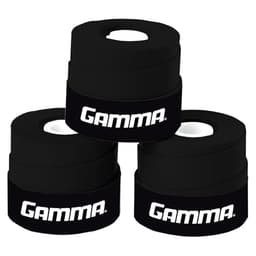
An overgrip goes overwhatever is already there. It is thin, it is cheap, it comes in multi-packs, and it is designed to be replaced every few months. Three of the four picks here are overgrips. For an aching elbow the overgrip’s superpower is not the surface — it is that you can wrap two of them. Each layer adds circumference. That is a mechanical change to how much flexor and extensor force the paddle demands, achieved for about a dollar.
How much circumference do you actually need?
Most paddles ship with a grip around 4.125 to 4.25 inches in circumference, and most makers do not publish the figure at all — of the twenty paddles we list, only a handful print one. The classic sizing check is to hold the paddle normally and see whether the index finger of your other hand fits in the gap between your fingertips and the base of your thumb. No gap means the handle is too small for you.
A single overgrip adds roughly a sixteenth of an inch of circumference; two layers, roughly an eighth. That sounds trivial and it is not — an eighth of an inch is about half a conventional grip size, and it is the difference between fingertips digging into your palm and a relaxed hold. Our full walkthrough is in pickleball grip size, and the wrapping method, including how to overlap for a thicker build, is in how to wrap a pickleball paddle grip.
The limit worth knowing: you can go too far. A handle built up so far that your fingers cannot close around it makes you grip harder, not softer, and it changes how the paddle rotates in your hand on an off-centre hit. Two layers of overgrip over a stock grip is a sensible ceiling for most hands. Three is a sign you should be looking at a paddle with a larger published grip instead — see best pickleball paddles for tennis elbow.
Why we did not just reuse our overgrip ranking
We already rank these products twice: once for everyone on best pickleball overgrips, and once for players whose hands sweat on overgrips for sweaty hands. The order on this page is different from both, deliberately.
On the sweaty-hands page the dry-feel family leads, because the single criterion is what happens to the surface when it gets damp. Here the dry grips are third and fourth, because they are both thin and neither can build a handle up — and for an inflamed extensor tendon, circumference outranks surface. The Selkirk grip tape that we recommend elsewhere for weak grip strength is absent entirely: it is tacky and cheap, which is useful, but it is thin and its tack fades when damp, so it changes neither of the two things this page ranks on.
What a grip cannot fix
Three honest limits, because the cheap fix is not always the right one.
It will not change your paddle’s weight or balance. If the shock you feel arrives through the face rather than through the handle — a harsh, ringing feel on off-centre contact — that is a core and face problem. See lowest-vibration pickleball paddles.
It will not substitute for a counterforce strap. A strap changes where the load lands on the tendon; a grip changes how much load there is. They are complementary, and most players managing an active flare use both. Our ranking is at best elbow braces for pickleball, and the placement instructions are in how to wear a tennis elbow brace.
It will not fix the wrong side of the elbow. If your pain is on the insideof the elbow, that is golfer’s elbow, and while the grip logic is identical the brace is worn differently — see best braces for golfer’s elbow.
What we would buy, in one paragraph
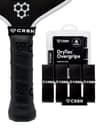
If your handle feels thin in your hand: a three-pack of Gamma Supreme, two layers, done — and you will have a spare for the next paddle. If your handle is the right size but hard and unforgiving: the Gamma Honeycomb replacement grip, which is the only cushioning on this page. If your hands sweat andyour fingertips are sore — common with arthritic hands, where the classic blue grip can feel abrasive — the CRBN Drytec, cut for pickleball handles. If you play four times a week and want the lowest cost per wrap, ten Tourna Grips will see most recreational players through a year. Nothing here was tested by us, nothing here is medical advice, and no grip is a substitute for the rest AAOS puts first. Our methodology is here.