The four shoes that publish an answer
This is the table that does not exist anywhere else, so here it is in prose. Among the court shoes we list, the following publish something about their insole:
- Skechers Viper Court Pro 2.0 (men’s and women’s) — “Patented Skechers Arch Fit EVA insole system with podiatrist-certified arch support,” and explicitly a “removable EVA insole.” Both claims on the maker’s own page. This is the only shoe we list that publishes both that the insole comes out and that it was designed to a podiatrist-certified shape.
- Fila Volley Zone (women’s)— a “removeable molded EVA sockliner,” plus a TPU midfoot shank. Removability published, arch shape not.
- K-Swiss Express Light— publishes an OrthoLite liner. OrthoLite liners are conventionally removable, but K-Swiss does not say so in the spec we read, so that cell stays unfilled.
- K-Swiss Ultrashot 4— no removable-insole claim is published, which we flagged as one of the stated reasons to buy something else in our K-Swiss Ultrashot 4 review.
Everything else — the ASICS Gel-Renma 2, the Gel-Dedicate 8, the Gel-Resolution X, the New Balance models, the Viper Court Smash — publishes nothing on this point. If you have the shoes in your hand, you can check in five seconds: reach into the heel and pull. If you are buying online and you intend to add an orthotic, that unpublished cell is a real risk and the Skechers is the safe choice.
What AAOS actually says about orthotics
Worth quoting honestly because the insole industry does not. On plantar fasciitis — far and away the commonest reason a 55+ player buys an insert — AAOS describes the evidence for orthotic devices as mixed. Not useless. Not proven. Mixed.
Two consequences follow, and they point in the same direction. First, buy the cheap one, because you are running an experiment on your own foot rather than following a protocol. Second, run the experiment before you spend on shoes, because an insert moves with you between pairs and a shoe does not.
That last point is worth dwelling on. An orthotic in your court shoes helps for two hours, three times a week. The same orthotic moved into your walking shoes supports the fascia all day — and plantar fasciitis is a cumulative-load problem, not a pickleball problem. For an arch that hurts on the first steps out of bed, the hours you are not playing are the hours that matter most.
Insert first or shoe first? It depends where it hurts
There is a sequencing rule we use across this site and it is worth stating plainly here.
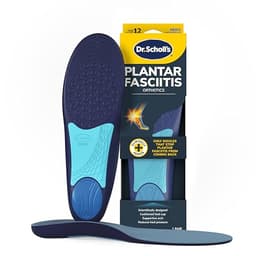
Heel and arch pain: insert first. A supportive arch and a shock-absorbing heel cup are what an irritated plantar fascia wants, and both are things an insert can add to a shoe you already own. See pickleball and plantar fasciitis and best pickleball shoes for plantar fasciitis.
Forefoot pain: shoe first.Pain under the ball of the foot or between the toes is usually about width, toe-box shape and how much pressure the forefoot takes. An insert cannot widen a shoe — it makes it narrower. Go to best pickleball shoes for wide feet or pickleball foot pain instead.
Arch collapsing inward: structure first, then the insert. An overpronating foot needs a shoe that will not twist along its length — a named midfoot chassis or shank — and an insert cannot supply one. Buy the structure, then add support inside it. See best pickleball shoes for flat feet.
Knee pain: neither, probably.“Insoles for knee pain” is a common search and a weak mechanism. What the court shoe does for a knee is mostly about cushioning and keeping the joint tracking straight, which is a midsole and frame question. See best pickleball shoes for bad knees and pickleball and your knees.
Fitting an insert without ruining the fit
Five practical notes, because this is where a good purchase goes wrong.
- Take the old sockliner out first. Always. Two insoles in one shoe raises your heel out of the heel counter, which is the part holding your ankle straight.
- Trim using the old one as a template.Lay the original sockliner on top of the new insert and cut to it. Cut less than you think — you can trim again, you cannot un-trim.
- Expect the shoe to feel tighter over the instep. A full-length orthotic takes up volume. If your court shoes are already snug, loosen the lacing a row or accept that this pair will not take an insert.
- Break it in off court. Wear it for a few days of walking before a session. A new arch shape changes how your foot loads and that takes a little adapting.
- Treat it as a consumable.Foam packs down. An insert that has flattened is doing nothing except taking up room, and the same is true of the midsole underneath it — see when to replace pickleball shoes.
What we would do, in one paragraph
If your heel or arch hurts: buy the trim-to-fit orthotic in your size, put it in the court shoes you already own, and move it into your walking shoes for the rest of the week — that is the cheapest, most reversible thing on this site and AAOS’s mixed verdict is a reason to try it cheaply, not a reason to skip it. If you are buying new shoes anyway and you know you will be adding an orthotic, buy the Skechers Viper Court Pro 2.0: it is the only shoe we list that publishes both a removable insole and a podiatrist-certified arch shape, which means the insert will fit and may not even be needed. If you want the published removability at a lower price and you wear a women’s size, the Fila Volley Zone states a removable molded EVA sockliner. And if your pain is in the forefoot rather than the heel, do not buy an insole at all — buy a wider shoe. Nothing here was tested by us and nothing here is medical advice. Our methodology is here.