Start with the insert — AAOS does
AAOS’s nonsurgical list for a collapsing arch starts where you would expect — switching to lower-impact exercise, ice, anti-inflammatories, physical therapy — and includes orthotics: an orthotic is a shoe insert designed to support and position the foot, and for mild cases an over-the-counter one is the starting point, with custom devices reserved for moderate-to-severe deformity. A prefabricated arch-support insert costs about fifteen dollars and drops into the court shoes you already own. That is a two-week, low-risk experiment, and its result tells you what to spend next: if the insert helps, a shoe with room for it is the upgrade; if it does nothing, your problem is probably not one a shoe will fix, and a podiatrist is the next call rather than a shoe store.
The two Dr. Scholl’s inserts listed here are sold for plantar fasciitis, and we recommend them on that page too. They are on this page because the thing they add — a supportive arch and a heel cup — is the thing a flat foot is missing. They are trim-to-fit and full length, so they replace the stock insole rather than sitting on top of it.
What “support” means on a spec sheet, and what to look for
- A midfoot chassis or frame the maker names. K-Swiss calls it a molded TPU support chassis; ASICS calls it a DYNAWALL frame and says it wraps the heel; New Balance describes integrated stabilizers. If a shoe’s spec sheet says nothing about the midfoot, assume there is nothing there.
- A firm heel counter. The cup around your heel is what stops the rearfoot rolling inward, which is where overpronation starts. Squeeze it; it should not fold.
- A wide, flat base. A flat foot wants ground under it. Narrow, rockered running-shoe soles are the worst possible platform for a foot that already rolls.
- A removable insole. So your arch support can go in. The Skechers and the New Balance say so on the spec sheet; for the others, lift the insole in the store and check it is not glued down.
- A wide width if you need it. Flat feet are often wide feet, and cramming a flat foot into a narrow shoe makes it roll harder. Only the New Balance and the Skechers here publish a wide; our wide-feet roundup has the rest.
The picks in order
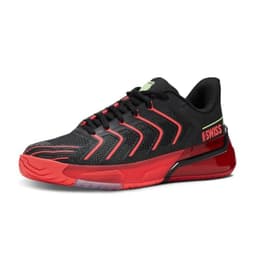
K-Swiss Ultrashot 4. The pickleball-specific shoe here whose spec sheet names a molded TPU support chassis under the midfoot, plus a shock frame under the heel. Structure where a flat foot needs it, cushioning where it wants it, and a DragGuard outsole built for the toe-drag this sport produces. It is not offered in a wide, and K-Swiss does not publish a heel-to-toe drop, which are the two honest marks against it.
ASICS Gel-Resolution X, women’s. The most structured platform we can find sold for court sport: the DYNAWALL frame extends around the heel, the midsole is two-piece so the heel can be softer than the forefoot, and there is a higher medial collar against the inward roll. It is heavy — 13.2 oz in a women’s 8 — and it is the stiffest shoe here, which some players find is simply too much shoe. For a foot that is actively collapsing rather than merely flat, that stiffness is the point. The men’s version is the same shoe at 15.0 oz; it is on our ankle-support roundup and the plantar fasciitis page, and the only reason it is not listed here is that its Amazon listing has had no live price for several days as we write.
Skechers Viper Court Pro 2.0, men’s. The opposite approach, and a legitimate one for a mild, lifelong flat foot that has never really hurt: a cushioned ULTRA GO midsole with the arch support built into a removable Arch Fit insole that Skechers describes as a podiatrist-certified shape. It is offered in a Wide, it needs no break-in, and it is the most comfortable shoe on the page from the first step. What it lacks is a rigid midfoot frame, so if your arch is actively collapsing, the two shoes above are the better tools. Full write-up in the Viper Court Pro 2.0 review.
New Balance Fresh Foam X 1007 in 4E. A different kind of pick. Tennis Warehouse describes it as a low-arch design, so on its own it does little for a flat foot — but it is offered in a 4E extra wide, it has integrated stabilizers through the midfoot, and it has the depth to take a serious orthotic without crowding the toes. If a podiatrist has already made you a custom insert, this is the chassis to put it in. If you are buying a shoe to fix a flat foot by itself, buy one of the two above instead.
Why the softest shoe is the wrong shoe
It is genuinely counterintuitive. Your arch aches, so cushioning seems like the answer, and for the first ten minutes it is. The problem is that a very soft midsole with no frame lets the foot sink and roll inward inside its own shoe, so the tendon that is already struggling to hold the arch up has to work harder, not less. AAOS makes the same point from the other direction: symptoms are worse in non-supportive footwear like sandals. The shoes here are structured with cushioning in the heel — not soft throughout — and that is deliberate. The one-second store test is the wring test: hold heel and toe and try to twist the shoe like a dishcloth. If it twists easily, put it back.
Flat feet, plantar fasciitis and the overlap
A collapsing arch and a sore plantar fascia often arrive together, because the fascia runs under the arch and gets stretched every time the arch flattens. That is why most of the shoes on this page also appear on our plantar fasciitis roundup. The difference is where the pain is: plantar fasciitis hurts under the heel and is worst in the first steps of the morning; a collapsing arch hurts along the inside of the foot and ankle and gets worse the longer you are on it. If you have both, the shoe advice is identical — structure first — and the insert is even more clearly the place to start.
What a shoe will not do
AAOS is clear that a progressing collapse can become a stiff, arthritic foot if it is left alone, and that early treatment matters. A supportive shoe and an insert make the sport comfortable; they do not repair a tendon. If the inside of your foot or ankle hurts after every session, if the ankle looks like it is rolling inward when you stand, or if you cannot rise onto the toes of one foot, that is a doctor visit, not a shopping decision. Nothing here is medical advice, we own none of these shoes, and every spec is read from the maker’s listing with every price checked daily and stamped with the date.