What the mmHg number actually means
Millimeters of mercury is a pressure unit, and on a compression sock it describes the squeeze at the ankle. The published bands, in Cleveland Clinic’s own words:
- Mild, 8–15 mmHg. Barely different from a snug athletic sock. Fine for a long drive to a tournament; not much use for a swollen ankle.
- Moderate, 15–20 mmHg. The band most players want and the band three of the picks here sit in. Noticeable, easy enough to put on, and the level most people describe as making their legs feel less heavy afterwards.
- Firm, 20–30 mmHg.Where the clinical indications start getting serious — vein problems, visible swelling, standing all day. It is also meaningfully harder to get on.
- Extra-firm, 30–40 mmHg.Described by Cleveland Clinic as medical-grade compression, usually available only by prescription and to be used under a doctor’s supervision. We list nothing in this band and you should not buy one off a shelf.
The word that matters as much as the number is graduated. The sock is meant to be tightest at the ankle and progressively looser up the calf, which is what encourages blood upward rather than simply constricting the leg. A sock that is uniformly tight is not doing the same job, and a listing that will not use the word is a listing you should read carefully.
Who should not wear compression socks
This is the section most pickleball sock pages leave out, and for a 55+ audience it is the most important one on the page. Cleveland Clinic is explicit about it. Do not wear compression socks if you have open wounds, a skin infection, or extremely fragile skin. Ask a provider firstif you have severe swelling, peripheral artery disease, or severely reduced sensation in your legs from neuropathy — including diabetes-related neuropathy.
That last one deserves a sentence of its own, because reduced sensation is exactly the condition under which a sock that is too tight does damage you cannot feel. If you have been told you have neuropathy in your feet, do not buy a pressure garment off this page without asking. The same caution runs through our pickleball foot pain guide.
Cleveland Clinic’s fitting advice is also worth following and almost impossible to follow online: get measured, and have a provider recommend the pressure level. Every sock on this page is sized by shoe size or by a broad S/M, L/XL band, which is coarser than a measured medical stocking. A pharmacist or medical-supply specialist can measure you, and if you are stepping up to the firm band that is worth doing.
What compression will and will not do for your game
Here is where we part company with most of the category’s marketing. The evidence for compression garments improving performance is inconsistent, and nothing we can cite says a sock will make you faster or stronger on a pickleball court. The mechanism that is reasonably well described is venous return: the socks help blood move back up the leg, which is why the strongest indications are vein problems, swelling and long periods on your feet rather than athletic output.
So be honest with yourself about which problem you have:
- Puffy ankles after play, heavy legs in the evening, visible veins. This is the compression case. Moderate band first, firm band if moderate is not enough.
- Calf cramps late in a session. Worth trying compression, worth also looking at hydration and at how long you have been playing without a break.
- Blisters, hot spots, a sore pad under the ball of the foot.Not a compression problem. This is a cushioning and friction problem, and a padded court sock is the answer. It is also often a shoe problem — see best pickleball shoes for seniors.
- Heel or arch pain in the morning. Neither. Read insoles for pickleball first, because a $15 insert is the cheaper experiment.
The two-sock question, and the fit trap in a court shoe
A compression sock with no cushioning has to be worn with something underfoot, or you are playing a lateral sport on a thin layer of nylon. Two layers means more heat, more bulk and a shoe that fits differently — and this is the trap: a court shoe fitted with a thin sock in a store will be too tight with a padded sock and a compression layer inside it.
Two practical rules. First, fit the shoe with the sock you will actually play in, which for most people means taking your socks to the store or ordering a shoe you can return. Second, if your shoes are already snug, buy the compression sock that cushions — the two Sockwell picks here both publish a cushion sole — rather than stacking a second layer in. Width matters more than length here, and our pickleball shoes for wide feet page lists which models publish a wide fitting.
The detail nobody mentions: the toe seam
If you have a bunion, an arthritic big-toe joint or a toe that has been operated on, a seam running across the toe box is a fixed pressure point you cannot move. One sock on this page publishes a seamless toe closure— Sockwell’s Women’s Circulator — and for that buyer it is the single most relevant spec in the table, well ahead of the pressure number. It is the same argument we make about toe box width in pickleball and bunions: the cheapest fix for a sore joint is removing the thing pressing on it.
What we would buy, in one paragraph
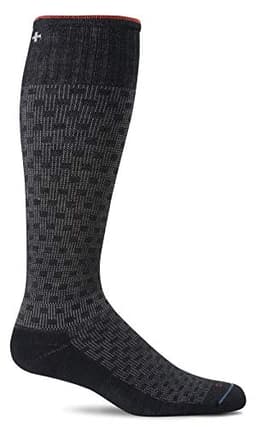
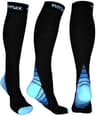
For most men, the Sockwell Shadow Box— 15 to 20 mmHg, the word graduated, over the calf, cushioned foot, all published on the listing. For most women, the Sockwell Women’s Circulator, which publishes the most complete spec table on this page including the full fiber blend and a seamless toe. If your ankles swell, the Physix Gear 20–30 mmHgis the firm band and the right band for that problem — as long as you can get it on. If you want to find out whether compression does anything for you at all, three pairs of the CHARMKING 15–20 mmHg cost less than one wool sock and still publish the number. And if you have no circulation complaint and a recurring blister, buy the Thorlo TX Max Cushioninstead and ignore the rest of this page; it publishes its padding and its fiber blend and makes no compression claim at all. Nothing here was tested by us, nothing here is medical advice, and every figure is the maker’s own. Our methodology is here.