Kitchen & Court

ASO Ankle Stabilizer Review: Sizing and How to Put It On

The brace we recommend more often than any other, and the one people search for sizing help on. Eight sizes by ankle circumference, one bilateral fit, and the routine Med Spec only publishes in a PDF.

Med Spec ASO Ankle Stabilizer

Our pick for most players

Med Spec ASO Ankle Stabilizer

Bilateral — one unit fits either foot, so the commonest expensive mistake in this category is impossible to make. Eight published sizes keyed to ankle circumference, and the figure-eight strap pattern athletic trainers have used for decades.

$35.71 · View on Amazon

$44.9521% off

Price as of November 9, 2026. #ad How we’re funded

Read the full write-up
By Stephen V.Last updated How we research

If you have landed here, there is a good chance you are not asking whether the ASO is any good. Look at what people actually search alongside its name: sizing, size chart, how to put on, instructions. People buy this brace and then need help fitting it.

So this review answers those questions first and the is-it-worth-buying question second. The short version: it is the ankle brace we point most pickleball players to first, it is sized from a single measurement you can take yourself, and it is bilateral — meaning one unit fits either foot and there is no left or right to get wrong. What it costs you is a three-step routine every time you play, and a shoe with room in it.

One thing to say up front, because it is the kind of omission this site exists to point out: Med Spec publishes application instructions, a sizing-and-fitting video and washing instructions — but all of them live behind a linked PDF or video rather than in text on the product page. That is why so many people end up searching for a stranger to explain it. The brand built a good brace and filed the instructions where a search engine cannot reach them.

How this is funded: we earn a commission if you buy through our links, at no extra cost to you. It never changes which product we recommend, and we’ll tell you plainly when to skip one. Full disclosure.

Med Spec ASO Ankle Stabilizer

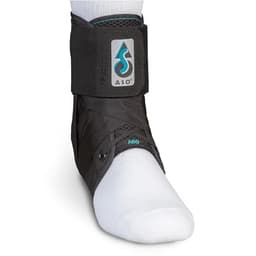
The one to buy first. Med Spec's ASO is the lace-up-plus-figure-eight design athletic trainers have strapped on for decades, and it is the only brace here that is bilateral - one unit fits either foot, so you cannot order the wrong side. Med Spec publishes what it is for in clinical terms (inversion and eversion sprains, medial or lateral instability, subtalar instability), and it is built to be worn inside a shoe, which is the test any brace has to pass before it is any use to you on a Tuesday morning.

Easier on the joints: A sprain is a ligament injury, and a stretched ligament does not tighten back up on its own - which is why one rolled ankle makes the next one likelier. The figure-eight strap does the job the ligament stopped doing: it resists the inward roll at the moment you plant and change direction, which on a pickleball court is every third shot.

What we like

  • Bilateral - the same brace fits your left or right foot, so there is no side to get wrong
  • Angled straps that 'form a complete figure-eight', the strapping pattern that resists the roll
  • Eight published sizes, from XX-Small (9-10 in ankle circumference) up to 3X-Large (16 in+)
  • Med Spec states the clinical indications outright, including subtalar joint instability

Skip it if

  • Laces plus two straps plus an elastic cuff is a three-step routine every time you play
  • Low-profile but not invisible - you will want a roomier shoe, or the next size up
  • The listing we link is one size (MD); check the size chart against your own ankle first
TypeLace-up ankle stabilizing orthosis
Support levelFigure-eight straps + circumferential elastic cuff
FitsBilateral - either left or right foot
Sizing8 sizes, XX-Small (9-10 in) to 3X-Large (16 in+)
MaterialsCoolFlex padding with spandex; spacer mesh tongue and Achilles panel
Indicated forInversion/eversion sprains, medial or lateral instability, subtalar instability

Specs read from the product listing, on October 4, 2026. “Not published” means the maker does not state that figure.

The size chart, in full

You need one number: the circumference of your ankle. Take a soft tape measure around the ankle at the level of the bony bumps on either side, with the foot flat and your weight on it. Then read off the chart Med Spec publishes:

  • XX-Small— 9 to 10 in
  • X-Small— 10 to 11 in
  • Small— 11 to 12 in
  • Medium— 12 to 13 in
  • Large— 13 to 14 in
  • X-Large— 14 to 15 in
  • XX-Large— 15 to 16 in
  • 3X-Large— 16 in and over

Three things to notice. First, the sizing is not by shoe size, which is how most people instinctively size footwear-adjacent products and is how most of the wrong orders happen. Second, there are eight sizes in one-inch bands, which is unusually fine granularity for a brace — it means a correct fit is available, and also that a careless guess will land you a band off. Third, the listing we link is one specific size, so check which before you pay: this brace comes in eight, and the buy link lands on a single one of them.

If you sit exactly on a boundary — a 13-inch ankle could be a Large or an X-Large — Med Spec publishes no tie-breaker, so we will not invent one. The practical consideration is that this brace goes inside a shoe, and a brace that is slightly loose can be laced tighter while one that is too tight cannot be made bigger.

Why bilateral is the feature that matters most

Med Spec states that the brace “is bilateral and fits either the left or right foot.” That single sentence is worth more than any construction detail on the spec sheet, and here is why.

The other serious braces in this category are side-specific andsize-specific. The Zamst A2-DX, which we also review, comes in four sizes and in left and right versions — eight distinct products, exactly one of which is the thing you meant to buy. We treat that ordering trap as the main practical risk of the Zamst in our review of it, and it is the first reason most players should start with the ASO instead.

Bilateral has a second, less obvious payoff for a 55+ player. Ankle sprains recur, and they do not always recur on the same side. Per AAOS, an ankle sprain is an injury to the ligaments that stabilize the joint, and around 90 percent are inversion injuries to the lateral ligaments — the inward roll. A stretched ligament does not tighten back up on its own, which is why one rolled ankle makes the next one likelier. If your other ankle goes in eighteen months, a bilateral brace moves across. A side-specific one is scrap.

Putting it on: the three-step routine

Med Spec publishes its application instructions only as a downloadable document, so what follows is a plain description of the brace’s own published design — the lace closure, the angled stabilizing straps that “form a complete figure-eight,” and the circumferential woven elastic cuff — in the order the construction implies. If you want the manufacturer’s exact wording, the PDF and the fitting video are both linked from the source we cite on this page.

  1. Lace it like a boot, sitting down. Slide the foot in with the brace fully open and the tongue centered. Med Spec notes that the shoe lace is “attached to the tongue to ensure lace is always centered”, which removes the commonest fiddle. Snug, not strangling — the laces hold position, the straps do the stabilizing.
  2. Wrap the figure-eight straps. These are the working part. Med Spec describes them as “angled stabilizing straps” that “contour above the malleoli for enhanced comfort and migration resistance” and that “form a complete figure-eight to help stabilize the subtalar and talocrural joints.” In plain terms: they pass under the arch and cross above the ankle bones, which is the geometry that resists the inward roll. Angled above the bony bumps rather than across them is the detail that keeps them from sliding down during play.
  3. Close the elastic cuff last.The “circumferential woven elastic cuff” goes over the top and, in Med Spec’s words, “keeps laces and stabilizing straps secure.” Think of it as the thing that stops step two coming undone in the third game.

That is three operations per ankle, every session. It is the honest cost of this brace, and for a player with arthritic fingers it is the single best reason to consider something simpler — our ankle brace ranking includes pull-on and single-strap options that are worse at stabilizing and much faster to put on.

What the construction is actually doing

Four published details, and what each one is for:

The figure-eight strap pattern. This is the whole argument for a lace-up stabilizer over a sleeve. A compression sleeve warms a joint and does essentially nothing to resist a roll. The figure-eight does the job the ligament stopped doing: it resists inversion at the instant you plant and change direction, which on a pickleball court is every third shot.

CoolFlex padding with spandex fiber, and spacer mesh. Med Spec publishes spacer mesh fabric in the tongue and along the Achilles area. Both are heat-and-moisture features, which sound cosmetic until you have worn a non-breathable brace inside a court shoe for two hours in July. A brace you stop wearing protects nothing.

The “invisible seam” at the rear boot. A seam behind the heel is a blister waiting to happen, and this brace sits under a sock inside a shoe. Removing it is a small, specific, sensible piece of design.

A PDAC Verified HCPCS code, published as L1902. This is the detail nobody writing about pickleball gear mentions. A verified billing code means the paperwork exists for this product to be handled as a medical device rather than as sporting goods. It does notmean your insurer will pay for it, and we are not going to suggest otherwise — but if you are buying this on a doctor’s recommendation after an actual sprain, it is a worthwhile question to ask at the appointment rather than after.

The honest problems

Four, and the first two are the ones that send people back to a search box.

1. It needs room in your shoe, and Med Spec says nothing about that. We re-read the product page specifically looking for it: there is no published guidance on shoe fit or shoe sizing anywhere on it. Sizing is based purely on ankle circumference. In practice a lace-up stabilizer adds real volume around the midfoot and ankle, so plan on either a half size up or a wide fitting. If you are buying shoes and a brace at the same time, our pickleball shoes for wide feet page lists which court shoes publish a wide option, and best pickleball shoes for seniors covers the rest of the fit question.

2. The instructions are not where you would look for them.As noted above, the application guidance, the fitting video and the washing instructions are all linked files rather than page text. For a product whose top related searches are “how to put on” and “instructions,” that is a real failure of publishing, and it is the reason this review spends a section on the routine.

3. Three steps, every time. Laces, two straps, cuff. If gripping and pulling is already the painful part of your morning, be realistic about whether you will do that twice a session for a year.

4. It is a brace, not a treatment, and not prevention on its own.AAOS puts the prevention emphasis elsewhere: warm up thoroughly, do ankle-strengthening work, choose footwear with appropriate support for the activity, and train balance and proprioception. It also names the footwear risk factors explicitly — shoes that do not provide enough foot and ankle support, and shoes with slippery soles. A brace is the thing you add after an ankle has already failed; it is not a substitute for the balance work. We cover that in pickleball ankle sprains and do braces actually help in pickleball.

Who should buy something else

Three cases where the ASO is the wrong purchase, stated plainly:

  • You have had a severe sprain and the ankle is chronically unstable. The Zamst A2-DX publishes an indication for Grade III high ankle sprains and chronic instability at its own “Strong” support level. That is more brace than most players need and the right brace for that player. The head-to-head is in ASO vs Zamst A2-DX.
  • Your hands cannot do laces and straps reliably.Be honest about this one. A less supportive brace you fit correctly every time beats a better brace you fit badly or skip — see the pull-on options in our ankle brace ranking.
  • Nothing is wrong with your ankle and you want to prevent problems. Start with the AAOS list — warm-up, strengthening, balance work, supportive non-slippery shoes. Bracing a healthy ankle is not the first move, and nothing we can cite says it should be.

The verdict

For a pickleball player over 55 with an ankle that has rolled before, the ASO is the right first brace, and it is the right first brace for a reason that has nothing to do with it being the most supportive thing on the market: it is the one you are most likely to end up owning in the correct size. Eight published bands off one measurement you can take yourself, and bilateral so the left-or-right decision does not exist. Add the figure-eight strap geometry that resists the specific movement that injures ankles on a court, breathable padding so you keep it on in summer, and a seam-free heel so it does not blister under a sock.

The costs are real and we would rather you know them before you buy: three operations per ankle per session, a shoe that needs room Med Spec will not tell you how much of, and instructions filed in a PDF. None of those is a reason to buy a worse brace. All of them are reasons to measure your ankle, check which size the buy link lands on, and try it at home before a league night.

Nothing here was tested by us — we own no units and every figure on this page is Med Spec’s or AAOS’s own published wording. Nothing here is medical advice; an ankle that is swollen, will not take weight, or keeps giving way is a question for a doctor. Our methodology is here.
Frequently asked questions

How do I size an ASO ankle brace?

By ankle circumference, not by shoe size. Measure around the ankle at the level of the bony bumps with your foot flat and weight on it, then read Med Spec's published chart: XX-Small 9-10 in, X-Small 10-11 in, Small 11-12 in, Medium 12-13 in, Large 13-14 in, X-Large 14-15 in, XX-Large 15-16 in, and 3X-Large 16 in and over. Eight sizes in one-inch bands means a correct fit exists and that a guess will land you a band off. Note that the buy link lands on one specific size, so check which one before you pay.

How do you put on an ASO ankle brace?

Three operations, in this order, sitting down. First, slide the foot in and lace it like a boot - Med Spec attaches the shoe lace to the tongue so it stays centered. Snug, not strangling. Second, wrap the two angled stabilizing straps, which pass under the arch and cross above the ankle bones to form what Med Spec calls a complete figure-eight; the angle above the bony bumps is what keeps them from migrating during play. Third, close the circumferential woven elastic cuff over the top, which Med Spec says keeps the laces and straps secure. Med Spec publishes its own application instructions and a sizing-and-fitting video as linked files rather than as text on the product page.

Is the ASO brace left or right specific?

No, and that is its single best feature. Med Spec states the brace is bilateral and fits either the left or right foot. Compare that with the Zamst A2-DX, which is side-specific and comes in four sizes - eight distinct products, exactly one of which is the one you meant to order. Bilateral also means the brace transfers if your other ankle is the one that goes next, which matters because a stretched ligament does not tighten back up on its own and one rolled ankle makes the next likelier.

Will an ASO brace fit inside a pickleball shoe?

It is designed to be worn inside a shoe, but Med Spec publishes nothing about shoe fit or shoe sizing - we checked the product page specifically for it. Sizing is based purely on ankle circumference. In practice a lace-up stabilizer adds real volume around the midfoot and ankle, so plan on a half size up or a wide fitting. If you are buying both at once, look for a court shoe that publishes a wide option rather than assuming your usual size will take the brace.

Is the ASO or the Zamst A2-DX better for pickleball?

For most pickleball players, the ASO - because it is bilateral, sized off one self-measurable number, cheaper, and less bulky inside a court shoe. The Zamst is the better brace for a specific player: Zamst publishes an indication for Grade III high ankle sprains and chronic ankle instability at its Strong support level, which is more brace than a recreational player with one old sprain needs. The practical catch with the Zamst is ordering: four sizes times left and right. We put the two head to head on a separate page.

What is the HCPCS code on the ASO for?

Med Spec publishes a PDAC Verified HCPCS code, L1902, on the product page. In plain terms that means the billing paperwork exists for this item to be handled as a medical device rather than as sporting goods. It does not mean an insurer will pay for it and we are not going to imply it does. If you are buying the brace on a doctor's recommendation after an actual sprain, it is worth asking about coverage at the appointment rather than afterwards.

Does wearing an ankle brace weaken your ankle?

Nothing we can cite supports that, and nothing we can cite rules it out either, so we will not claim a verdict. What AAOS does publish is where the prevention emphasis belongs: warming up thoroughly, ankle-strengthening exercises, footwear with appropriate support for the activity, and balance or proprioception training. It also names the footwear risk factors directly - shoes without enough foot and ankle support, and shoes with slippery soles. Read that as the ordering it implies: a brace is what you add after an ankle has failed, not instead of the balance work.

Sources

  • Med Spec - ASO Ankle Stabilizer product page, re-read for the size chart and application material — Re-read live on this date for the sizing and fitting detail the review turns on. THE FULL SIZE CHART, by ankle circumference: XX-Small 9-10 in, X-Small 10-11 in, Small 11-12 in, Medium 12-13 in, Large 13-14 in, X-Large 14-15 in, XX-Large 15-16 in, 3X-Large 16 in and over - eight sizes, each with a black and a white part number. STRAP DESIGN, in Med Spec's words: 'Angled stabilizing straps contour above the malleoli for enhanced comfort and migration resistance' and they 'form a complete figure-eight to help stabilize the subtalar and talocrural joints'. Construction: a 'circumferential woven elastic cuff', 'CoolFlex' padding containing spandex fiber, 'spacer mesh fabric' in the tongue and boot interior, an 'invisible seam' at the rear boot, and a shoe lace 'attached to the tongue to ensure lace is always centered'. The brace 'is bilateral and fits either the left or right foot'. Regulatory: 'PDAC Verified HCPCS: L1902'. Patents US 8,808,215, US 9,375,339 and US 10,383,404. WHAT THE PAGE DOES NOT CONTAIN: the application instructions, the sizing-and-fitting guidance and the washing instructions exist only as a linked PDF and a linked video, not as text on the page - and nothing at all is published about wearing the brace inside a shoe or about shoe sizing (accessed November 1, 2026)
  • Med Spec - ASO Ankle Stabilizer product page (manufacturer specifications) — Med Spec publishes: an 'ankle stabilizing orthosis' with 'angled stabilizing straps' that 'form a complete figure-eight', plus a 'circumferential woven elastic cuff' and a lace closure; 'CoolFlex' padding with spandex fiber and 'spacer mesh fabric' in the tongue and along the Achilles tendon area; the brace 'is bilateral and fits either the left or right foot'; eight sizes from XX-Small (9-10 in ankle circumference) through 3X-Large (16 in+); an 'invisible seam' at the rear boot and a shoe lace 'attached to the tongue to ensure lace is always centered'. Published indications: 'inversion or eversion ankle sprains', 'medial or lateral ankle instability' and 'subtalar joint instability'. PDAC Verified HCPCS code L1902 (accessed October 4, 2026)
  • American Academy of Orthopaedic Surgeons (OrthoInfo) — Sprained Ankle — An ankle sprain is 'an injury to one or more of the ligaments that stabilize the ankle'; about 90% are inversion injuries to the lateral ligaments (ATFL and CFL). Causes named: walking or exercising on an uneven surface, falling or tripping, and 'high-risk sports that require cutting or jumping actions, such as trail running, basketball, tennis, football, and soccer'. Footwear risk factors: 'wearing shoes that do not provide enough foot and ankle support' and 'shoes with slippery soles'. Prevention: 'warm up thoroughly before exercise and physical activity', strengthening exercises for ankle stability, 'choose footwear with appropriate support for your activity', and balance (proprioception) training, often on a balance board (accessed September 18, 2026)
  • Zamst - A2-DX Ankle Brace product page (manufacturer specifications) — Zamst publishes a 'Strong' support level for the A2-DX, built around 'Protective Guards' that 'prevent excessive inward and outward movements' plus a 'Dual X-Strap Stabilizer' offering 'three-way support (Anterior, Lateral, Medial)'; 'Rear Application' that 'enables easy application and adjustment'; 'low-profile material with excellent breathability and anti-microbial properties'; sizes Small, Medium, Large and Extra Large; a 'Left and Right Specific Design' to 'provide a better fit'. Indications: 'For high ankle sprains (Grade III) & chronic ankle instability' and 'Reduces inversion & eversion movements'. Zamst recommends it for basketball and sports requiring quick turnaround movements; it publishes no pickleball-specific guidance (accessed October 4, 2026)
  • Non-fatal senior pickleball and tennis injuries in US EDs, 2010–2019 — Injury Epidemiology (2021) — For players 60+: strains/sprains 31.0%, fractures 30.4%; the wrist is the single most-injured body part (13.2%); women 3.7x more likely to fracture (accessed July 22, 2026)

Keep reading