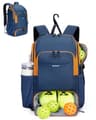
Two straps beat one, and it isn’t close
A single-shoulder bag hangs its entire load off one side of your body. To stay upright you tilt the other way, which means your neck, one shoulder and your lower back spend the whole walk holding a position they didn’t choose. If you’ve already got a stiff neck, a cranky rotator cuff or a lower back that complains, that walk is where the session starts hurting — before you’ve hit a ball.
A two-strap backpack puts the load down the middle of your spine, where your body is built to carry it. The only real exception is when the load is genuinely tiny: a paddle, a couple of balls, keys and a phone in a crossbody sling weigh so little that the asymmetry doesn’t matter, and the sling is faster to get in and out of on court. Under about five pounds, carry the sling. Over it, use both straps.
The fence hook is the feature nobody sells you on
It is a small metal or plastic hook that lets the bag hang off the court fence. That’s all. And for a player with bad knees or a sore back it’s the most valuable feature on this page, because every trip to your bag becomes a reach rather than a squat. Over a two-hour session you go to your bag — for water, a towel, a spare ball, your glasses — maybe a dozen times. That’s a dozen squats down to ground level and back up, and if you already ration those, you’ll feel the difference the first time you play with a hook.
It also keeps your gear out of the dirt, wet grass and whatever the court surface offers, which matters if you carry court shoes and would rather not put them back in with your clothes.
How much bag do you actually need?
- Paddle, balls, water, keys. A crossbody sling. Anything bigger is weight you carry for nothing.
- The above, plus a towel, a brace, sunscreen and a spare paddle. A mid-size bag with a fence hook and separate pockets. This is where most recreational players actually live.
- All of that, plus court shoes you change into. A full backpack with a dedicated shoe compartment, so wet or dusty shoes stay away from everything else.
One thing worth saying plainly: buying the biggest bag is a mistake most people make once. A big bag gets filled, a filled bag gets heavy, and you carry that weight every single session for the two occasions a year you needed the extra room. Buy for your normal session, not your busiest one.
Small things that make a difference on court
Look for a bag that stands up on its own rather than flopping over, so you’re not chasing a rolling bag on a windy day. Look for zip pulls big enough to grip — tiny metal tabs are genuinely difficult with arthritic fingers or gloves on. And check that the paddle compartment is padded or separate; a paddle face rubbing against keys all season is a slow way to ruin the texture that gives you spin, and a worn paddle is one you replace sooner than you needed to.