Kitchen & Court

Franklin X-40 vs Dura Fast 40

The two outdoor tournament standards, side by side on measured numbers rather than folklore — including the one spec that decides it if your elbow or wrist already complains.

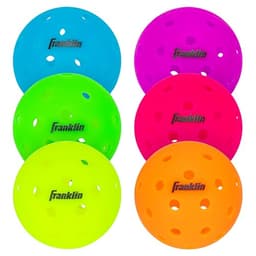
Franklin Sports X-40 Tournament Pickleballs

For most players over 55

Franklin Sports X-40 Tournament Pickleballs

The X-40 is the softerof the two by a wide margin — one independent measurement put the Dura around 40% stiffer — and softer means less of every hit reaching your hand. It is usually the cheaper ball too. Choose the Dura instead if your courts are genuinely windy.

$10.39 · View on Amazon

$29.9965% off

Price as of September 6, 2026. #ad How we’re funded

Read the full write-up
By Stephen V.Last updated How we research

These are the two balls you will actually be handed at open play, and the argument between them is older than most people’s paddles. It is also full of confidently repeated claims that fall apart when someone measures them — including one we had wrong on this site until we checked, and have now corrected.

Both are USA Pickleball approved outdoor balls with 40 holes. Both are one-piece rotationally molded — neither is two halves glued together, whatever the seam looks like. So this page skips the folklore and compares them on the three things that are actually different: how stiff each one is, how the holes are arranged, and how each ages. For the reader this site is written for, the first of those decides it.

How this is funded:we earn a commission if you buy through our links, at no extra cost to you. It never changes which product we recommend, and we’ll tell you plainly when to skip one. Full disclosure.

Quick picks

Ranked on published specs, grip and build, and honest buyer fit. Select a row to jump to the full write-up. We have not lab-tested these — here is exactly what we do instead.

#ProductBest forPrice
1
Franklin Sports X-40 Tournament Pickleballs

Franklin Sports X-40 Tournament Pickleballs

The default outdoor ball in America, and the one most club and tournament play uses. The 40-hole outdoor pattern flies straight in a breeze, it is USA Pickleball approved, and the neon finish is the easiest of the common colors to pick up against a dark court. If you buy one ball and never think about it again, buy this one.

Softer, and the pick for a sore arm
$10.39 · View on Amazon

$29.9965% off

Price as of September 6, 2026. #ad How we’re funded

2
Dura Fast 40 Outdoor Pickleballs

Dura Fast 40 Outdoor Pickleballs

The other outdoor standard, and the tournament ball a lot of long-time players still swear by. Its mixed 40-hole pattern — sixteen large, twenty-four small — is why it holds a line in wind better than most, and it keeps its character as it ages instead of going progressively dead. The catch for this site's reader: it is the stiffer of the two big outdoor balls by a considerable margin, and stiffer means more shock arriving at your hand.

Stiffer, and the pick for wind
$12.99 · View on Amazon

Price as of September 6, 2026. #ad How we’re funded

The picks in full

#1Softer, and the pick for a sore arm

Franklin Sports X-40 Tournament Pickleballs

The default outdoor ball in America, and the one most club and tournament play uses. The 40-hole outdoor pattern flies straight in a breeze, it is USA Pickleball approved, and the neon finish is the easiest of the common colors to pick up against a dark court. If you buy one ball and never think about it again, buy this one.

Easier on the joints: A high-contrast ball is a joint issue in disguise. Seeing the ball a fraction of a second earlier means one fewer lunge, and lunging late is how older players end up on the ground — falls are the single biggest injury category in senior pickleball.

What we like

  • USA Pickleball approved — legal for sanctioned play
  • Neon finish is high-contrast against most outdoor court surfaces
  • The most widely used outdoor ball, so your practice matches your games

Skip it if

  • Hard outdoor plastic cracks eventually, especially in the cold
  • Softens as it ages faster than a Dura — one measured comparison found it losing about 10% of its stiffness every four games, so its feel drifts over a season
  • Its uniform hole pattern is the reason it gets pushed around in wind more than a Dura
  • Too hard and too loud for indoor gym play
TypeOutdoor
ConstructionOne-piece rotationally molded (mold parting line, not a weld)
Hole pattern40 holes, uniform diameter (~0.29 in measured)
Measured stiffness, new94 lb/in (Pickleball Science)
USA Pickleball approvedYes (per listing)
Quantity6 per pack (per listing)
ColorNeon

Specs read from the product listing, on August 19, 2026. “Not published” means the maker does not state that figure.

#2Stiffer, and the pick for wind

Dura Fast 40 Outdoor Pickleballs

The other outdoor standard, and the tournament ball a lot of long-time players still swear by. Its mixed 40-hole pattern — sixteen large, twenty-four small — is why it holds a line in wind better than most, and it keeps its character as it ages instead of going progressively dead. The catch for this site's reader: it is the stiffer of the two big outdoor balls by a considerable margin, and stiffer means more shock arriving at your hand.

Easier on the joints: This is the one to think twice about if your elbow or wrist already complains. A stiffer ball gives way less on contact, so more of each hit travels up the paddle into your hand — and over a two-hour session that accumulation is exactly what a sore arm notices. If wind is not your problem, the softer X-40 is the kinder choice.

What we like

  • Mixed large/small hole pattern is the reason for its reputation in wind
  • Holds its stiffness as it ages — one measured comparison found it changed about 0.25% per game against the X-40's 2.5%
  • A long-standing tournament ball with a devoted following, and USA Pickleball approved
  • Neon finish for visibility outdoors

Skip it if

  • Measurably the stiffer ball — around 40% stiffer new than an X-40 in one independent test, which is the wrong direction for a sore elbow or wrist
  • Widely reported to crack sooner, especially in cold weather, though the one measured head-to-head we found had both balls cracking at around 30 games
  • Usually the pricier of the two
TypeOutdoor
ConstructionOne-piece rotationally molded, seamless (per Onix)
Hole pattern40 holes — 16 large + 24 small (per Onix)
Measured stiffness, new130 lb/in (Pickleball Science)
USA Pickleball approvedYes
QuantityNot published
ColorNeon

Specs read from the product listing, on September 13, 2026. “Not published” means the maker does not state that figure.

The short answer

Buy the Franklin X-40 unless you have a specific reason not to. It is the softer ball, it is usually the cheaper one, and softer is the direction you want if you are over 55 and your elbow, wrist or hands have opinions. Buy the Dura Fast 40 if you play somewhere genuinely breezy, or if you care more about a ball behaving identically in game thirty than in game one.

That is the whole decision. Everything below is why, and what we could not verify.

The correction we owe you first

Until this page was written, our own best pickleball balls roundup described the Dura Fast 40 as the softer of the two and called it “a shade less jarring on contact.” That was wrong, and on a site whose entire argument is about how much shock reaches a sore arm, it was wrong in a way that mattered.

An independent measured comparison by Pickleball Science put the new Dura Fast 40 at 130 lb/in of stiffness against the new Franklin X-40 at 94 lb/in — the Dura is roughly 40% stiffer, not softer. A separate retailer comparison independently describes the X-40 as having the softer feel of the two. We have corrected the roundup, the product entries and the award that went with it. We would rather publish the correction loudly than quietly swap the words.

Stiffness: the spec that decides it for this reader

Stiffness is not a comfort nicety here. A ball that gives way less on contact transmits more of the impact up through the paddle into your hand, wrist and elbow. It is a small effect on any single shot and a real one across a two-hour morning, which is exactly the kind of accumulation an arthritic hand or a grumbling tendon notices. If you have read our tennis-elbow paddle roundup and bought a paddle to reduce shock, playing with the stiffer ball works against that purchase.

The honest limits of that number: it is one testing setup, measured by one independent site rather than a governing body, and “feel” as players describe it also takes in bounce, sound and speed rather than compression alone. We are citing it because it is a stated measurement with a stated method, which beats the impression-based claims that dominate this topic — including our own previous one. Treat it as the best available evidence, not as a lab certification.

How each one ages, which nobody mentions

This is the most interesting finding and the one that changes how you buy. The two balls do not just start different, they drift at very different rates.

In the same measured comparison, the Dura changed about 8% over 32 games — roughly a quarter of a percent per game. The Franklin lost about 10% of its stiffness every four games, around 2.5% per game, and had gone too soft to measure reliably after twelve. Both cracked at around thirty games of aggressive play.

So the practical shape of it: the Dura plays the same on day one and day thirty, which is why tournament players like it. The Franklin starts softer and keeps getting softer, so a well-used X-40 is a noticeably deader ball than a fresh one. For a recreational player that is mostly fine — and for a sore arm, a softening ball is drifting in the helpful direction. What it does mean is that if you care about consistency, you should retire X-40s earlier than cracking alone would suggest.

Holes: why the Dura holds a line in wind

Both balls have forty holes, and that is where the similarity stops. The Franklin uses a uniform hole pattern, measured at about 0.29 inches across. The Dura uses a deliberately mixed pattern — Onix publishes it as sixteen large holes and twenty-four small ones, and the measured diameters come out around 0.26 and 0.32 inches.

That mixed pattern, and the slightly smaller total open area that comes with it, is the reason for the Dura’s long-standing reputation in wind. If your home courts are exposed and you spend half of every windy morning watching the ball sail somewhere you did not aim it, that is a real and specific reason to pay more for the stiffer ball. If you play in still air or indoors on an outdoor ball, it buys you nothing.

What we could not verify, and are not going to guess

Two things, stated plainly rather than papered over.

  • Weight. The sources conflict. The measured comparison recorded both balls at 0.95 oz new, while Onix publishes the Dura at 0.881 oz — and USA Pickleball’s own rules put the legal band below 0.95 oz, which makes us doubt that measurement rather than repeat it. So we print no weight comparison at all. The safe statement is that both are approved balls and therefore both sit inside the same regulation window.
  • Which cracks first. The popular answer, repeated by retailers and players alike, is that the Dura cracks sooner, especially in cold weather. The one measured head-to-head we found had both balls cracking at around thirty games. We report both, because a widely-held belief and a single test disagreeing with it is genuinely where the evidence sits, and pretending otherwise would be inventing certainty.

Cold weather, and a note for anyone playing into fall

Hard outdoor plastic gets more brittle as the temperature drops, and both of these balls crack more readily in the cold. The stiffer ball starts from a stiffer place, so if you play through a northern winter the Dura is the one more likely to split on you — and a cracked ball is not just an annoyance. It bounces unpredictably, and an unpredictable bounce is what turns a comfortable step into an off-balance reach. That chain ends in the fall category that dominates senior pickleball injuries. Retire cracked balls immediately, whichever brand you are loyal to.

Visibility, which matters more than either

Both come in neon, and for an older player that is the more consequential choice than the brand on the box. What your eye tracks is contrast, not brightness: neon against a dark green or blue outdoor court is about as readable as this sport gets. Picking the ball up a fraction earlier is worth more to your knees than any stiffness difference, because it is the difference between two comfortable steps and one long reach. Our full ball roundup ranks on visibility first for exactly that reason.

So which should you actually buy?

If you are over 55, play recreationally, and either your arm complains or you would simply rather it did not start: Franklin X-40. Softer, usually cheaper, and the direction of drift as it wears is the direction you want.

If you play in wind, play competitively, or want a ball whose behavior you can trust not to change over its life: Dura Fast 40, and accept the stiffer feel as the price of that consistency.

And the genuinely cheap experiment nobody runs: buy one pack of each. Between them they cost about what a single overgrip pack does per ball, and one session will tell you more about which you prefer than any comparison page — including this one.

Frequently asked questions

Is the Franklin X-40 or the Dura Fast 40 softer?

The Franklin X-40, by a wide margin. An independent measured comparison by Pickleball Science put the new Dura Fast 40 at 130 lb/in of stiffness against the Franklin X-40's 94 lb/in — the Dura is roughly 40% stiffer. A separate retailer comparison independently describes the X-40 as the softer-feeling of the two. This is worth knowing if you have tennis elbow, a sore wrist or arthritic hands, because a stiffer ball sends more of every hit up the paddle into your arm.

Which pickleball is better for tennis elbow or a sore arm?

The Franklin X-40, on the available evidence. It is measurably the softer of the two big outdoor tournament balls, and softer means less shock transmitted through the paddle into your hand and elbow. It also softens further as it wears, which for a sore arm is drift in the helpful direction. If you have already bought an arm-friendly paddle to reduce shock, pairing it with the stiffer ball works against that purchase.

Which ball is better in wind?

The Dura Fast 40, and its hole pattern is why. Both balls have 40 holes, but the Franklin's are a uniform diameter of about 0.29 inches while the Dura uses a mixed pattern — Onix publishes it as 16 large and 24 small holes, measured at roughly 0.32 and 0.26 inches. That mixed pattern and slightly smaller total open area is the basis of the Dura's long-standing reputation for holding a line in a breeze. In still air it buys you nothing.

Which one lasts longer?

The honest answer is that the evidence disagrees with itself. Retailers and players widely report that the Dura cracks sooner, particularly in cold weather. But the one measured head-to-head we could find had both balls cracking at around 30 games of aggressive play. What is clearer is how they age before cracking: the Dura held its stiffness to within about 8% over 32 games, while the Franklin lost roughly 10% every four games and had gone too soft to measure reliably after twelve. So the Dura stays consistent longer even if it does not necessarily survive longer.

Are the Franklin X-40 and Dura Fast 40 two-piece balls?

No, and this is the most commonly repeated mistake about both. Each is a single piece of plastic made by rotational molding, where molten plastic is spun inside a two-part mold until it solidifies. The faint line around the equator that people take for a weld is just the parting line between the two halves of the mold. Onix describes the Dura as seamless and one-piece, and the measured comparison found the same for both balls.

Are both USA Pickleball approved?

Yes. Both the Franklin X-40 and the Dura Fast 40 appear on USA Pickleball's approved-ball list as outdoor balls and are legal for sanctioned tournament play — both have served as official balls of major events. For recreational play nobody checks, but buying from the approved list is a cheap way to avoid a batch that flies oddly, which is worth having when you are trying to read the ball early.

How much do they cost, and is the difference worth it?

Both sit in the same budget bracket — a pack of outdoor balls is one of the cheapest things in the sport — with the Franklin usually the less expensive of the two. Live prices for both are on the buy buttons on this page rather than quoted in the text, because ball prices move week to week and we would rather show you today's number than anchor you to a stale one. Given how close they are, price should not decide this: pick on stiffness if your arm matters and on wind if your courts are exposed.

Sources

  • Pickleball Science — DuraFast 40 vs Franklin X-40 (independent measured comparison)Measured both balls as single-piece rotationally molded, the equatorial seam being a mold parting line rather than a weld. New stiffness: DuraFast 40 at 130 lb/in against the Franklin X-40 at 94 lb/in — the Dura roughly 40% stiffer. Aging: the Dura changed about 8% in 32 games (~0.25% per game) while the X-40 lost about 10% of its stiffness every four games (~2.5% per game) and was too soft to measure reliably after 12. Both cracked at around 30 games of aggressive play. Hole diameters: Dura mixed 0.26 in / 0.32 in (2.56 sq in open area), X-40 uniform ~0.29 in (2.64 sq in) (accessed September 13, 2026)
  • Onix Pickleball — Dura Fast 40 product page (manufacturer specifications)Onix publishes the Dura Fast 40 as a seamless one-piece rotationally molded ball with a patented 40-hole pattern of 16 large and 24 small holes, approved for USA Pickleball / IFP sanctioned play (accessed September 13, 2026)
  • USA Pickleball — Approved Ball listThe official approved-ball database — 382 approved models at time of access, each classified Indoor (Ind), Outdoor (Out) or both (I/O) (accessed August 19, 2026)
  • USA Pickleball — Equipment Standards ManualThe manufacturing specifications and testing (including the PBCoR power test) paddles must meet to be approved (accessed July 22, 2026)
  • Pickleball-Related Geriatric Fractures — Arthroscopy, Sports Medicine & Rehabilitation (2025)Adults 60+ account for 74.1% of pickleball ED visits and are 1.6x more likely to fracture; 56.1% of geriatric injuries are ground-level falls; women 3x higher fracture odds (accessed July 22, 2026)

Keep reading