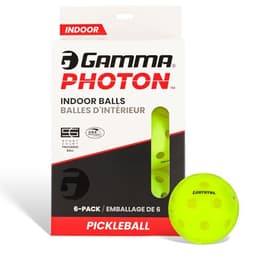
The differences, in one table
Every figure below comes from what the makers publish or from the independent measured comparison cited in the sources — not from testing we did.
| | Indoor ball | Outdoor ball |
|---|
| Holes | Fewer and larger — Gamma publishes a 26-hole pattern on its Photon line | 40 holes. Franklin’s X-40 uses a uniform ~0.29 in pattern; Dura’s Fast 40 mixes 16 large and 24 small |
|---|
| Plastic | Softer, more flexible | Harder, denser |
|---|
| Flight | Slower, floats more, easier to track | Faster, holds a line, survives wind |
|---|
| Noise | Noticeably quieter off the paddle | The crack that gets courts restricted |
|---|
| Shock to your arm | Least of the hard balls | Most — and it varies: 130 lb/in (Dura) vs 94 lb/in (X-40) when new, measured |
|---|
| How it dies | Scuffs, goes soft and out of round | Cracks — both big outdoor balls cracked at about 30 games of aggressive play in the measured comparison |
|---|
| Use it on | Gym floors, indoor sport courts | Outdoor asphalt and concrete, anywhere with wind |
|---|
Can you use an outdoor ball indoors, or the other way round?
Outdoor ball indoors: yes, and plenty of clubs do it, usually because that is what is in the box. It plays fast and loud on a gym floor, it bounces higher off a wood surface than you expect, and it is harder on your arm. If your venue runs outdoor balls indoors and your elbow objects, that is a legitimate thing to raise — it is the single easiest variable in the building to change.
Indoor ball outdoors: not really. A soft, light ball in even a modest breeze changes direction after you have committed to the shot, and for an older player that is not a scoring problem, it is a falling problem. Falls are the dominant injury category in senior pickleball, and a ball that behaves unpredictably in the last few feet is exactly what produces the off-balance lunge that causes them.
If your elbow or wrist hurts, the ball is a lever
Most players never think of the ball as equipment. It is: it is the thing your paddle hits sixty times a game, and its stiffness decides how much of each impact arrives at your hand. The measured difference between the Dura Fast 40 and the Franklin X-40 is instructive precisely because they are both “the standard outdoor ball” — one is 40% stiffer than the other and nobody tells you. If your arm is sore and you play outdoors, the X-40 is the softer of the two and the one we would pick. The full head-to-head is on Franklin X-40 vs Dura Fast 40.
There is an important caveat about the X-40 that the measured comparison also found: it softens fast, losing roughly 10% of its stiffness every four games against the Dura’s 0.25% per game. That is a feel problem, not a comfort problem — the ball gets kinder as it ages, but it also stops playing the way it did out of the bag. If you want one ball that plays the same in game 30 as in game 1, that is the Dura, and you are accepting a stiffer ball to get it.
For drilling with an arm that is already complaining, the foam ball is the real answer. A Gamma Librarian comes off the paddle with almost no shock, which lets you get reps in on technique while an elbow settles. It is a practice ball and does not pretend otherwise — flight and pace do not match a real outdoor ball, and it is not for approved play. The other reason it exists is noise, and in a 55+ community that is a live issue: the crack of a hard ball is what gets court hours cut.
Visibility: the spec nobody lists
Ball colour is not a performance spec on any maker’s sheet and it should be. Seeing the ball a fraction of a second earlier is the difference between a comfortable step and a stretch, and the stretch is where older players get hurt. Outdoors, neon against grey or green asphalt is the easiest combination to track, which is why both big outdoor balls sell in it. Indoors it is harder — a yellow ball against a pale maple gym floor is genuinely difficult for aging eyes, and that is the one thing that separates the Gamma Photon from a generic indoor ball, because Gamma markets it on high visibility specifically.
If you are losing the ball under gym lighting, do not stop at the ball. Our eye protection page covers lens tints and the impact standards worth caring about, and best pickleball balls ranks the whole field on visibility as well as flight.
Approved play, and what the lists actually mean
USA Pickleball maintains a published list of approved balls, and approval is per model — indoor and outdoor models are approved separately. The Franklin X-40, the Dura Fast 40 and the Gamma Photon are all stated as approved on their listings or by their makers; the Onix Fuse G2 listing does not state it, which is why that row of its table reads “Not published” rather than “no”. The foam practice ball is not an approved ball and is not sold as one. If you play sanctioned events, check the current list rather than a product page — approvals change.
One last practical note. The Franklin X-40 has no buyable offer on Amazon as this page publishes, so its row shows “Check price on Amazon” rather than a number. That is our price layer declining to display a figure it cannot verify today, not an oversight.