Your shirt is not sun protection, and the numbers are brutal
Before the hats, the fact that reframes this entire page for a pickleball player. The Skin Cancer Foundation publishes the UPF of an ordinary white T-shirt: about UPF 7 when it is dry, and UPF 3 when it is wet.
Read that again with a Tuesday-morning session in mind. Ninety minutes into a hot doubles rotation, the shirt on your shoulders is wet, and the garment you were counting on has dropped to roughly a twentieth of the protection a UPF 50 fabric gives. For comparison, the same source puts a dark, long-sleeved denim shirt at about UPF 1,700— which tells you the two things that drive fabric protection are weave density and color, not price. Dark or bright colors absorb UV instead of letting it through; densely woven cloth beats sheer.
It also tells you why a hat is the highest-leverage purchase on this page. A hat does not get less protective when it gets damp, it does not wear off, and it shades the parts of you that take the most cumulative sun over a pickleball career: nose, ears, cheekbones, scalp and the back of the neck.
The court itself is working against you
One line in the CDC’s skin cancer guidance applies to this sport more directly than to almost any other. UV rays, it says, “reflect off of surfaces like water, cement, sand, and snow.”
An outdoor pickleball court is acrylic paint over concrete. It is a large, pale, hard, reflective surface, and you spend your whole session looking down at it and standing on it. That reflected component comes at you from belowthe brim, which is the honest limitation of every hat on this page and the reason a hat is a partial answer rather than a complete one. The CDC’s own advice for anywhere a hat cannot reach is unglamorous and correct: broad-spectrum sunscreen, SPF 15 or higher, on all exposed skin including the ears and the back of the neck.
Two more CDC facts worth building a schedule around. UV is strongest from 10 a.m. to 4 p.m., which is an argument for the 8 a.m. rotation that most senior leagues already play. And UV “can reach you on cloudy and cool days,” with precautions advised whenever the UV Index is 3 or higher— so an overcast November morning is not automatically a day off.
Hat or visor: what you are actually trading
Two of our four picks are visors, and we want to be straight about why they are here at all, because on the headline criterion they lose.
What a visor gives up.An open crown means the scalp is unshaded. The Skin Cancer Foundation’s three-inch brim guidance explicitly includes the scalpin what a brim should shade, and the CDC asks for a wide brim to shade “your face, head, ears, and neck.” A visor shades the face. That is the trade, stated plainly.
What a visor gives you.Heat management, and therefore compliance. An older body manages heat less efficiently, and the player who overheats in a closed-crown booney takes it off and finishes the session bare-headed — which is strictly worse than having worn a visor all morning. If you have a full head of hair, a visor plus sunscreen on the ears and neck is a defensible choice. If your scalp is thinning or bald, it is not; buy a hat.
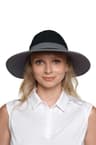
There is a middle option worth knowing about: a wide-brim visor, which is what our value pick is. You get much of the face-and-neck shading of a booney with the open crown of a visor. It is still the scalp you are trading away.
The chin strap is a fall-prevention feature
This sounds like an overstatement until you have watched it happen. A gust takes somebody’s hat off mid-game; they turn, backpedal and grab for it. Walking backwards with your eyes and hands up is the exact movement pattern that puts an older player on the ground, and ground-level falls are the largest single injury category in senior pickleball — they account for 56.1 percent of pickleball injuries in patients aged 60 and over. We make the full argument in how to prevent pickleball injuries.
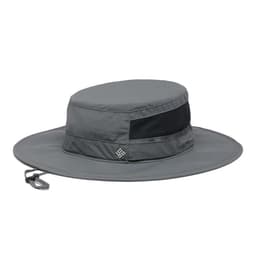
Which is why retention is third on our list rather than last. The Columbia publishes an adjustable chin strap plus a draw cord and toggle. The Coolibar has an elastic drawcord at the back of the crown and no chin strap, which is a genuine mark against it given it also has the widest brim here to catch wind. The MISSION visor publishes a no-slip band, which solves the creeping-up-the-forehead problem but not the blowing-off one.
Sun protection does not stop at your head
Two gaps that a hat leaves wide open, and both have their own page on this site.
Your eyes. The CDC notes that over time too much UV exposure can cause skin cancer and cancer of the eye, and recommends sunglasses that wrap around and block both UVA and UVB. On a pickleball court there is a second, more immediate reason for eyewear that has nothing to do with UV: ball and paddle strikes. Our pickleball eye protection ranking sorts protectors by whether the maker claims ASTM F803, the racket-sport impact standard, and the published eye-injury data explains why players over 50 are the larger group in the emergency-room figures.
Your arms and the back of your paddle hand.The Foundation’s advice is to choose long sleeves “whenever possible,” which is awkward advice in July. A UPF sleeve is the compromise, and the back of the paddle hand is the patch nobody manages to protect because sunscreen sweats straight off it. Our pickleball arm sleeve ranking covers both, including the only sleeve we found that covers any part of the hand.
What we would buy, in one paragraph
For most players, the Columbia Bora Bora Booney— UPF 50 on the solid fabric, a wicking sweatband and mesh to keep it bearable, and a chin strap so it stays on your head. If sun damage is a live medical issue for you rather than an abstraction, pay for the Coolibar Matchplay: 4 inches of brim at the front and 3 at the sides, tested-and-verified UPF 50+, and the Skin Cancer Foundation’s Seal of Recommendation — the only third-party check in this category. If heat is the reason you stop wearing hats, the MISSION Cooling Stretchy Visor publishes both a UPF 50 rating and the no-slip band, and you accept an unshaded scalp as the price. And if you want a wide brim with an open crown for the cost of a sleeve of balls, the Sukeen wide-brim visoris the one to leave in the car for the day you forget the good hat. Whatever you buy, add sunscreen for the reflected light coming up off the concrete — no brim reaches that. Nothing here was tested by us and nothing here is medical advice. Our methodology is here.