The back of your hand is the gap nobody closes
Start here, because it is the argument this page exists to make and almost nothing written about pickleball apparel mentions it.
Think about where your paddle hand spends a session. It is held out in front of you, knuckles up, in direct sun, for every rally you play. It cannot be shaded by a hat. Sunscreen applied to it at 7:45 is largely gone by the second game, because that is the surface doing the most sweating and the most contact with a grip. And it is one of the sites where sun damage on an older hand shows up most visibly.
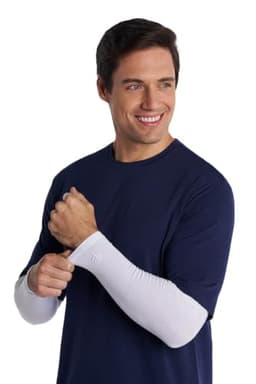
Now look at what the category offers. The Skin Cancer Foundation’s clothing guidance says to choose long sleeves “whenever possible” — and does not mention the hands at all. Coolibar, the best-specified maker here, publishes open cuffson both the men’s and women’s Navagio, and states its own limit in its own words: its fabrics are effective UV protectants for covered areas only. Of the five picks on this page, one covers any part of the hand — the beister, with a published thumb-hole design and half-hand coverage.
That is a crude fix. The fingers and palm are still exposed, and a layer of fabric across the back of your hand sits right next to your grip, so try it in a practice session before a league night. But it is the only fix on offer, it costs about what an overgrip costs, and the gap it closes is real. If you buy one thing off this page on medical grounds, consider buying the Coolibar for your arms and the beister for the days the sun is high.
What the sleeve is replacing, and why that is not nothing
The temptation is to dismiss a sun sleeve as fussy. The numbers argue otherwise. An ordinary white T-shirt measures about UPF 7 when dry and UPF 3 when wet, per the Skin Cancer Foundation — so the short-sleeved shirt you play in offers your upper arms roughly a twentieth of a UPF 50 fabric’s protection, and less once you are sweating. Below the shirt line, your forearms have nothing at all.
The same source explains why: protection is driven by weave density and color. Dark or bright colors absorb UV rather than letting it through, and densely woven cloth beats sheer — which is why a dark long-sleeved denim shirt measures about UPF 1,700 and a thin pale tee measures 7. A purpose-built sleeve is an engineered version of the denim shirt that you can wear in August.
And remember where you are standing. The CDC notes that UV “reflect[s] off of surfaces like water, cement, sand, and snow”. An outdoor court is acrylic over concrete: pale, hard and reflective. A sleeve covers your forearm from both the sky and the slab, which a hat brim cannot do. The CDC also puts peak UV at 10 a.m. to 4 p.m. and advises precautions whenever the UV Index is 3 or higher, including on cloudy days.
Sizing: the spec that decides whether you keep wearing it
The single most common complaint about arm sleeves has nothing to do with UV. It is that they slide down. A sleeve at your elbow instead of your bicep protects half of what you paid for and annoys you into abandoning it.
The spec that predicts this is the bicep opening, and Coolibar is the only maker here that publishes one. The figures are worth printing because they show how different the two cuts are:
- Men’s Navagio— length 17¼ in (S/M), 17¾ in (L/XL), 18 in (XXL); bicep openings 5–6 in, wrist openings 3–4 in.
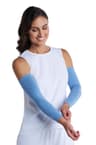
- Women’s Navagio— length 15 in (XS), 15½ in (S/M), 16½ in (L/XL); bicep openings about 4⅜–4⅞ in, wrist openings about 3⅛–3⅝ in.
Those are not the same garment in two colors. The women’s cut is up to three inches shorter and over an inch narrower at the bicep, which is exactly why it gets its own entry here rather than a footnote. Take a tape measure to your own upper arm before you order either one — and note that reviewer opinion on Coolibar’s sizing is mixed, which we would rather tell you than hide.
For the three cheaper sleeves, no length and no circumference is published anywhere we could find. The ROCK TAKIN at least claims a “plus-size fit” and “non-slip,” which is two more relevant words than most listings manage — but a claim is not a measurement, and we have recorded it as a claim.
If you want compression, you are on the wrong page
This needs saying because the search term blurs two products together.
A graduated compressiongarment states a pressure in mmHg, is tighter at one end than the other, and does a circulation job. Cleveland Clinic publishes the bands — mild 8–15, moderate 15–20, firm 20–30 mmHg — and our compression socks for pickleball page ranks entirely on that figure, because sock makers print it.
Not one arm sleeve we found publishes a mmHg figure, including the ones sold as “compression sleeves.” So when a sleeve listing says compression, treat it as meaning “snug,” which is a fit description rather than a specification. We have put “Not published” in that row for all five picks, and the uniformity of that column is the finding.
Three places to go instead, depending on what you actually want:
- Pressure on the lower leg for swelling. That is a published-mmHg purchase and it exists: compression socks.
- Support for a painful elbow.That is a counterforce strap or a sized sleeve, not a sun sleeve — see best pickleball elbow braces and elbow strap vs elbow sleeve, which explains why those two products are not interchangeable.
- Padding for the knock when you go down. That is the McDavid Hex Shooter at the bottom of this page, which publishes hex padding and noUPF rating at all — it fails this page’s own gate, and it is here because it honestly answers a different question.
The small benefit we will claim, and the one we will not
Will claim: a thin layer over the forearm keeps the muscle warmer between rallies. On a 50-degree morning that is a real comfort difference for an older arm, and a warm forearm is a more compliant one at the first hard drive of the day. That is ordinary physiology, not a product claim, and it is why some players wear a sleeve in spring and fall for reasons unrelated to the sun.
Will not claim:that a sleeve does anything for tennis elbow, grip strength, recovery or performance. No maker on this page publishes a figure for any of that, we have measured nothing, and the honest answer to “will a sleeve help my sore elbow” is that the equipment lever for a sore elbow is the paddle handle and the core — see best pickleball paddles for tennis elbow and best pickleball grips for tennis elbow. A sleeve is shade with sleeves on.
What we would buy, in one paragraph
For a tested number and a published spec table, the Coolibar Navagioin the cut that matches your arm — men’s at 17¼–18 in with a 5–6 in bicep opening, women’s at 15–16½ in with roughly a 4⅜–4⅞ in opening. For the gap every other sleeve leaves open, the beister thumb-hole sleeve, which is the only hand coverage in this category and costs about what an overgrip does. For everyday use where the real obstacle is having a clean dry pair at 7:30 in the morning, the ROCK TAKIN three-pack, which publishes non-slip and plus-size fit. And if you are honestly shopping for padding over the elbow and forearm rather than sun protection, the McDavid Hex Shooter— which publishes hex padding and no UPF rating, and which we would not let you buy under the impression it is sun protection. Pair any of them with a hat; our pickleball hats and visors ranking is the other half of this problem. Nothing here was tested by us. Our methodology is here.