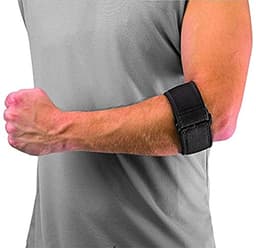
Strap vs sleeve, side by side
Every row below is read from what the makers and listings publish about these four products — the type, the support mechanism and the sizing — not from a test we ran.
| | Counterforce strap | Compression sleeve |
|---|
| Where it sits | 1-2 in below the elbow, on the forearm muscle | Over the elbow joint itself |
|---|
| What it does | Diverts grip load away from the tendon attachment | Warmth, even compression, position awareness |
|---|
| Best for | Pain that appears during and after play | A dull ache present all day, chronic cases |
|---|
| Wear it | For games and gripping tasks; take it off after | Through the day, including off-court hours |
|---|
| Sizing | Usually one size adjustable (Mueller) or a wide range — Sleeve Stars publishes 9-23 in forearm | Measured sizes — Bauerfeind publishes numbered sizes 1-6 |
|---|
| Typical cost | Lowest on this page | Highest on this page |
|---|
| Main complaint | Pressure over bare skin; needs repositioning | Warm in summer; does nothing for a sharp on-contact catch |
|---|
How to fit a strap, because most people get it wrong
A strap positioned badly feels like a strap that does not work. Three things decide it:
- Position. Find the bony bump on the outside of your elbow. The strap goes roughly two finger-widths down your forearmfrom it, over the muscle bulk — never on the bump itself. If it is sitting on bone, it is too high.
- Tension, set with the muscle flexed.Make a loose fist and bend your wrist back, so the muscle is engaged, then tighten the strap. Tightened on a relaxed arm it will be too loose during play and too tight at rest. Snug, not numbing — fingers should never tingle.
- The pad faces the sore side. On the Mueller, the gel pad is the working part; it goes over the outside of the forearm, in line with the pain. A pad rotated round to the inside of the arm is decoration.
And take it off between sessions. A counterforce strap is a tool for loaded activity, not a bandage. Wearing one around the clock gives you the one thing it is genuinely bad at — constant pressure on the forearm — and none of the benefit of a sleeve.
Which one if you only buy one?
For a pickleball player specifically: the strap. The reason is simply that the activity is the trigger. If your elbow is sore because of what a paddle does to your forearm — and for most players over 55 it is — the hours that need help are the hours you are gripping the handle, and that is the window a strap addresses. It is also the cheaper experiment. CAMBIVO sells its strap in a two-pack for a few dollars, which makes finding out whether a strap helps you at all a near-free test; if it does, step up to the Mueller gel pad, and if it does not, you have learned something useful before spending $100 on a knitted support.
Buy the sleeve first in one specific case: when the elbow hurts independently of pickleball. A dull morning ache, stiffness that eases after you move, pain lifting a full kettle — that is a chronic tendon problem that a load-diverter worn for two hours a day will barely touch. Bauerfeind’s EpiTrain is the proper version of that product, sized 1-6 on a forearm measurement rather than sold one-size, and it is the one place on this page where paying three figures is defensible.
And if you want both without buying twice, that is what the Mueller Hg80 is: a compression sleeve with a counterforce element built into it. It is the pick for people who have tried a bare strap and found the pressure on skin unbearable, which is a more common complaint than the product reviews suggest.
What neither of them fixes
A support manages a symptom. The paddle in your hand is upstream of it, and for pickleball the three changes that actually reduce tendon load are a bigger grip (so you stop squeezing to stop the paddle twisting), a thicker core (so less shock arrives in the first place) and a shorter swing. Our best paddles for tennis elbow page is built around the first two, 16 mm paddles covers the core, and an overgrip is the cheapest way to add a sixteenth of an inch to a grip you already own. If the pain is in the wrist rather than the elbow, wrist supports is the right page, and best tennis elbow braces is the full roundup this page sits beside.
The ordinary medical caveat applies and is not boilerplate here: an elbow that is swollen, that hurts at night, that is weak rather than sore, or that has not improved in several weeks is a conversation with a doctor, not a purchase. We have examined nobody and own none of these supports — here is exactly what we do and do not do.