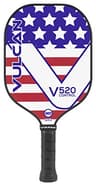
Grip size matters more here than anywhere else
If you have smaller hands, this is the spec to get right and the one most likely to be wrong on a paddle bought off a shelf. A handle that’s too thick for your hand means your fingers can’t wrap far enough to control it, so you compensate with pressure — and squeezing is what leaves a hand aching and keeps pulling on the tendons behind tennis elbow.
The frustrating part is that most paddle makers don’t publish a grip circumference at all, which is why so many of the cells in our spec tables read “Not published.” A few do — the Niupipo publishes a 4.8-inch grip length, which is unusually forthcoming — but for the rest you are buying on feel. The practical answer is to buy the thinner option when in doubt, because you can always add an overgrip to build a handle up by half a size, and you can never take material away. Our grip-size guide has a thirty-second measurement you can do at home.
Why we rank weight above almost everything
Every ounce in the paddle head has to be accelerated and then stopped by your wrist, forearm and shoulder, hundreds of times a session. If your grip strength isn’t what it was, a heavy paddle doesn’t just tire you — it starts controlling you, arriving late and pulling you off balance at the end of a swing. That’s a comfort problem and a balance problem at the same time.
A lighter, standard-shape paddle keeps its weight close to your hand, which makes it quicker to bring up at the kitchen line and far less demanding to stop. You give up some power. For the vast majority of recreational play over 55, that trade is straightforwardly worth making — placement wins points at this level, not pace, as our senior strategy guide argues at length.
The fracture-risk point, said plainly
Emergency-department research on pickleball injuries in adults 60 and over is consistent on two things: falls are the dominant injury mechanism, and women are markedly more likely than men to end up with a fracture when one happens. That is not a reason to avoid the sport — the health case for playing is strong and we make it at length in our pillar guide. It is a reason to weight your equipment choices toward staying balanced.
In practice that means three things: a paddle light enough that it never pulls you through a swing, proper court shoes with real lateral grip rather than running shoes, and a habit of taking the ball early instead of backing up for overheads. The paddle is the cheapest of those to fix and the one most people get wrong first.
What about “women’s” paddles specifically?
Some brands do market paddles at women, and a few of those genuinely come with a slimmer grip circumference or a lower stock weight — which is useful, and the reason to check. But plenty are the standard paddle in a different colorway at the same price, and a few are the standard paddle in a different colorway at a higher price. Buy the spec, not the marketing: a light paddle with a handle you can wrap your fingers around is the right paddle regardless of who the box was aimed at.