Kitchen & Court

Best Pickleball Paddles for Shoulder Pain

A sore shoulder feels swing weight, not paddle weight — so these are ranked on the published ounces and the length of the paddle, shortest and lightest first, with the overhead habit to break.

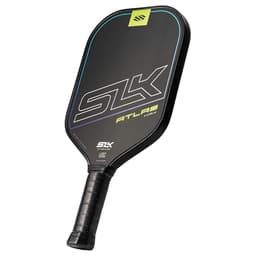
Selkirk SLK Atlas Max

Our pick

Selkirk SLK Atlas Max

A published 7.6-8.1 oz on a 16-inch widebody with a short 4.85 in handle, so the mass sits close to your hand and the swing stays light — and a 16 mm core that soaks up the ball instead of sending it up your arm. The most complete spec sheet under $100, from a maker that prints the number most of the market hides.

$63.99 · View on Amazon

$79.9920% off

Price as of September 17, 2026. #ad How we’re funded

Read the full write-up
By Stephen V.Last updated How we research

Shoulder pain is the pickleball complaint nobody sells a paddle for, which is odd, because the shoulder is the joint that does the most work in the one shot this sport is famous for. The American Academy of Orthopaedic Surgeons describes most rotator cuff trouble as wear that accumulates slowly rather than a single injury, puts people over 40 at greater risk, and names repetitive shoulder motion — with tennis specifically on the list — as the thing that stresses the cuff. Pickleball’s version of that motion is the overhead: the smash, the put-away, the lob you chase down and swing at from above your head, twenty or thirty times a morning.

A paddle cannot fix a shoulder. What it can do is change how much work each swing asks of it, and the number that matters is not the weight on the box but the swing weight: how heavy the paddle feels moving through the air, which rises with every ounce and rises faster the further that ounce sits from your hand. A long, head-heavy paddle is the worst case. So this list is ranked on two published figures — weight and length — shortest and lightest first, and any paddle whose maker will not print a weight had to earn its place another way. Then we cover the part that matters more than any paddle: which shots to let bounce.

How this is funded: we earn a commission if you buy through our links, at no extra cost to you. It never changes which product we recommend, and we’ll tell you plainly when to skip one. Full disclosure.

Quick picks

Ranked on published specs, grip and build, and honest buyer fit. Select a row to jump to the full write-up. We have not lab-tested these — here is exactly what we do instead.

#ProductBest forPrice
1
Selkirk SLK Atlas Max

Selkirk SLK Atlas Max

The paddle that makes the sub-$100 argument all by itself. A carbon-fiber face over a 16mm polymer honeycomb core is the same recipe premium comfort paddles use, and Selkirk publishes the whole spec sheet - weight range, grip circumference, handle length - which almost nothing else at this price will do. If you want one paddle under $100 and you want it to feel muted rather than tinny, start here.

Best overall — light, short, published
$63.99 · View on Amazon

$79.9920% off

Price as of September 17, 2026. #ad How we’re funded

2
Onix Graphite Z5 MOD

Onix Graphite Z5 MOD

The widebody. At 8.125 inches across it has the broadest face here, which is simply more paddle to hit the ball with - the most forgiving shape on the list for anyone whose contact has become less reliable. It is also the one with the firmest core, so it suits a player chasing forgiveness more than a player chasing softness.

Shortest paddle, lightest published floor
$63.09 · View on Amazon

Price as of September 17, 2026. #ad How we’re funded

3
Paddletek Bantam EX-L

Paddletek Bantam EX-L

A long-running paddle from an established American maker, and the most settled reputation on this list. Paddletek publishes its weight range and handle length, the Bantam PolyCore is a proper polymer honeycomb, and the standard 16 x 8-inch shape keeps the weight close to your hand rather than out at the tip. It is the closest thing under $100 to buying a serious club player's paddle.

Best standard shape, established brand
$89.99 · View on Amazon

$99.9910% off

Price as of September 17, 2026. #ad How we’re funded

4
Franklin Sports Signature Series Pro 16mm

Franklin Sports Signature Series Pro 16mm

The one on this list built for a hand that hurts. Its published grip circumference is 4.5 inches - the largest we found on any paddle under $100 - and a larger grip is what lets an arthritic hand hold the paddle loosely instead of squeezing it. Add a 16 mm polypropylene core and USA Pickleball approval and that is a lot of comfort for the money.

Best big grip (elongated — read the note)
$64.85 · View on Amazon

Price as of September 17, 2026. #ad How we’re funded

5
ProKennex Ovation Speed II

ProKennex Ovation Speed II

ProKennex built its whole reputation on arm comfort, and the Ovation Speed II is the clearest expression of it — a Toray carbon face and the brand's cushioned Comfort Pro grip, aimed squarely at players whose elbow or wrist flares up. If a paddle has ever left your arm sore, this is the brand to try first.

Best if the elbow hurts too
$159.99 · View on Amazon

Price as of September 17, 2026. #ad How we’re funded

The picks in full

#1Best overall — light, short, published

Selkirk SLK Atlas Max

The paddle that makes the sub-$100 argument all by itself. A carbon-fiber face over a 16mm polymer honeycomb core is the same recipe premium comfort paddles use, and Selkirk publishes the whole spec sheet - weight range, grip circumference, handle length - which almost nothing else at this price will do. If you want one paddle under $100 and you want it to feel muted rather than tinny, start here.

Easier on the joints: A 16 mm core is the thickest, softest construction in common use, and it does the single most important job for a sore elbow: it slows the impact down. Pair that with a carbon face, which returns a duller, more predictable ball than fiberglass, and you get about the least jarring feel available under $100.

What we like

  • 16 mm Rev-Control polymer honeycomb core - the thick, soft kind that muffles impact
  • Carbon-fiber face gives a muted, predictable response instead of a lively fiberglass ping
  • Selkirk publishes weight, grip circumference and handle length - rare at this price

Skip it if

  • The 4.85-inch handle is short - no room for a two-handed backhand and little to choke up on
  • Selkirk's own product page does not state USA Pickleball approval, so we do not claim it
  • The 4.25-inch grip is fine for most hands but on the small side for arthritic fingers
Face materialRaw carbon fiber (Raw Spin Technology)
Core16 mm Rev-Control polymer honeycomb
Weight7.6-8.1 oz (published range)
Grip circumference4.25 in
Handle length4.85 in
ShapeMax (widebody)
Dimensions16 x 7.85 in
Edge guardEdgeSentry (low-profile)
USA Pickleball approvedNot published

Specs read from the product listing, on September 15, 2026. “Not published” means the maker does not state that figure.

#2Shortest paddle, lightest published floor

Onix Graphite Z5 MOD

The widebody. At 8.125 inches across it has the broadest face here, which is simply more paddle to hit the ball with - the most forgiving shape on the list for anyone whose contact has become less reliable. It is also the one with the firmest core, so it suits a player chasing forgiveness more than a player chasing softness.

Easier on the joints: A wider face means more centered hits, and a centered hit sends far less jarring shock up your arm than a mis-hit off the edge. The trade is the Nomex core, which is stiffer than polymer - so this is the forgiving-shape pick rather than the soft-feel pick.

What we like

  • 8.125-inch widebody face - the largest hitting area of any pick here
  • Onix publishes the full spec sheet and states USA Pickleball approval
  • Perforated cushion grip fitted from the factory

Skip it if

  • Nomex core is the hardest, loudest core type here - more feedback into the arm than polymer
  • 4-inch grip circumference is the smallest on this list, so arthritic hands will want an overgrip or two
  • The wide shape trades reach for forgiveness - less help stretching for a ball at the kitchen line
Face materialGraphite
CoreNomex honeycomb
Weight7.5-8.2 oz (published range)
Grip circumference4 in
Handle length5 in
Dimensions15.5 x 8.125 in (widebody)
USA Pickleball approvedYes

Specs read from the product listing, on August 24, 2026. “Not published” means the maker does not state that figure.

#3Best standard shape, established brand

Paddletek Bantam EX-L

A long-running paddle from an established American maker, and the most settled reputation on this list. Paddletek publishes its weight range and handle length, the Bantam PolyCore is a proper polymer honeycomb, and the standard 16 x 8-inch shape keeps the weight close to your hand rather than out at the tip. It is the closest thing under $100 to buying a serious club player's paddle.

Easier on the joints: A standard 16 x 8-inch shape carries its weight close to the handle rather than out at the tip, so it feels lighter to swing than the number suggests - and that balance matters more to a sore wrist than the raw ounces do.

What we like

  • Established brand with a long production history behind this exact model
  • Bantam PolyCore polymer honeycomb core, not a cheap stiff core
  • Standard 16 x 8-inch shape keeps weight near the hand - easier on the wrist than an elongated paddle

Skip it if

  • 7.8-8.4 oz is the heaviest published range on this list
  • The 12.7 mm core is thinner than the 16 mm picks, so the feel is firmer
  • Paddletek does not publish a grip circumference
Face materialPolycarbonate (per listing)
Core12.7 mm Bantam PolyCore honeycomb
Weight7.8-8.4 oz (published range)
Grip circumferenceNot published
Handle length5 in
Dimensions16 x 8 in (standard)
USA Pickleball approvedYes (per listing)

Specs read from the product listing, on August 24, 2026. “Not published” means the maker does not state that figure.

#4Best big grip (elongated — read the note)

Franklin Sports Signature Series Pro 16mm

The one on this list built for a hand that hurts. Its published grip circumference is 4.5 inches - the largest we found on any paddle under $100 - and a larger grip is what lets an arthritic hand hold the paddle loosely instead of squeezing it. Add a 16 mm polypropylene core and USA Pickleball approval and that is a lot of comfort for the money.

Easier on the joints: Grip size is the one paddle spec that changes how hard your hand has to work, and a too-small grip is the classic self-inflicted cause of hand and elbow pain. At 4.5 inches this is the rare affordable paddle you can hold loosely without building it up with overgrips first.

What we like

  • 4.5-inch grip circumference - the largest published grip in this price range
  • 16 mm polypropylene honeycomb core for a soft, stable, quiet feel
  • USA Pickleball approved, so it is legal for club and tournament play

Skip it if

  • At 7.9-8.3 oz it is one of the heavier paddles here - not the pick for a weak wrist
  • That 4.5-inch grip is genuinely large; smaller hands will find it a stretch
  • The fiberglass face is livelier than carbon, so it transmits a little more feel
Face materialMaxGrit coated fiberglass
Core16 mm polypropylene honeycomb
Weight7.9-8.3 oz (published range)
Grip circumference4.5 in (large)
Handle length5.6 in
Dimensions16.5 x 7.5 in
USA Pickleball approvedYes

Specs read from the product listing, on August 24, 2026. “Not published” means the maker does not state that figure.

#5Best if the elbow hurts too

ProKennex Ovation Speed II

ProKennex built its whole reputation on arm comfort, and the Ovation Speed II is the clearest expression of it — a Toray carbon face and the brand's cushioned Comfort Pro grip, aimed squarely at players whose elbow or wrist flares up. If a paddle has ever left your arm sore, this is the brand to try first.

Easier on the joints: ProKennex designs its comfort line around vibration control, and pairs it with an extra-cushioned grip — the two things that most reduce the shock and squeeze your elbow and hand feel on every hit.

What we like

  • Toray T700 carbon-fiber face — a controlled, muted feel rather than a harsh pop
  • Cushioned Comfort Pro grip takes pressure off the palm and fingers
  • ProKennex is the brand arm-sensitive players reach for — that following is real

Skip it if

  • Among the pricier paddles here for its category
  • Exact weight and grip circumference are not published on the listing
Face materialToray T700 carbon fiber
CoreNot published
GripComfort Pro (cushioned)
WeightNot published
USA Pickleball approvedYes (per listing)

Specs read from the product listing, on July 22, 2026. “Not published” means the maker does not state that figure.

What a sore shoulder actually feels in a paddle

Two things, and neither is the total weight. The first is swing weight, which is the resistance you feel starting and stopping the paddle. Push the mass toward the head — an elongated shape, a long handle balancing a long face, lead tape on the tip — and the same eight ounces feels heavier through every swing, because your shoulder is moving that mass through a longer arc. The second is what happens at contact: a stiff face on a thin core sends more of the ball’s energy back into the paddle, and some of that reaches the shoulder as a jolt, especially on the overhead where the arm is extended and the cuff is doing the stabilizing.

So the profile of a shoulder-friendly paddle is: as light as the maker will admit to, as short as you can tolerate, mass kept close to the hand, and a thick core. USA Pickleball’s equipment rules set no minimum or maximum weight, which is why makers are free not to publish one; on this site, a maker that prints the number is ranked above one that does not, because you cannot manage what nobody will tell you.

The picks, in order

Selkirk SLK Atlas Max. Selkirk publishes 7.6-8.1 oz, a 16-inch widebody at 7.85 in wide, a 4.85 in handle and a 16 mm Rev-Control core. Short handle, wide face, mass in close, soft core: it is the profile above, written as a spec sheet, at a price that undercuts most of the paddles that publish nothing. The widebody shape also gives a large sweet spot, which matters for a shoulder, because a mis-hit off the edge is the most jarring contact there is. Full write-up in the Atlas Max review.

Onix Graphite Z5 MOD. The shortest paddle on this page at 15.5 inches, the widest at 8.125, and the lightest published floor at 7.5-8.2 oz. In swing-weight terms, that is about as friendly as a paddle gets. The honest trade is the Nomex core, which is the firm, loud kind — more feedback into the arm at contact than a polymer core — so this is the pick for a shoulder that hurts on the swing rather than one that hurts on impact. Its 4-inch grip is also the smallest here; build it up with an overgrip if your hands are large.

Paddletek Bantam EX-L. A 16 x 8 standard shape with a 5-inch handle and a published 7.8-8.4 oz, from a brand that has been making paddles for a long time. The 12.7 mm PolyCore is thinner than the Selkirk’s, so there is a little more pop and a little less absorption, but the mass stays close to the hand. The pick for a player who wants an established name and a classic shape.

Franklin Signature Pro 16mm. Here for one specific shoulder: the one attached to an arthritic hand. Its 4.5 in grip is the largest published on the site, and a grip you do not have to clench relaxes the whole arm. It publishes 7.9-8.3 oz and a 16 mm core, both good. The caveat is real: at 16.5 inches long with a 5.6 in handle it is the most elongated paddle here, and elongated is the wrong direction for swing weight. If your shoulder is the only problem, choose one of the three above.

ProKennex Ovation Speed II. ProKennex does not publish a weight, which on this page is a strike against it. It is here because the brand built its reputation on arm comfort — vibration control and a cushioned Comfort Pro grip — and because shoulder pain very often travels with tennis elbow in the same arm. If you have both, the contact-shock half of the problem is the one ProKennex addresses. The Black Ace is the same idea at a lower price.

The overhead: the shot to give up, or at least ration

This is the section that will do more for your shoulder than any paddle on the page. The overhead smash is a tennis reflex, it is the single most shoulder-loading motion in pickleball, and in the recreational game it is usually unnecessary. A lob over your head at the kitchen line will, most of the time, land in and bounce — and a ball that has bounced can be hit at waist height with a compact swing. Let more of them bounce. Your partner, who is often better placed for it, can take the rest.

AAOS’s first two nonsurgical steps for a sore cuff are rest, meaning limiting overhead activity, and activity modification, meaning avoiding the things that hurt. For a pickleball player those two steps are the same instruction. The third is physical therapy for strength and flexibility, which for most people means a short daily routine of external-rotation and scapular work — something a therapist can set up in one visit and that our warm-up guide touches on for the pre-game part.

Three smaller changes

  • Serve underhand, genuinely. The rules require it, but a lot of players turn the serve into a shoulder-driven swing. Let the arm hang and swing from the elbow and wrist.
  • Take the paddle back less. A pickleball swing is a block and a push far more than a tennis stroke. The shorter the backswing, the less the shoulder travels, and the ball is light enough that you lose nothing.
  • Do not add weight to the head. Lead tape at the tip is a popular power tweak and it is exactly the wrong thing for a sore shoulder — it raises swing weight more than the same tape anywhere else on the paddle. If you want to add weight at all, add it at the throat or handle.

When it is not a paddle problem

AAOS lists pain at rest and at night lying on the affected shoulder, pain lifting or lowering the arm, and weakness when lifting or rotating it as the symptoms of a cuff tear, and a sudden tear tends to arrive as intense pain with immediate weakness. Those are doctor symptoms, not shopping symptoms. A shoulder that is merely tired after a long session and fine the next day is the one this page can help with. Nothing here is medical advice; every spec above is the maker’s own published figure or marked as not published; every price is checked daily and stamped with the date; and we have not tested these paddles.
Frequently asked questions

What kind of pickleball paddle is best for shoulder pain?

A light, short one with the mass kept close to the hand and a thick core — because a sore shoulder feels swing weight, not scale weight. Look for a published weight under about 8 oz, a standard or widebody shape rather than an elongated one, a short handle and a 16 mm polymer core. Our top pick is the Selkirk SLK Atlas Max: a published 7.6-8.1 oz, 16 inches long with a 4.85 in handle and a 16 mm core. The Onix Z5 MOD is even shorter and lighter at the floor of its range but has a firmer core.

Does a lighter paddle help a rotator cuff?

It helps the swing, which is where a cuff does its work. Every ounce you remove lowers the swing weight, and an ounce removed from the head of the paddle lowers it more than an ounce removed from the handle. AAOS describes most rotator cuff problems as slow wear from repetitive shoulder motion, and its first nonsurgical steps are limiting overhead activity and avoiding what hurts — so a lighter paddle helps, but rationing overheads helps more.

Should I avoid elongated paddles with a sore shoulder?

As a rule, yes. An elongated shape moves mass away from your hand, which raises swing weight even when the total weight is unchanged, and that is what a shoulder feels on every swing and especially on an overhead. The one elongated paddle on this page, the Franklin Signature Pro, is there for its 4.5 in grip — for an arthritic hand whose clenching is loading the whole arm — and we say to skip it if the shoulder is your only problem.

Can pickleball cause a rotator cuff injury?

AAOS names repetitive shoulder motion as a stress on the rotator cuff and lists tennis among the sports that carry an overuse risk; it does not name pickleball, and we found no pickleball-specific study on cuff injury. The overhead smash is the pickleball motion that most resembles the tennis serve and overhead, so the honest answer is that the repeated overhead is the part of the sport to be careful with, particularly over 40. Persistent pain, night pain or weakness need a doctor.

Why is the ProKennex on this list if it doesn't publish a weight?

Because shoulder pain very often travels with tennis elbow in the same arm, and ProKennex built its reputation on the contact-shock half of that problem — vibration control and a cushioned grip. It is fifth, not first, precisely because the weight is unpublished. If your shoulder is the only joint complaining, the four paddles above it are the better buys.

Is it better to add weight to a paddle for a sore shoulder?

No. Added weight raises swing weight, and weight added at the tip raises it most — lead tape at the head is the single worst modification for a sore shoulder. If you want a more stable paddle, add a small amount at the throat or in the handle, where it changes the balance least, or choose a widebody shape whose larger sweet spot gives you stability without mass.

Sources

  • American Academy of Orthopaedic Surgeons (OrthoInfo) — Rotator Cuff TearsThe rotator cuff is four muscles whose tendons form a covering around the head of the humerus. 'Most tears are the result of a wearing down of the tendon that occurs slowly over time'; people over 40 are at greater risk, and blood supply to the tendons decreases with age. 'Repeating the same shoulder motions again and again can stress your rotator cuff muscles and tendons' — tennis, baseball, rowing and weightlifting are named as overuse risks, as is overhead work. Symptoms include pain at rest and at night lying on the shoulder, pain lifting or lowering the arm, and weakness. Nonsurgical care: rest and limiting overhead activity, activity modification, NSAIDs, physical therapy (strengthening and flexibility), steroid injection (accessed September 18, 2026)
  • USA Pickleball — Equipment Standards ManualThe manufacturing specifications and testing (including the PBCoR power test) paddles must meet to be approved (accessed July 22, 2026)
  • Non-fatal senior pickleball and tennis injuries in US EDs, 2010–2019 — Injury Epidemiology (2021)For players 60+: strains/sprains 31.0%, fractures 30.4%; the wrist is the single most-injured body part (13.2%); women 3.7x more likely to fracture (accessed July 22, 2026)
  • Selkirk Sport — SLK Atlas Max product page (manufacturer specifications)Selkirk publishes a full spec sheet: premium carbon fiber face with Raw Spin Technology, 16 mm Rev-Control polymer honeycomb core, 7.6-8.1 oz weight range, 4.25 in grip circumference, 4.85 in handle length, 16 in x 7.85 in, EdgeSentry low-profile edge guard, SLK Ultra-Comfort grip, skill level beginner-intermediate, 1-year limited warranty, designed and quality controlled in the USA and manufactured in China. No USA Pickleball approval statement appears anywhere on the page (accessed September 15, 2026)
  • Paddletek — Bantam EX-L product page (manufacturer specifications)Paddletek publishes: 7.8-8.4 oz weight range, 5 in handle length, a 'Standard - 16 x 8' shape, 12.7 mm core thickness, Bantam PolyCore interior, $89.99. Grip circumference, face material and USA Pickleball approval are not stated on the page (accessed September 18, 2026)

Keep reading