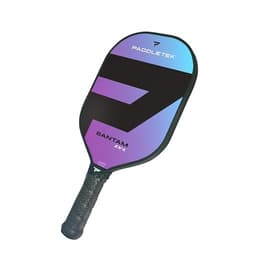
What the 16 x 8 inch face actually buys you
Start with the constraint nobody mentions. USA Pickleball caps the combined length and width of a paddle, including edge guard and butt cap, at 24 inches, with length alone capped at 17. A 16 x 8 paddle therefore sits exactly on the line: Paddletek has spent its entire allowance, and every alternative shape on the market is just a different way of dividing the same 24 inches.
So this is not a paddle that is bigger than the rules allow — no such thing exists — it is a paddle that has chosen the squarest possible split. Against a typical elongated paddle at 16.5 x 7.5 in (123.8 sq in), the EX-L gives you half an inch more width and 4.2 more square inches, and gives up half an inch of reach to get them.
For a 55+ recreational player that is usually the right trade, and here is why. The reach you lose matters on balls you had to stretch for. The width you gain matters on balls you already got to and hit slightly off-center — which, as reactions slow, is a much larger share of your shots. Stretching late is also how older players fall, and falls are the dominant injury category in senior pickleball (we set out the evidence in how to prevent pickleball injuries). A paddle that rewards staying balanced is doing more for you than one that rewards lunging.
One honest caveat on the word “sweet spot”: Paddletek does not publish one, and neither does anyone else, because no industry test produces a sweet-spot measurement. A wider face puts more material either side of center, so an off-center hit twists the paddle less. That is a real mechanical effect. It is not the same as a published number, and we are not going to invent one. We rank the whole field on this basis in pickleball paddles with the largest sweet spot.
The core, and the reason this is not our comfort pick
The Bantam EX-L runs a 12.7 mm Bantam PolyCore polymer honeycomb. Two things to say about that, one good and one not.
The good: it is a proper polypropylene honeycomb, not Nomex and not a cheap stiff filler. Polymer is the material that flexes on contact and swallows some of the impact before it reaches your hand. Against the Onix Graphite Z5 MOD, the only paddle we list with a wider face, the Paddletek is clearly the gentler construction — the Onix uses Nomex, the hardest and loudest core type in common use.
The not-good: 12.7 mm is thin by current standards. The paddles we recommend for a painful elbow are almost all 16 mm, and the extra three-odd millimeters is not a rounding error — a thicker core deforms further on contact, which spreads the impact over more time and sends less shock up the handle. Our 13 mm vs 16 mm guide walks through what that difference does. If your complaint is “my arm aches the day after,” this is the wrong paddle and we would rather say so on its own review page than sell you one.
The clean way to think about it: the EX-L is a contact paddle, not a comfort paddle. It helps you hit the ball cleanly. It does less than a 16 mm paddle to soften what you feel when you do.
Weight: 7.8 to 8.4 oz, published, and on the heavy side
Paddletek prints a 7.8–8.4 oz range, which deserves credit on its own — most paddle makers publish nothing at all, and roughly half of our registry has “Not published” in the weight cell. Knowing the range before you buy is worth something real.
What the range tells you is that this is one of the heavier paddles we list. The floor of 7.8 oz is where several lighter paddles finish, and the ceiling of 8.4 oz is near the top of the field. Two consequences for an older player:
- For a wrist or shoulder, that is a downside. Every ounce is mass you start and stop a few hundred times a session. If your limiting joint is above the elbow, go and read lightweight pickleball paddles before committing to this one.
- For an elbow, it is partly a plus.A heavier paddle absorbs more of the ball’s energy instead of being knocked back by it, so less of the hit is transmitted to your forearm. Weight is not a straightforwardly bad thing — our paddle weight guide explains which joints prefer which direction.
The mitigating factor is balance. A 16 x 8 standard shape carries its mass closer to the handle than an elongated paddle of the same weight, so an 8.1 oz EX-L swings lighter than an 8.1 oz elongated paddle does. Where the weight sits matters more than what the scale says, and this shape sits well.
The spec Paddletek will not print
Grip circumference.It is not on the product page and it is not on the listing, so our spec table says “Not published” rather than guessing. Paddletek does publish a 5-inch handle length, which is a useful number — it is long enough to choke up on and just about long enough for a two-handed backhand — but handle length is not handle thickness, and the thickness is what your hand feels.
For most buyers this is a minor annoyance. For an arthritic hand it is not, because grip circumference is the single most important paddle spec for a painful hand: a grip that is too small makes you clench, and clenching is what inflames a thumb joint, a wrist and eventually an elbow. If that describes you, you have two sane options. Buy a paddle that publishes the number — the Franklin Signature Series Pro 16mm prints a 4.5-inch large grip and pairs it with a 16 mm core — or buy the EX-L and plan on building the handle up, which costs under $15 and takes ten minutes. Each wrap of overgrip adds roughly a sixteenth of an inch of circumference; our guide to wrapping a paddle grip covers how to deliberately build one out, and how to measure your grip size tells you what you are aiming for.
Who should buy it
- Players catching the ball off-center. If your miss-pattern is edge contacts rather than mistimed swings, the largest face on the market is the most direct fix available, and it works the day it arrives.
- Buyers who want an established maker. Paddletek has a long production history with this exact model. You are not buying a marketplace brand that will be a different paddle under the same name next year.
- Players who want reach kept near the hand. A 16 x 8 standard shape with a 5-inch handle is a balanced, predictable thing to swing.
- Anyone who values a published spec sheet. Weight range, handle length, dimensions and core thickness are all printed. That is more than most.
Who should buy something else
If your elbow hurts, buy a 16 mm core instead. The Selkirk SLK Atlas Max is 16 x 7.85 in — only two and a half square inches smaller — with a 16 mm Rev-Control polymer core and a published 4.25-inch grip, and it usually costs less. That is the trade we would make for a sore arm, and we say so on best pickleball paddles for tennis elbow as well.
If your wrist or shoulder is the problem, the 7.8–8.4 oz range is heavier than you want. Start with our paddles for wrist pain ranking instead.
If you need a known grip size today, buy a paddle that publishes one rather than planning a rewrap.
If the budget is tight, the HEAD Extreme Elitepublishes a 16 x 7.875 in face — two square inches smaller than the EX-L — at roughly a quarter of the price. It gives up the published core thickness and the brand pedigree, and for a first paddle that may not matter to you.
How it compares
Against the Onix Graphite Z5 MOD: the Onix is wider (8.125 in against 8.0) but shorter, so its total area is fractionally smaller, and its Nomex core is markedly harsher. The Paddletek is the better paddle for an older arm; the Onix is the one to pick if raw width is all you care about.
Against the Selkirk SLK Atlas Max: nearly the same face area, a much softer core, a published grip, and usually a lower price. On paper the Selkirk wins for this site’s reader. What the Paddletek has is the larger face, the longer handle (5 in against Selkirk’s 4.85) and a production record measured in years rather than seasons.
Against the elongated field — the JOOLA Ben Johns Hyperion CAS 16, the Franklin Signature Pro, the Selkirk SLK Halo — it is a straight philosophical split. They spent their 24 inches on reach and spin; Paddletek spent it on not missing. If you are reading a page about paddles for seniors, that is usually the better spend.
The verdict
The Bantam EX-L is the clearest forgiveness buy in our registry, and it earns that on a published number rather than a marketing claim: 16 x 8 inches, 128 square inches, the biggest face we can evidence. Paired with a polymer core, a published weight range and a five-inch handle from a maker with real history, it is an easy recommendation for a player whose contact has become the weak link.
It is not the paddle for a painful elbow, because 12.7 mm of core is less than the field now offers and the thickness is the part that protects your arm. And it is not a confident buy for an arthritic hand until you have decided how you will build the handle up, because Paddletek will not tell you how thick it is. Both of those are solvable or avoidable; neither is hidden. Nothing here was tested by us, nothing here is medical advice, and every specification on this page is Paddletek’s own.