Kitchen & Court

Pickleball Paddles With the Largest Sweet Spot

No maker publishes a measured sweet spot, so we rank on the number they do publish - face width - and on whether the core behind it is soft enough for you to feel the difference.

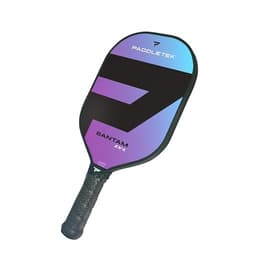
Paddletek Bantam EX-L

Our pick

Paddletek Bantam EX-L

The only paddle we list that measures a full 16 x 8 inches — 128 square inches of face, the largest published hitting area in our registry, on a polymer honeycomb core and a standard shape that keeps the extra width close to your hand instead of out at the tip.

$89.99 · View on Amazon

$99.9910% off

Price as of October 20, 2026. #ad How we’re funded

Read the full write-up
By Stephen V.Last updated How we research

The verdict first. For the biggest hitting face you can actually buy, the Paddletek Bantam EX-L — a published 16 x 8 in, which is 128 square inches and the largest face area in our registry. If raw width is what you are after rather than total area, the Onix Graphite Z5 MOD is wider still at 8.125 inches across, and it is the only paddle here that gets there.

Now the part that other pages with this title skip. No paddle maker publishes a measured sweet spot. Not one. There is no industry test for it, no number on a spec sheet, no units it would be expressed in. Every “biggest sweet spot” list you will read is therefore built on somebody’s feel, or on a marketing phrase a brand wrote about its own paddle. We are not going to do that, because the whole point of this site is that we own no units and test nothing.

What we can do is rank on the things makers dopublish and that genuinely drive forgiveness on an off-center hit: how wide the face is, how much total area it has, what the core behind it is made of and how thick it is. Those are printed numbers, they are in our product registry, and you can check every one of them against the maker’s own page. Here is the order we rank on:

  1. Published face width, in inches. The sweet spot sits roughly in the middle of the face, and the commonest mis-hit for a player with slowing reactions is low and toward the edge. A wider face puts more material either side of center. Only nine of our nineteen paddles publish their dimensions at all; the other ten are not eligible for this page and we say so rather than estimating from a product photo.
  2. Total face area. Width alone can mislead, because a wide paddle is forced to be a short one (see the 24-inch rule below). We multiply the published length by the published width and print the result.
  3. Core material and thickness. A big face you cannot feel is a marketing claim. A thick polymer honeycomb core deforms on contact and softens the shock that reaches your elbow; a thin or Nomex core transmits more of it. Forgiveness is as much about what a mis-hit feels like as about whether you make contact.
  4. Shape class.Widebody, standard and elongated are three different trades of width against reach. We name which one each paddle is, using the maker’s own word for it.
  5. Price last. The paddles below run from under $25 to around $90 at the price we last read. Face size is not a premium feature, and the cheapest paddle here has a bigger face than several paddles costing four times as much.

Nothing on this page was tested by us. Every dimension is the maker’s or the retailer spec sheet’s own published figure, every price is a live daily read with its date shown, and where a maker publishes nothing we print “Not published.”

How this is funded: we earn a commission if you buy through our links, at no extra cost to you. It never changes which product we recommend, and we’ll tell you plainly when to skip one. Full disclosure.

Quick picks

Ranked on published specs, grip and build, and honest buyer fit. Select a row to jump to the full write-up. We have not lab-tested these — here is exactly what we do instead.

#ProductBest forPrice
1
Paddletek Bantam EX-L

Paddletek Bantam EX-L

A long-running paddle from an established American maker, and the most settled reputation on this list. Paddletek publishes its weight range and handle length, the Bantam PolyCore is a proper polymer honeycomb, and the standard 16 x 8-inch shape keeps the weight close to your hand rather than out at the tip. It is the closest thing under $100 to buying a serious club player's paddle.

Largest published face area
$89.99 · View on Amazon

$99.9910% off

Price as of October 20, 2026. #ad How we’re funded

2
Onix Graphite Z5 MOD

Onix Graphite Z5 MOD

The widebody. At 8.125 inches across it has the broadest face here, which is simply more paddle to hit the ball with - the most forgiving shape on the list for anyone whose contact has become less reliable. It is also the one with the firmest core, so it suits a player chasing forgiveness more than a player chasing softness.

Widest face of any paddle we list
$63.00 · View on Amazon

Price as of October 20, 2026. #ad How we’re funded

3
Selkirk SLK Atlas Max

Selkirk SLK Atlas Max

The paddle that makes the sub-$100 argument all by itself. A carbon-fiber face over a 16mm polymer honeycomb core is the same recipe premium comfort paddles use, and Selkirk publishes the whole spec sheet - weight range, grip circumference, handle length - which almost nothing else at this price will do. If you want one paddle under $100 and you want it to feel muted rather than tinny, start here.

Best wide face with a soft core
$63.99 · View on Amazon

$79.9920% off

Price as of October 20, 2026. #ad How we’re funded

4
HEAD Extreme Elite

HEAD Extreme Elite

The cheapest paddle on the site that still comes with a real spec sheet: a published 7.7-7.9 oz - the lightest and tightest range of anything under $50 - on a 16 x 7 7/8 in standard shape with a 5 in handle and a medium 4 1/4 in grip. Fiberglass over a polymer honeycomb, from the tennis brand. For a first paddle, or a spare in the bag, it is hard to argue with at the price.

Biggest face under $50
$24.99 · View on Amazon

Price as of October 20, 2026. #ad How we’re funded

5
Franklin Sports Signature Series Pro 16mm

Franklin Sports Signature Series Pro 16mm

The one on this list built for a hand that hurts. Its published grip circumference is 4.5 inches - the largest we found on any paddle under $100 - and a larger grip is what lets an arthritic hand hold the paddle loosely instead of squeezing it. Add a 16 mm polypropylene core and USA Pickleball approval and that is a lot of comfort for the money.

Best if you want reach as well
$65.41 · View on Amazon

Price as of October 20, 2026. #ad How we’re funded

The picks in full

#1Largest published face area

Paddletek Bantam EX-L

A long-running paddle from an established American maker, and the most settled reputation on this list. Paddletek publishes its weight range and handle length, the Bantam PolyCore is a proper polymer honeycomb, and the standard 16 x 8-inch shape keeps the weight close to your hand rather than out at the tip. It is the closest thing under $100 to buying a serious club player's paddle.

Easier on the joints: A standard 16 x 8-inch shape carries its weight close to the handle rather than out at the tip, so it feels lighter to swing than the number suggests - and that balance matters more to a sore wrist than the raw ounces do.

What we like

  • Established brand with a long production history behind this exact model
  • Bantam PolyCore polymer honeycomb core, not a cheap stiff core
  • Standard 16 x 8-inch shape keeps weight near the hand - easier on the wrist than an elongated paddle

Skip it if

  • 7.8-8.4 oz is the heaviest published range on this list
  • The 12.7 mm core is thinner than the 16 mm picks, so the feel is firmer
  • Paddletek does not publish a grip circumference
Face materialPolycarbonate (per listing)
Core12.7 mm Bantam PolyCore honeycomb
Weight7.8-8.4 oz (published range)
Grip circumferenceNot published
Handle length5 in
Dimensions16 x 8 in (standard)
USA Pickleball approvedYes (per listing)

Specs read from the product listing, on August 24, 2026. “Not published” means the maker does not state that figure.

#2Widest face of any paddle we list

Onix Graphite Z5 MOD

The widebody. At 8.125 inches across it has the broadest face here, which is simply more paddle to hit the ball with - the most forgiving shape on the list for anyone whose contact has become less reliable. It is also the one with the firmest core, so it suits a player chasing forgiveness more than a player chasing softness.

Easier on the joints: A wider face means more centered hits, and a centered hit sends far less jarring shock up your arm than a mis-hit off the edge. The trade is the Nomex core, which is stiffer than polymer - so this is the forgiving-shape pick rather than the soft-feel pick.

What we like

  • 8.125-inch widebody face - the largest hitting area of any pick here
  • Onix publishes the full spec sheet and states USA Pickleball approval
  • Perforated cushion grip fitted from the factory

Skip it if

  • Nomex core is the hardest, loudest core type here - more feedback into the arm than polymer
  • 4-inch grip circumference is the smallest on this list, so arthritic hands will want an overgrip or two
  • The wide shape trades reach for forgiveness - less help stretching for a ball at the kitchen line
Face materialGraphite
CoreNomex honeycomb
Weight7.5-8.2 oz (published range)
Grip circumference4 in
Handle length5 in
Dimensions15.5 x 8.125 in (widebody)
USA Pickleball approvedYes

Specs read from the product listing, on August 24, 2026. “Not published” means the maker does not state that figure.

#3Best wide face with a soft core

Selkirk SLK Atlas Max

The paddle that makes the sub-$100 argument all by itself. A carbon-fiber face over a 16mm polymer honeycomb core is the same recipe premium comfort paddles use, and Selkirk publishes the whole spec sheet - weight range, grip circumference, handle length - which almost nothing else at this price will do. If you want one paddle under $100 and you want it to feel muted rather than tinny, start here.

Easier on the joints: A 16 mm core is the thickest, softest construction in common use, and it does the single most important job for a sore elbow: it slows the impact down. Pair that with a carbon face, which returns a duller, more predictable ball than fiberglass, and you get about the least jarring feel available under $100.

What we like

  • 16 mm Rev-Control polymer honeycomb core - the thick, soft kind that muffles impact
  • Carbon-fiber face gives a muted, predictable response instead of a lively fiberglass ping
  • Selkirk publishes weight, grip circumference and handle length - rare at this price

Skip it if

  • The 4.85-inch handle is short - no room for a two-handed backhand and little to choke up on
  • Selkirk's own product page does not state USA Pickleball approval, so we do not claim it
  • The 4.25-inch grip is fine for most hands but on the small side for arthritic fingers
Face materialRaw carbon fiber (Raw Spin Technology)
Core16 mm Rev-Control polymer honeycomb
Weight7.6-8.1 oz (published range)
Grip circumference4.25 in
Handle length4.85 in
ShapeMax (widebody)
Dimensions16 x 7.85 in
Edge guardEdgeSentry (low-profile)
USA Pickleball approvedNot published

Specs read from the product listing, on September 15, 2026. “Not published” means the maker does not state that figure.

#4Biggest face under $50

HEAD Extreme Elite

The cheapest paddle on the site that still comes with a real spec sheet: a published 7.7-7.9 oz - the lightest and tightest range of anything under $50 - on a 16 x 7 7/8 in standard shape with a 5 in handle and a medium 4 1/4 in grip. Fiberglass over a polymer honeycomb, from the tennis brand. For a first paddle, or a spare in the bag, it is hard to argue with at the price.

Easier on the joints: Light and short with a medium grip is the profile a sore wrist or shoulder wants: less mass, kept close to the hand, held without a clench. What it gives up is a thick core, so it is the pick for the swing rather than for contact shock.

What we like

  • Published 7.7-7.9 oz - the lightest floor and narrowest range on this page
  • Standard 16 x 7 7/8 in shape with a 5 in handle keeps the mass close to the hand
  • 4 1/4 in medium grip - the size most adult hands land on without an overgrip
  • Typically the lowest price of any paddle we list

Skip it if

  • Core thickness is not published, so we cannot say how soft it is
  • Fiberglass face is livelier than carbon - more feedback into the arm on a mis-hit
  • No USA Pickleball approval statement on the spec sheet we read
Face materialFiberglass
CorePolymer honeycomb (thickness not published)
Weight7.7-7.9 oz (published range; 7.8 oz average)
Grip circumference4.25 in (medium)
Handle length5 in
Dimensions16 x 7.875 in (standard)
USA Pickleball approvedNot published

Specs read from the product listing, on September 20, 2026. “Not published” means the maker does not state that figure.

#5Best if you want reach as well

Franklin Sports Signature Series Pro 16mm

The one on this list built for a hand that hurts. Its published grip circumference is 4.5 inches - the largest we found on any paddle under $100 - and a larger grip is what lets an arthritic hand hold the paddle loosely instead of squeezing it. Add a 16 mm polypropylene core and USA Pickleball approval and that is a lot of comfort for the money.

Easier on the joints: Grip size is the one paddle spec that changes how hard your hand has to work, and a too-small grip is the classic self-inflicted cause of hand and elbow pain. At 4.5 inches this is the rare affordable paddle you can hold loosely without building it up with overgrips first.

What we like

  • 4.5-inch grip circumference - the largest published grip in this price range
  • 16 mm polypropylene honeycomb core for a soft, stable, quiet feel
  • USA Pickleball approved, so it is legal for club and tournament play

Skip it if

  • At 7.9-8.3 oz it is one of the heavier paddles here - not the pick for a weak wrist
  • That 4.5-inch grip is genuinely large; smaller hands will find it a stretch
  • The fiberglass face is livelier than carbon, so it transmits a little more feel
Face materialMaxGrit coated fiberglass
Core16 mm polypropylene honeycomb
Weight7.9-8.3 oz (published range)
Grip circumference4.5 in (large)
Handle length5.6 in
Dimensions16.5 x 7.5 in
USA Pickleball approvedYes

Specs read from the product listing, on August 24, 2026. “Not published” means the maker does not state that figure.

The 24-inch rule, and why there is no free area

This is the single most useful thing to understand before you shop, and almost nobody writing about sweet spots mentions it. USA Pickleball caps paddle size: the combined length and width, including any edge guard and butt cap, must not exceed 24 inches, and the length on its own must not exceed 17 inches. There is no limit on thickness.

Read that again, because it has a consequence. Every inch of width a maker adds has to come off the length. A 16.5 x 7.5 in elongated paddle and a 15.5 x 8.125 in widebody are both legal and both sit under the cap — they have simply spent their 24 inches differently. That is why there is no paddle on the market that is both long and wide, and why anyone promising you one is selling you something.

So the real question is not “which paddle is biggest” but “where do I want my allowance spent?”For a player over 55, the honest answer is usually width. Reach helps you get to a ball you had to stretch for; width helps you hit the ball you already got to. Stretching for balls is how older players end up on the ground, and falls are the biggest injury category in senior pickleball — we make that argument in full in how to prevent pickleball injuries. A wider face does not stop you reaching, but it does mean more of your ordinary swings come off clean.

What “sweet spot” actually means, honestly

Three different things get called the sweet spot, and they do not all move together:

  • The area that returns the most power. Roughly the geometric center of the face, where the core is best supported. Bigger faces do not move this; they surround it with more usable material.
  • The area that twists least on contact. Hit far from the center line and the paddle rotates in your hand. This is where width genuinely helps: more material either side of center means a given off-center hit is proportionally less off-center.
  • The area that does not sting. This one is almost entirely about the core, not the outline. A 16 mm polymer honeycomb absorbs more of a mis-hit than a 12.7 mm one, and far more than Nomex.

A page that ranks only on outline will hand you a big, hard paddle and call it forgiving. For a sore elbow that is the wrong answer, which is why the core column is in our ranking and why the widest paddle on this page is not the one at the top of it. If shock rather than contact is your problem, go to lowest-vibration pickleball paddles instead — that page ranks on nothing but feel.

The numbers side by side

Every figure below is published by the maker or by the retailer spec table named on each product card. Area is simply length multiplied by width, rounded to the nearest tenth:

  • Paddletek Bantam EX-L — 16 x 8 in standard, 128.0 sq in, 12.7 mm Bantam PolyCore honeycomb, 7.8–8.4 oz published.
  • HEAD Extreme Elite — 16 x 7.875 in standard, 126.0 sq in, polymer honeycomb of unpublished thickness, 7.7–7.9 oz published.
  • Onix Graphite Z5 MOD— 15.5 x 8.125 in widebody, 125.9 sq in, Nomex honeycomb, 7.5–8.2 oz published.
  • Selkirk SLK Atlas Max — 16 x 7.85 in widebody, 125.6 sq in, 16 mm Rev-Control polymer honeycomb, 7.6–8.1 oz published.
  • Franklin Signature Series Pro 16mm— 16.5 x 7.5 in elongated, 123.8 sq in, 16 mm polypropylene honeycomb, 7.9–8.3 oz published.

Look at how small the spread is: from the biggest face here to the smallest is 4.2 square inches, about 3 percent. That is the honest headline of this page. Nobody is going to hand you a paddle with a dramatically bigger face, because the 24-inch cap will not let them. What separates these five in practice is the shape of that area and what sits behind it — which is exactly why the Atlas Max, fourth on raw area, is the one we would hand to someone with a sore arm.

Where the extra width costs you something

Three honest trades, because every pick on this page has at least one:

Reach. The Onix Z5 MOD is 15.5 inches long. A 16.5-inch elongated paddle gives you a full inch more at full stretch, and at the kitchen line that inch is real. If you play a lot of doubles at the net and find yourself reaching, the width may not be worth it.

Swing weight.A wide paddle puts mass further from the handle axis, which makes it slower to rotate even when the scale says the same number. Two paddles at 8.0 oz can feel a half-ounce apart. A shoulder or a wrist notices this before an elbow does — see what pickleball paddle weight actually does.

Core compromise.The widest paddle here, the Z5 MOD, uses Nomex — the hardest, loudest core type in common use. You are trading the shock absorption of a thick polymer core for the widest face available. Whether that is the right trade depends entirely on whether your complaint is “I keep mis-hitting” or “my arm hurts afterwards.”

The cheaper experiment before you buy anything

Before you replace a paddle to chase a few square inches, check whether the problem is actually the grip. A handle that is too small for your hand makes you clench, and a clenched hand steers the paddle face badly on contact — which reads as a small sweet spot when it is really a grip-size problem. Measuring takes two minutes (here is how), and an overgrip costs under $15 and adds roughly an eighth of an inch of circumference per wrap. Do that first. It is reversible, and it is the single cheapest change available to you.

The second thing to check is the ball, not the paddle. A ball you pick up late is a ball you hit off-center, and contrast matters more than most players realize — our best pickleball balls page ranks on visibility for exactly that reason.

What we would buy, in one paragraph

If you want the most face for your money and a core that is not harsh, the Paddletek Bantam EX-L— 128 square inches, an established American maker, a published weight range, and a standard shape that keeps the width near your hand. If you specifically want the widest paddle that exists in our registry and you can live with a hard Nomex core, the Onix Graphite Z5 MOD at 8.125 inches across. If your elbow is the reason you are reading this, take the Selkirk SLK Atlas Maxinstead and give up two and a half square inches for a 16 mm core — that is the trade we would make. If the budget is tight, the HEAD Extreme Elite has the second-largest face here at roughly a quarter of the price of the paddle above it. And if you would rather have reach than width, the Franklin Signature Series Pro 16mmspends its 24 inches the other way round, with a large 4.5-inch grip that suits arthritic hands. Nothing here was tested by us; nothing here is medical advice; and every number on this page is the maker’s, not ours. Our methodology is here.
Frequently asked questions

Which pickleball paddle has the largest sweet spot?

No maker publishes a measured sweet spot, so nobody can answer that honestly with a number - including us. What we can tell you is which paddle has the largest published hitting face, and that is the Paddletek Bantam EX-L at 16 x 8 inches, or 128 square inches. The widest face belongs to the Onix Graphite Z5 MOD at 8.125 inches across, though it is shorter at 15.5 inches so its total area is slightly smaller. Treat anyone quoting you a sweet-spot measurement with suspicion: there is no industry test that produces one.

How big can a pickleball paddle legally be?

USA Pickleball caps the combined length and width - including the edge guard and butt cap - at 24 inches, and caps length alone at 17 inches. There is no restriction on thickness. That cap is why there is no such thing as a paddle that is both long and wide: every inch of width a maker adds must come off the length. A 16 x 8 in standard shape and a 15.5 x 8.125 in widebody have simply spent the same allowance differently.

Does a wider paddle really help an older player?

It helps with one specific problem: hits that land off-center toward the edge, which is the commonest mis-hit as reactions slow. More material either side of the center line means a given off-center contact is proportionally less off-center, and the paddle twists less in your hand. What width does not fix is the sting of a mis-hit - that is the core's job, and a 16 mm polymer honeycomb does far more for it than any outline. If your complaint is 'my arm hurts after playing' rather than 'I keep catching it off the edge', buy for the core first.

Is a widebody paddle better than an elongated one?

Neither is better; they trade width for reach under the same 24-inch cap. A widebody gives you more face either side of center, which is more forgiving on ordinary swings. An elongated paddle gives you an extra inch or so of reach, which matters at the kitchen line and for players with a two-handed backhand. For most players over 55 we would take the width, because reaching late is how you end up overstretched - but if you play a lot of doubles at the net, the reach is a real argument.

How many paddles publish their dimensions?

Nine of the nineteen paddles in our registry publish a length and width. The other ten do not, which is why they are not on this page - we are not going to estimate a face size from a product photograph. That gap is itself information: a maker that will not print a dimension as basic as paddle width is telling you something about how much of its spec sheet is marketing.

Will a bigger paddle face make my arm hurt less?

Indirectly and only a little. A centered hit transmits less shock up the handle than an edge hit, so a face that produces more centered hits does reduce the number of jarring contacts you absorb over a session. But the much bigger lever is the core: a 16 mm polymer honeycomb deforms on contact and absorbs energy, while a Nomex core passes it through. If arm pain is the reason you are shopping, read our lowest-vibration paddle ranking and our paddles for tennis elbow page before you buy on face size.

Sources

  • USA Pickleball - Official Rulebook (paddle dimensions) — USA Pickleball caps paddle size in the rulebook's equipment section, and repeats it as 2.E.3 ('Size') of the Equipment Standards Manual: the combined length and width of the paddle, INCLUDING any edge guard and butt cap, shall not exceed 24 inches (60.96 cm), and the paddle length alone shall not exceed 17 inches (43.18 cm). No restriction is placed on paddle thickness. This is the rule that makes face width and face length a zero-sum trade - a maker cannot add width without taking away length - and it is why no legal paddle is both long and wide (accessed October 18, 2026)
  • USA Pickleball — Equipment Standards Manual — The manufacturing specifications and testing (including the PBCoR power test) paddles must meet to be approved (accessed July 22, 2026)
  • Paddletek — Bantam EX-L product page (manufacturer specifications) — Paddletek publishes: 7.8-8.4 oz weight range, 5 in handle length, a 'Standard - 16 x 8' shape, 12.7 mm core thickness, Bantam PolyCore interior, $89.99. Grip circumference, face material and USA Pickleball approval are not stated on the page (accessed September 18, 2026)
  • Onix - Graphite Z5 MOD product page (manufacturer specifications) — Onix publishes a complete spec sheet, re-read in full on October 4, 2026 and unchanged from our August reading: graphite face, Nomex core, 7.5-8.2 oz weight range, 4 in grip circumference, 5 in handle length, 15.5 in length, 8.125 in face width, 'Meets USAPA requirements: Yes', and a 'Tennis Handle' grip shape Onix describes as mimicking a flared wood handle. Listed at $89.99 on the page (accessed October 4, 2026)
  • Selkirk Sport — SLK Atlas Max product page (manufacturer specifications) — Selkirk publishes a full spec sheet: premium carbon fiber face with Raw Spin Technology, 16 mm Rev-Control polymer honeycomb core, 7.6-8.1 oz weight range, 4.25 in grip circumference, 4.85 in handle length, 16 in x 7.85 in, EdgeSentry low-profile edge guard, SLK Ultra-Comfort grip, skill level beginner-intermediate, 1-year limited warranty, designed and quality controlled in the USA and manufactured in China. No USA Pickleball approval statement appears anywhere on the page (accessed September 15, 2026)
  • Pickleball Central - Franklin Sports Signature Series Pro 16mm spec table (retailer-published manufacturer specifications) — Re-read in full on October 4, 2026 and unchanged: core thickness '16mm (.629")', polypropylene honeycomb core, 'Max Grit coated Fiberglass' face, weight range '7.9 - 8.3 ounces' with an 8.1 oz average, grip circumference '4 1/2" (Large)', 5.6 in handle length, 16.5 in length, 7.5 in width, elongated shape, 'USAP Approved'. Used because franklinsports.com returns HTTP 403 to automated requests, so the maker's own page cannot be read directly (accessed October 4, 2026)

Keep reading