What $50 actually buys now
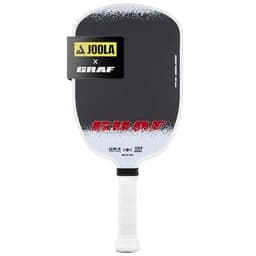
More than it did two years ago. The budget tier used to mean a thin, undisclosed core under a fiberglass face, a stock grip of unknown size, and a weight you found out about when the box arrived. Two of the paddles on this page break that pattern outright: the JOOLA Graf Edge publishes a 16 mm core, a carbon face, a weight range and a grip circumference, and the Franklin Signature Pro 13mm publishes all of the same things with a thinner core. The HEAD Extreme Elite publishes weight, grip, handle and dimensions and only withholds the core thickness. That is a spec sheet most $100 paddles did not offer in 2024.
What $50 does not buy is the whole package. You will not get a thermoformed build, a raw carbon face over a 16 mm core with a published weight and a standard shape all at once — the JOOLA gets closest and pays for it with an elongated shape. And you will not get a large grip: the biggest published circumference here is 4 1/4 in, and the 4.5 in handle we recommend for arthritic hands lives on the 16 mm Franklin, which sits just over this page’s line.
The two specs to check before the price
- Core thickness. A 16 mm polypropylene core flexes more on contact and sends less of the ball’s energy back up the handle; a 13 mm core is stiffer, with more pop and more vibration. If your elbow, wrist or hand feels the game, the 16 is the number you want, and our 13mm vs 16mm guide explains why. Only two paddles here publish it.
- Weight, as a published range. Lighter is kinder to a wrist and a shoulder, but the number matters less than knowing it at all: a maker that prints 7.7-7.9 oz is telling you what to expect, and a maker that prints “lightweight” is not. Three of the five here print a range; the Niupipo says lightweight without a number, and the HEAD Radical Elite prints nothing, which is partly why it is fifth. Our paddle weight guide covers what the ounces mean.
The third thing, which is not a spec but decides more than either: the shape. Two paddles here are elongated (16.5 inches long), which moves mass away from your hand and raises the swing weight a sore wrist feels. The HEAD Extreme Elite is standard, and two — the Niupipo and the HEAD Radical Elite — publish no dimensions at all. Our paddle shapes guide has the whole argument; the short version is that a weak wrist should buy standard.
The picks in order
JOOLA Graf Edge 16mm. First because it is the only paddle under $50 we could find that gives an arm-sore player the three things that matter: a 16 mm polypropylene honeycomb core, a textured carbon face, and a published 7.6-8.0 oz. It also publishes a 4 1/8 in grip (small — most adults will want an overgrip or two) and a 5.5 in handle, and it carries USA Pickleball and UPA-A approval. The honest caveat is the shape: 16.5 x 7.5 in and elongated, which is the wrong direction for a weak wrist, and the reason it is not a blanket recommendation. Its retail list is around double the Amazon price we see, so treat the live button as the price and do not assume it will stay there.
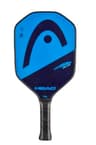
HEAD Extreme Elite. Second, and the pick for a sore wrist or shoulder. It publishes the lightest floor and tightest range on the page, 7.7-7.9 oz, on a 16 x 7 7/8 in standard shape with a 5 in handle and a medium 4 1/4 in grip — light, short, mass close to the hand, held without a clench. It is also usually the cheapest paddle we list anywhere. What HEAD does not publish is the core thickness, so we cannot tell you how soft it is at contact, and the fiberglass face is livelier than carbon. A first paddle, or a permanent spare.
Niupipo fiberglass paddle. The paddle we recommend first to beginners over 60, and it belongs here for the same reasons: a fiberglass face over a polypropylene honeycomb core, a cushioned grip, a published 4.8 in grip length, USA Pickleball approval, and a price that does not need a conversation. Niupipo calls it lightweight without printing a figure, which is why the two paddles above it — which do — rank higher. Full write-up in the Niupipo review.
Franklin Sports Signature Series Pro 13mm. The budget power pick. Same MaxGrit fiberglass face, 16.5 x 7.5 in shape and 5.6 in handle as the 16 mm Franklin on our under-$100 list, but a 13 mm core, a medium 4 1/4 in grip and a published 7.5-8.0 oz. The thinner core is the stiffer, poppier kind: more drive, and more feedback into the arm on a mis-hit, which is why it sits behind the JOOLA for the players this site is written for. Elongated, so again not the pick for a weak wrist. USA Pickleball approved.
HEAD Radical Elite. Fifth, honestly. A dependable fiberglass paddle from a tennis brand, with a honeycomb polymer core and a comfort grip, that has sat on our lightweight and beginner lists since launch. It is here because it is a known name at the ceiling of this page’s budget and because a lot of readers will see it first. It is last because HEAD publishes no weight, no grip size and no core thickness for it — the Extreme Elite from the same brand publishes three of those four for less money. Full write-up in the Radical Elite review.
Which one, for which arm
- Tennis elbow, or contact that stings. The JOOLA, for the 16 mm core and the carbon face — and size the small grip up first, because a clench undoes the benefit. If the elongated shape worries you, the ProKennex paddles on our tennis-elbow list are standard-shape but cost two to three times as much.
- Sore wrist or shoulder. The HEAD Extreme Elite. Lightest published weight, standard shape, short handle, medium grip.
- Brand new to the sport, over 60. The Niupipo. Forgiving, cushioned and cheap enough that switching later costs nothing.
- Healthy arm, want to put the ball away. The Franklin 13mm.
- Arthritic hands. None of these, honestly. The largest published grip here is 4 1/4 in. Spend the extra fifteen dollars on the 16 mm Franklin with the 4.5 in grip from the under-$100 list, or read the arthritis roundup.
What we skipped, and why
Two-paddle sets. Under $50 is full of them, and they are the wrong purchase for a player shopping around a joint: two undisclosed paddles for the price of one disclosed one. Paddles with no live listing. Several budget models from brands we like — Onix, Vulcan, Gamma — came up in our search at attractive prices but with no in-stock offer, or as a series name with no way to tell which model the listing actually ships; we do not feature a paddle we cannot verify is buyable today, and we do not guess which variant you would get. And anything whose maker publishes nothing at all beyond a face material, unless, like the Niupipo and the Radical Elite, it has earned a place on other lists here for reasons that survive the missing numbers.
Prices move; the ranking does not
Every price on this page is pulled from Amazon daily and stamped with the date; if a paddle drifts over $50 on a given day, the button will show it and we would rather you see the real number than a rounded promise. The ranking is on published specs and buyer fit, not on price, so a five-dollar swing does not reorder it. We own none of these paddles, have not tested them, and say so; every spec above is read from the maker’s or retailer’s published sheet on the date in the product’s table. If you are deciding between the top two, our how to choose a paddle guide puts weight, grip, core and shape in the order they matter for an older arm.