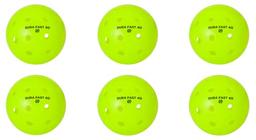
The one number that separates these balls
Hole counts and marketing copy tell you very little. Stiffness tells you almost everything, and Pickleball Science publishes measured figures for the two balls that matter most here:
- Franklin X-40: 94 lb/in new. The softer ball. More dwell on the paddle face, a slightly slower game, a more forgiving feel — and more change over the ball’s life.
- Dura Fast 40: 130 lb/in new. Nearly 40% stiffer. Faster off the face, truer in wind, and a ball that plays much the same in game 30 as it did in game 1.
Which one suits you after 55 is not obvious, and we are going to give you the honest trade rather than a slogan. A stiffer ball transmits more impact into the paddle, and therefore into your hand, wrist and elbow. Published work on lateral epicondylitis points at repeated impact loading as the mechanism, so if your elbow is the thing that limits you, the softer X-40 — or a thicker 16 mm paddle core, which does far more about this than the ball does — is genuinely the kinder option. If your problem is a windy outdoor court and balls that go soft in a month, the Dura is the better buy. That is why we rank the Dura first here while still recommending the X-40 as the overall ball on best pickleball balls: this page is for someone who has already decided to switch.
The direct head-to-head, with the hole patterns and the wind argument in full, is on Franklin X-40 vs Dura Fast 40.
Hole pattern: uniform versus uneven
Both balls have 40 holes, and that is where the similarity ends. The X-40’s holes are uniform, all at roughly 0.29 in. The Dura’s are not: Onix publishes 16 large and 24 small. An uneven pattern is a deliberate aerodynamic choice and it is part of why the Dura is the ball experienced players reach for when the wind gets up.
Do not over-read it. Nobody publishes a flight-stability figure for either ball, so we will not invent one — what we can tell you is which ball is built which way, and that the stiffer, unevenly perforated one is the one with the wind reputation.
If the reason you are switching is price
Then the Onix Fuse G2 is the pick: the cheapest outdoor ball we can price, published as seamless construction, which matters because a welded seam is the first thing to fail on a ball that gets hit hard in cold weather. Two gaps on its listing, stated rather than smoothed over: the quantity per pack is not published and neither is USA Pickleball approval. For open play and practice that is usually irrelevant. For sanctioned play, check your exact model on USA Pickleball’s official approved-ball list before you commit — a ball’s approval status is decided there, not on a retail page.
If you have moved indoors
Then none of the outdoor balls above is the right answer, and this is the most common mistake we see in the winter. Indoor and outdoor pickleballs are different products: an outdoor ball is harder, heavier-feeling and has smaller holes to cut wind; an indoor ball is softer with larger holes and a longer dwell. Playing an outdoor ball on a gym floor gives you a fast, skiddy game and a lot of noise.
The Gamma Photon is our indoor pick here: an indoor hole pattern (26 holes in Gamma’s Photon line), USA Pickleball approved per its listing, six to a pack, and — the reason we rate it for this audience — built for visibility against a gym floor, which is a genuine problem for anyone whose eyes are not what they were. The whole question is settled on indoor vs outdoor pickleballs.
If the complaint about the X-40 is the noise
Then the budget pick is also the specialist pick. The Selkirk Q1 Quiet is the cheapest ball on this page and the only one that is USA Pickleball approved AND listed in the Quiet Category — the official list that HOAs, clubs and community courts under a noise complaint actually reference. Selkirk publishes real numbers on it too: 40 holes, 0.86 oz, 2.9 in diameter, injection moulded from a custom blend, and a claim of being 34% quieter than a standard pickleball.
Two caveats we will not bury. That 34% is Selkirk’s own claim, and no measured decibel figure is published, so we cannot tell you how much quieter it is in your yard. And Selkirk does not publish whether it is an indoor or an outdoor ball, which is an odd omission on an otherwise well-specified product. If keeping the courts open is the actual problem, the ball is only half of it — the paddle matters at least as much, and both sides are covered on best quiet pickleball balls and gear.
How this page is ranked, and what we do not claim
We own no balls, run no lab, and have hit nothing. The stiffness figures are Pickleball Science’s published measurements, not ours. Every other specification is read from the maker’s own page — onix.com for the Dura, selkirk.com for the Q1 — or from the listing named in each product’s source row, on the date shown there. There are no scores and no awards we made up.
The Franklin X-40 is deliberately not a pick on this page for two reasons: you came here having already considered it, and it had no live offer when we wrote this, which means we could not honestly put a buy button on it. Prices come from the live price layer with an “as of” date attached, so if the X-40 comes back into stock, that is reflected where it is listed rather than asserted here.