Kitchen & Court

Best Control Pickleball Paddles

Touch-and-placement paddles that reward a soft, relaxed game over big swings — the smarter, more joint-friendly way to play as you age.

By Stephen V.Last updated How we research

Pickleball is won at the kitchen line, and it’s won with touch, not power. A control paddleis built for exactly that: it dampens the ball so you can place a soft dink, reset a hard drive, and put the ball where you want it rather than just hitting it hard. For an older or joint-conscious player that’s a double win, because a control game means smaller, gentler swings — far easier on the elbow, wrist and shoulder than trying to bang winners all day.

What makes a paddle control-oriented is a softer, thicker polypropylene core that absorbs the ball, a forgiving facewith a generous sweet spot, and a balance that isn’t trying to add power out at the head. We ranked these on touch, forgiveness and a relaxed feel rather than pop. Here are six that reward placement over pace.

How this is funded:we earn a commission if you buy through our links, at no extra cost to you. It never changes which product we recommend, and we’ll tell you plainly when to skip one. Full disclosure.

Quick picks

Ranked on published specs, grip and build, and honest buyer fit. Select a row to jump to the full write-up. We have not lab-tested these — here is exactly what we do instead.

#ProductBest forPrice
1
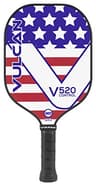
Vulcan V520

Vulcan V520

A control-first paddle at a fair price. The polypropylene core and fiberglass face are tuned for touch rather than raw power, which is exactly what most older players want — placement and soft hands beat trying to bang winners.

Best control overall
$44.99 · View on Amazon

Price as of August 4, 2026. #ad How we’re funded

2
Gamma Obsidian 13

Gamma Obsidian 13

The standout for hands that hurt: Gamma gives this one a molded foam handle instead of a hard wrapped grip, plus a system that lets you add handle weight to balance the paddle. Softer to hold and easier to customize is exactly what an arthritic grip wants.

Best control for sore hands
$129.99 · View on Amazon

$159.9919% off

Price as of August 4, 2026. #ad How we’re funded

3
Niupipo Fiberglass Pickleball Paddle

Niupipo Fiberglass Pickleball Paddle

The value pick, and a smart first paddle for a 55+ player. It's marketed as lightweight, has an ultra-cushion grip, and publishes its 4.8-inch grip length — one of the few here that tells you a real grip number. For a starter paddle that's easy on the hand, it's hard to beat the price.

Best value
$34.99 · View on Amazon

$36.995% off

Price as of August 4, 2026. #ad How we’re funded

4
Selkirk SLK Evo Hybrid XL

Selkirk SLK Evo Hybrid XL

Selkirk is a top-tier pickleball name, and the SLK Evo Hybrid is its most affordable way in. A fiberglass XL shape gives you extra reach and a bigger sweet spot for the money — a lot of forgiveness for a budget paddle.

Most forgiving
$59.88 · View on Amazon

Price as of August 4, 2026. #ad How we’re funded

5
JOOLA Essentials Performance

JOOLA Essentials Performance

JOOLA is one of the sport's biggest names, and the Essentials is its budget on-ramp: a reinforced fiberglass face over a polypropylene honeycomb core. A safe, softer-feeling starter paddle from a brand you'll see all over the courts.

Softest feel
$59.95 · View on Amazon

Price as of August 4, 2026. #ad How we’re funded

6
JOOLA Ben Johns Hyperion CAS 16

JOOLA Ben Johns Hyperion CAS 16

The performance benchmark on this list — a carbon-surface, 16mm-core paddle with an elongated handle built for spin and reach. It's more paddle than a beginner needs, but for an improving player the extra sweet spot and control are the payoff. Note the elongated handle suits a two-handed backhand.

Best for an improving player
$119.99 · View on Amazon

Price as of August 4, 2026. #ad How we’re funded

The picks in full

#1Best control overall

Vulcan V520

A control-first paddle at a fair price. The polypropylene core and fiberglass face are tuned for touch rather than raw power, which is exactly what most older players want — placement and soft hands beat trying to bang winners.

Easier on the joints: A control paddle rewards a relaxed, placement-focused game — which means less full-force swinging and less strain on the arm than a power paddle invites.

What we like

  • Tuned for control and touch, not power
  • Polypropylene core dampens the ball nicely
  • USA Pickleball approved at a mid-budget price

Skip it if

  • Not the paddle if you want to hit hard
  • Specs beyond materials aren't published
Face materialFiberglass
CorePolypropylene
StyleControl performance
WeightNot published
USA Pickleball approvedYes (per listing)

Specs read from the product listing, on July 22, 2026. “Not published” means the maker does not state that figure.

#2Best control for sore hands

Gamma Obsidian 13

The standout for hands that hurt: Gamma gives this one a molded foam handle instead of a hard wrapped grip, plus a system that lets you add handle weight to balance the paddle. Softer to hold and easier to customize is exactly what an arthritic grip wants.

Easier on the joints: The molded foam handle spreads pressure across your palm instead of concentrating it, and the weight system lets you keep the paddle light — both directly reduce hand and wrist strain.

What we like

  • Molded foam handle is genuinely softer to grip than a standard wrap
  • Customizable handle-weight system lets you tune the balance
  • 13mm carbon-fiber build for a controlled, forgiving feel

Skip it if

  • Foam handle is a love-it-or-not feel — try before committing if you can
  • Exact weight isn't published
Face materialCarbon fiber
Core thickness13 mm
GripMolded foam handle
WeightNot published (adjustable via weight system)
USA Pickleball approvedNot published

Specs read from the product listing, on July 22, 2026. “Not published” means the maker does not state that figure.

#3Best value

Niupipo Fiberglass Pickleball Paddle

The value pick, and a smart first paddle for a 55+ player. It's marketed as lightweight, has an ultra-cushion grip, and publishes its 4.8-inch grip length — one of the few here that tells you a real grip number. For a starter paddle that's easy on the hand, it's hard to beat the price.

Easier on the joints: A lightweight paddle with a cushioned grip asks the least of your wrist and elbow on every swing — the two things that matter most when you're new or playing around a sore joint.

What we like

  • Publishes a 4.8-inch grip length — most paddles won't tell you
  • Ultra-cushion grip and a lightweight build, both easy on the hand
  • USA Pickleball approved and comes with a cover

Skip it if

  • Fiberglass face gives less control finesse than carbon at higher levels
  • You'll likely outgrow it if you get serious about play
Face materialFiberglass
CorePolypropylene honeycomb
Grip length4.8 in (per listing)
WeightLightweight (exact figure not published)
USA Pickleball approvedYes (per listing)

Specs read from the product listing, on July 22, 2026. “Not published” means the maker does not state that figure.

#4Most forgiving

Selkirk SLK Evo Hybrid XL

Selkirk is a top-tier pickleball name, and the SLK Evo Hybrid is its most affordable way in. A fiberglass XL shape gives you extra reach and a bigger sweet spot for the money — a lot of forgiveness for a budget paddle.

Easier on the joints: A bigger sweet spot means more clean, centered hits — and a centered hit sends far less jarring vibration into your arm than a mis-hit off the edge.

What we like

  • Selkirk quality at an entry price
  • XL shape gives a larger, more forgiving sweet spot
  • Good reach for defending the kitchen line

Skip it if

  • Fiberglass face over carbon at this tier
  • Elongated shape can feel head-heavy to some hands
Face materialFiberglass
CoreNot published
ShapeXL (elongated)
WeightNot published
USA Pickleball approvedNot published

Specs read from the product listing, on July 22, 2026. “Not published” means the maker does not state that figure.

#5Softest feel

JOOLA Essentials Performance

JOOLA is one of the sport's biggest names, and the Essentials is its budget on-ramp: a reinforced fiberglass face over a polypropylene honeycomb core. A safe, softer-feeling starter paddle from a brand you'll see all over the courts.

Easier on the joints: The honeycomb polypropylene core is the softer, more forgiving kind — it cushions impact better than a stiff budget core and keeps shock out of your hand.

What we like

  • Big-name brand at a beginner price
  • Polypropylene honeycomb core for a softer feel
  • Reinforced fiberglass face holds up to recreational play

Skip it if

  • Basic build compared with JOOLA's performance line
  • Weight and grip size aren't published
Face materialReinforced fiberglass
CorePolypropylene honeycomb
GripNot published
WeightNot published
USA Pickleball approvedNot published

Specs read from the product listing, on July 22, 2026. “Not published” means the maker does not state that figure.

#6Best for an improving player

JOOLA Ben Johns Hyperion CAS 16

The performance benchmark on this list — a carbon-surface, 16mm-core paddle with an elongated handle built for spin and reach. It's more paddle than a beginner needs, but for an improving player the extra sweet spot and control are the payoff. Note the elongated handle suits a two-handed backhand.

Easier on the joints: The thick 16mm core is the soft, control-oriented kind that muffles impact well — but the elongated head puts a little more weight out front, so it's better for elbows than for a weak wrist.

What we like

  • Carbon abrasion surface generates real spin and control
  • Thick 16mm polypropylene honeycomb core for a soft, muted feel
  • Elongated handle helps two-handed backhands and reach

Skip it if

  • The elongated head can feel heavier in the hand — not ideal for a sore wrist
  • More paddle (and price) than a casual player needs
Face materialCarbon abrasion surface
Core thickness16 mm polypropylene honeycomb
HandleElongated (sure-grip)
WeightNot published
USA Pickleball approvedYes (per listing)

Specs read from the product listing, on July 22, 2026. “Not published” means the maker does not state that figure.

What makes a paddle a “control” paddle

Three things, and they work together. A thick, soft core— polypropylene honeycomb, ideally on the thicker side — deadens the ball so it sits on the face a fraction longer, which is what gives you touch on a dink or a reset. A forgiving face with a large sweet spot means off-center hits still go roughly where you aimed. And a balanced, not head-heavy build keeps the paddle maneuverable at the net, where control points are decided.

Power paddles do the opposite: stiff faces and firmer builds that launch the ball hard. They’re fun, but they reward a big swing — and a big swing is exactly what stresses an aging elbow and wrist. If you have a sore joint, a control paddle isn’t a compromise, it’s the correct choice.

Control paddles and a joint-friendly game

The paddle and the strategy reinforce each other. A control paddle nudges you toward the soft game— patience, placement and letting the other side make the error — which is both how older players beat harder hitters and how they spare their arms. If your hands are the issue, the Gamma’s foam handle makes it our arthritisfavorite too; if you’re still picking your first paddle, our how-to-choose guide covers the rest.

Frequently asked questions

Are control paddles better for older players?

For most, yes. A control paddle rewards placement and a relaxed, soft-game style rather than a big, arm-stressing swing — which is both a smarter way to play as you age and much easier on the elbow, wrist and shoulder. Save the power paddles for players trying to bang winners; control wins more points at the kitchen line anyway.

What is the difference between a control and a power paddle?

A control paddle has a softer, usually thicker core and a forgiving face that deadens the ball for touch and placement. A power paddle has a stiffer, livelier face that launches the ball harder. Control paddles reward finesse and a relaxed swing; power paddles reward a big, committed one — which is harder on aging joints.

Does a thicker core mean more control?

Generally, yes. A thicker polypropylene core (think 16mm versus 13mm) absorbs more of the ball's energy, giving a softer, more muted feel that's easier to control on dinks and resets. It also means a bit less raw power — a trade most control-minded and older players are happy to make.

Can a beginner use a control paddle?

Absolutely — a forgiving control paddle is one of the best things a beginner can learn on, because it rewards good technique over brute force and is gentle on the arm. Several picks here double as excellent beginner paddles; see our beginner list if you're just starting out.

Sources

Keep reading