Kitchen & Court

Best Pickleball Paddles for Power

The paddles built to drive the ball, ranked on published core, face and build — and the honest case for not buying one if your elbow already hurts.

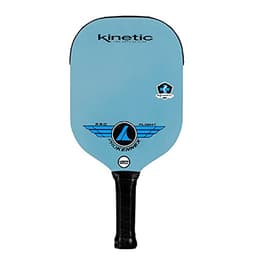
ProKennex Pro Flight

Our pick

ProKennex Pro Flight

The power paddle for a player over 55, because it is the only one here designed to give you drive and protect your arm at the same time: a Toray T700 carbon face and ProKennex’s cushioned Comfort Pro grip, from the brand arm-sensitive players already reach for. It is the most expensive paddle we list, so the budget pick is the Franklin Signature Series Pro 13mm— a published 13 mm core and a MaxGrit fiberglass face on an elongated body, for about a quarter of the price and none of the arm protection.

$189.95 · View on Amazon

Price as of November 8, 2026. #ad How we’re funded

Read the full write-up
By Stephen V.Last updated How we research

Power in a pickleball paddle comes from three published things: how much mass is in the paddle, how stiff the core is, and how rigidly the whole body is built. A heavier paddle carries more momentum into the ball. A thinner core deforms less, so less of the ball’s energy is absorbed and more of it comes back out. A thermoformed body with foam-injected walls flexes less at the edges, which is why the performance end of the market standardized on it. Everything else — face material, shape, grip — changes how the paddle feels, not how hard it hits.

Which means this page comes with a warning the rest of the internet usually leaves off. Every mechanism that adds power also adds vibration or weight, and vibration and weight are exactly what an older elbow, wrist and shoulder cannot absorb. If your arm already hurts, the correct answer is not on this page: it is the tennis-elbow roundup or the low-vibration list. What follows is for a healthy arm that wants to put the ball away — five paddles ranked on what their makers publish, with the live price and the date it was checked on every button.

How this is funded: we earn a commission if you buy through our links, at no extra cost to you. It never changes which product we recommend, and we’ll tell you plainly when to skip one. Full disclosure.

Quick picks

Ranked on published specs, grip and build, and honest buyer fit. Select a row to jump to the full write-up. We have not lab-tested these — here is exactly what we do instead.

#ProductBest forPrice
1
ProKennex Pro Flight

ProKennex Pro Flight

A slightly more all-court ProKennex than the Ovation, with the same Toray carbon face and Comfort Pro grip. You keep the brand's arm-friendly feel but get a touch more reach and drive, which suits players who want comfort without giving up the ability to put a ball away.

Best overall — drive with arm protection
$189.95 · View on Amazon

Price as of November 8, 2026. #ad How we’re funded

2
Selkirk SLK Halo Power XL

Selkirk SLK Halo Power XL

A carbon-fiber Selkirk that still lands under most premium paddles. The XL shape adds reach and a generous sweet spot; the carbon face gives a cleaner, more controlled response than the fiberglass Evo. A strong mid-tier step up.

Best drive for the money — 13 mm core
3
JOOLA Ben Johns Hyperion CAS 16

JOOLA Ben Johns Hyperion CAS 16

The performance benchmark on this list — a carbon-surface, 16mm-core paddle with an elongated handle built for spin and reach. It's more paddle than a beginner needs, but for an improving player the extra sweet spot and control are the payoff. Note the elongated handle suits a two-handed backhand.

Heaviest published weight — 8.3 oz
$159.95 · View on Amazon

Price as of November 8, 2026. #ad How we’re funded

4
Friday Challenger

Friday Challenger

Friday's Gen 2 paddle, and the cheapest way into the brand's thermoformed carbon build. Two layers of T700 raw carbon over a 16mm honeycomb core with foam-injected walls give a stiff, stable, big-sweet-spot feel that flatters a developing game — and unlike most makers here, Friday actually publishes what the paddle weighs.

Best thermoformed build
$99.99 · View on Amazon

Price as of November 8, 2026. #ad How we’re funded

5
Franklin Sports Signature Series Pro 13mm

Franklin Sports Signature Series Pro 13mm

The thinner, livelier sibling of the 16 mm Franklin we recommend for arthritic hands - same MaxGrit fiberglass face and 16.5 x 7.5 in shape with a 5.6 in handle, but a 13 mm core, a medium 4 1/4 in grip and a published 7.5-8.0 oz. More pop and a little more feedback into the arm, for the budget buyer who wants to put the ball away. USA Pickleball approved.

Budget pick — 13 mm under $55
$51.99 · View on Amazon

$99.9948% off

Price as of November 8, 2026. #ad How we’re funded

The picks in full

#1Best overall — drive with arm protection

ProKennex Pro Flight

A slightly more all-court ProKennex than the Ovation, with the same Toray carbon face and Comfort Pro grip. You keep the brand's arm-friendly feel but get a touch more reach and drive, which suits players who want comfort without giving up the ability to put a ball away.

Easier on the joints: The carbon face plus ProKennex's cushioned grip is the same arm-friendly recipe as the Ovation — a good option if you want comfort but don't want a pure control paddle.

What we like

  • Same Toray T700 carbon face and cushioned grip as the Ovation
  • A bit more all-court than the pure-comfort models
  • USA Pickleball approved

Skip it if

  • The most expensive paddle in this roundup
  • Weight is not published, so you're buying on feel and reputation
Face materialToray T700 carbon fiber
CoreNot published
GripComfort Pro (cushioned)
WeightNot published
USA Pickleball approvedYes (per listing)

Specs read from the product listing, on July 22, 2026. “Not published” means the maker does not state that figure.

#2Best drive for the money — 13 mm core

Selkirk SLK Halo Power XL

A carbon-fiber Selkirk that still lands under most premium paddles. The XL shape adds reach and a generous sweet spot; the carbon face gives a cleaner, more controlled response than the fiberglass Evo. A strong mid-tier step up.

Easier on the joints: Carbon faces tend to feel more muted and predictable than fiberglass, so the ball comes off cleanly — easier on the arm than a lively, unpredictable budget face.

What we like

  • Carbon-fiber face for cleaner control than fiberglass
  • XL shape adds reach and forgiveness
  • Priced well below premium carbon paddles

Skip it if

  • The Power build leans toward drive, not pure touch
  • Elongated shape isn't for everyone
Face materialT700 CarbonFusion carbon fiber
Core13 mm Rev-Power polymer honeycomb
ShapeXL (elongated)
Weight7.7-8.0 oz (published range)
Grip circumference4.25 in
Handle length5.75 in
Dimensions16.4 x 7.4 in
USA Pickleball approvedNot published

Specs read from the product listing, on September 18, 2026. “Not published” means the maker does not state that figure.

#3Heaviest published weight — 8.3 oz

JOOLA Ben Johns Hyperion CAS 16

The performance benchmark on this list — a carbon-surface, 16mm-core paddle with an elongated handle built for spin and reach. It's more paddle than a beginner needs, but for an improving player the extra sweet spot and control are the payoff. Note the elongated handle suits a two-handed backhand.

Easier on the joints: The thick 16mm core is the soft, control-oriented kind that muffles impact well — but the elongated head puts a little more weight out front, so it's better for elbows than for a weak wrist.

What we like

  • Carbon abrasion surface generates real spin and control
  • Thick 16mm polypropylene honeycomb core for a soft, muted feel
  • Elongated handle helps two-handed backhands and reach

Skip it if

  • The elongated head can feel heavier in the hand — not ideal for a sore wrist
  • More paddle (and price) than a casual player needs
Face materialCarbon abrasion surface
Core thickness16 mm polypropylene honeycomb
HandleElongated (sure-grip)
Weight8.3 oz average (published)
Grip circumference4.25 in
Handle length5.5 in
Dimensions16.5 x 7.5 in
USA Pickleball approvedYes (per listing)

Specs read from the product listing, on September 18, 2026. “Not published” means the maker does not state that figure.

#4Best thermoformed build

Friday Challenger

Friday's Gen 2 paddle, and the cheapest way into the brand's thermoformed carbon build. Two layers of T700 raw carbon over a 16mm honeycomb core with foam-injected walls give a stiff, stable, big-sweet-spot feel that flatters a developing game — and unlike most makers here, Friday actually publishes what the paddle weighs.

Easier on the joints: Foam-injected walls stiffen the paddle's edges, which widens the area that answers the same way on contact — and more centered-feeling contact is the single biggest thing you can do to keep harsh off-center vibration out of your elbow.

What we like

  • Double-layer T700 raw carbon face with a gritty surface for spin
  • Thermoformed Gen 2 build with foam-injected walls — a stable, large sweet spot
  • USA Pickleball approved, and Friday publishes the weight when most brands won't

Skip it if

  • Thermoformed paddles feel stiffer, which not every sore arm loves
  • At 16.5 in it's an elongated shape, which sits heavier in the hand than a standard head
Face materialDouble-layer T700 raw carbon fiber
ConstructionThermoformed (Gen 2), foam-injected walls
Core16 mm polypropylene honeycomb
Weight8.0 oz average (published)
USA Pickleball approvedYes (per listing)

Specs read from the product listing, on August 24, 2026. “Not published” means the maker does not state that figure.

#5Budget pick — 13 mm under $55

Franklin Sports Signature Series Pro 13mm

The thinner, livelier sibling of the 16 mm Franklin we recommend for arthritic hands - same MaxGrit fiberglass face and 16.5 x 7.5 in shape with a 5.6 in handle, but a 13 mm core, a medium 4 1/4 in grip and a published 7.5-8.0 oz. More pop and a little more feedback into the arm, for the budget buyer who wants to put the ball away. USA Pickleball approved.

Easier on the joints: A 13 mm core returns more of the ball's energy than a 16, which is where the pop comes from and also where the extra feedback into your elbow comes from. If something already hurts, buy the 16 mm Franklin or the JOOLA instead; if nothing does and you miss the drive, this is the honest budget choice.

What we like

  • Published 7.5-8.0 oz - one of the lighter floors on this page
  • Long 5.6 in handle suits a two-handed backhand
  • USA Pickleball approved, from an established brand with a published spec sheet

Skip it if

  • 13 mm core is the stiffer, poppier kind - more vibration and harsher mis-hits than the 16 mm version
  • Elongated 16.5 in shape moves mass away from the hand - not the pick for a sore wrist
  • The 16 mm version's 4.5 in large grip is not offered here; this one is a medium 4 1/4 in
Face materialMaxGrit coated fiberglass
Core13 mm polypropylene honeycomb
Weight7.5-8.0 oz (published range; 7.75 oz average)
Grip circumference4.25 in (medium)
Handle length5.6 in
Dimensions16.5 x 7.5 in (elongated)
USA Pickleball approvedYes

Specs read from the product listing, on September 20, 2026. “Not published” means the maker does not state that figure.

What actually makes a paddle powerful

Core thickness is the clearest lever, and Pickleball Studio’s analysis of it is the plainest summary we have found: a thinner core “doesn’t absorb as much energy, so the ball comes off faster”, and thinner paddles “feel stiffer when the ball hits the paddle”. The same piece notes the cost — thinner paddles “usually provide more vibration and worse off-center shot performance”. That sentence is the trade this whole page is about.

Published weight is the second lever, and the one most buyers get backwards. A heavier paddle hits harder for the same swing, but it also needs more of your shoulder to swing and more of your wrist to stop. The heaviest published figure in our registry is 8.3 oz (the JOOLA Hyperion); the lightest is 7.5 oz. That is less than an ounce of spread, and an ounce further from your hand on an elongated body feels like considerably more than an ounce. Our paddle weight guide explains what the figures mean in practice.

Build rigidity is the third, and the hardest to compare because almost nobody publishes it. Exactly one paddle in our registry states a thermoformed construction with foam-injected walls, and that is the Friday Challenger. Everything else either is not thermoformed or declines to say.

The picks in order

ProKennex Pro Flight. First, and the only paddle on this page we would recommend to a reader of this site without a caveat about their arm. ProKennex built its reputation on vibration control, and the Pro Flight is the model in that line aimed at players who want drive rather than pure touch — a Toray T700 carbon fiber face, the brand’s cushioned Comfort Pro grip, and USA Pickleball approval per the listing. Be clear about what that means and does not mean: the comfort claim rests on ProKennex’s stated design intent and the following it has among arm-sensitive players, not on a test we ran. ProKennex publishes neither a core thickness nor a weight for it, which on a power page is a real gap. It is first because it is the only paddle here where power and arm comfort are both the design brief. Full write-up in the Pro Flight review.

Selkirk SLK Halo Power XL. Second, and the best pure-drive value on the page. Selkirk publishes the whole sheet: a 13 mm Rev-Power polymer honeycomb core — the name is the product positioning — a T700 CarbonFusion carbon face, 7.7–8.0 oz, a 4.25 in grip, a long 5.75 in handle and 16.4 x 7.4 in dimensions. Thin core plus elongated body plus long handle is the classic drive geometry, and the handle length makes a two-handed backhand possible. The cost is the one the thin core always charges: more feedback into the hand. Full write-up in the SLK Halo review.

JOOLA Ben Johns Hyperion CAS 16. Third, and the heaviest published paddle we list: JOOLA states an 8.3 oz average, with a 4.25 in grip, a 5.5 in grip length, 16.5 x 7.5 in, a 16 mm Response honeycomb polymer core, a Carbon Abrasion Surface face and USA Pickleball approval. It makes its power from mass and build rather than from a thin core, which is a gentler way to get there — the 16 mm core still absorbs pace. The caveat is the one the mass creates: 8.3 oz on a 16.5 in body is the most demanding paddle here for a shoulder. Full write-up in the Hyperion review.

Friday Challenger. Fourth, and the most modern build. A double-layer T700 raw carbon fiber face on a thermoformed Gen-2 body with foam-injected walls, over a 16 mm polypropylene honeycomb core, with a published 8.0 oz average weight and USA Pickleball approval per the listing. Thermoforming is the technique the performance market uses to get power out of a thick core: stiffen the perimeter, keep the soft middle. It is fourth because Friday publishes no grip circumference and no dimensions, so we cannot tell you how it sits in the hand — and grip is the one spec that decides whether a powerful paddle hurts you.

Franklin Sports Signature Series Pro 13mm. The budget pick, and the cheapest way to get the power recipe on purpose rather than by accident. Franklin publishes a 13 mm polypropylene honeycomb core, a MaxGrit coated fiberglass face, 7.5–8.0 oz, a medium 4.25 in grip, a 5.6 in handle, 16.5 x 7.5 in elongated dimensions and USA Pickleball approval. Thin core, lively fiberglass face, long body — all three power levers, for around fifty dollars. It is also the harshest paddle on this page, with no engineering anywhere in it aimed at your arm. Buy it if your arm is fine and the budget is the constraint; do not buy it as a first paddle if anything already aches.

The honest case against buying a power paddle at 55-plus

Three arguments, in order of how often they turn out to be right.

  • Power is not what loses most 55-plus games. At recreational level the third-shot drop, the reset and the dink exchange decide points far more often than the drive does, and every one of those is a control shot. A control paddle will win you more points than a power paddle will, which is not what the marketing says.
  • The arm pays the bill, and it pays it later. AAOS treats an equipment check as part of managing racquet-sport elbow pain for a reason. A stiffer, heavier paddle is a bigger load per contact across a two-hour session, several times a week. People rarely connect the new paddle to the elbow that started hurting a month afterwards.
  • You can get most of the drive from the ball and the grip. A fresh, firm outdoor ball comes off the paddle faster than a softened one, and a grip you are not strangling lets you accelerate the head properly. Both are cheaper than a paddle.

If after all that you still want the drive — plenty of healthy 60-year-old arms do, and there is nothing wrong with that — buy the ProKennex if the budget allows and the Franklin if it does not, size the grip correctly, and stop if your elbow starts talking.

What this page does not claim

No measured ball speed, no power rating, no swing-weight or twist-weight figure. None of the makers here publishes one and we have not measured one; we own none of these paddles. Everything above is the manufacturer’s published core, face, weight and geometry, read from the pages named in each product’s spec table on the date shown there, plus our reading of who the combination suits. Prices come from the live price layer and carry an “as of” date, and the ranking is on specs and fit, so a price change does not reorder it.
Frequently asked questions

What is the best pickleball paddle for power?

For a player over 55, the ProKennex Pro Flight — the only paddle we list where drive and arm comfort are both the design brief, with a Toray T700 carbon face and ProKennex's cushioned Comfort Pro grip. For pure drive at a lower price, the Selkirk SLK Halo Power XL publishes a 13 mm Rev-Power core, a T700 carbon face and a long 5.75 in handle. The budget pick is the Franklin Signature Series Pro 13mm at around a quarter of the ProKennex price.

Does a heavier paddle give more power?

Yes, for the same swing — more mass carries more momentum into the ball. But the spread is small: the heaviest published weight in our registry is 8.3 oz and the lightest is 7.5 oz, and an extra ounce placed further from your hand on an elongated body costs more shoulder and wrist effort than it returns in ball speed. Weight is the power lever that most often backfires on an older player.

Is a thin core or a thick core better for power?

Thin. A thinner core deforms less on contact, so it absorbs less of the ball's energy and the ball leaves faster — Pickleball Studio's analysis puts it exactly that way. The cost is more vibration into your hand and worse performance on off-center hits. A 16 mm paddle can still hit hard if it is heavy or thermoformed, which is how the JOOLA Hyperion and the Friday Challenger manage it.

Will a power paddle give me tennis elbow?

No paddle causes tennis elbow on its own, and we will not claim one does. What is fair to say is that the mechanisms that add power — a stiffer core, more mass, a more rigid body — all increase the load your arm absorbs per contact, and AAOS counts a racquet-sport equipment check as part of treating epicondylitis. If your elbow already hurts, buy a 16 mm control paddle and size the grip first.

Do I need a power paddle to beat harder hitters?

Usually not. At recreational 55-plus level the drop, the reset and the dink exchange decide more points than the drive does, and those are control shots. Matching a harder hitter blow for blow with a stiffer paddle tends to produce more unforced errors, not more winners. A control paddle plus a reliable third-shot drop is the cheaper and more durable answer.

What is a thermoformed paddle, and does it add power?

Thermoforming moulds the paddle body as one rigid unit, usually with foam injected into the perimeter walls, so the edges flex less than on a conventionally assembled paddle. That stiffer perimeter returns more energy on off-center shots, which reads as power and as a bigger effective sweet spot. Exactly one paddle in our registry publishes a thermoformed construction — the Friday Challenger — so we rank it on that and do not guess for the others.

Sources

  • Pickleball Studio — How Thick Should Your Pickleball Paddle Be? (Chris Olson, Aug 31, 2022) — Thicker cores (16 mm and above) are for control: 'less power but usually improves your blocks, resets, and drop shots', 'helps absorb more of the pace from the ball', and they 'usually feel like they have a better sweet spot'. Thinner cores (13 mm and below) 'feel stiffer when the ball hits the paddle', the core 'doesn't absorb as much energy, so the ball comes off faster', and 'thinner paddles usually provide more vibration and worse off-center shot performance'. Recommendation: 'If you are a new player up to about 3.5, I would usually tell you to opt for a thicker paddle.' The article does not address arm pain or older players specifically (accessed September 18, 2026)
  • Selkirk Sport — SLK Halo Power product page (manufacturer specifications, XL and Max variants) — Selkirk publishes a full spec sheet for the Halo Power XL: 7.7-8.0 oz weight range, 4.25 in grip circumference, 5.75 in handle length, 16.4 in x 7.4 in, 13 mm Rev-Power polymer honeycomb core, T700 CarbonFusion carbon fiber face, SLK Ultra-Comfort grip. The Max variant on the same page: 7.7-8.0 oz, 4.25 in grip, 4.85 in handle, 16 in x 7.85 in, 16 mm Rev-Control core, 18k UltraWeave carbon face. No USA Pickleball approval statement appears on the page (accessed September 18, 2026)
  • JOOLA — Ben Johns Hyperion CAS 16 product page (manufacturer specifications) — JOOLA publishes: average weight 8.3 oz (no range stated), grip circumference 4.25 in ('may vary slightly'), grip length 5.5 in, paddle length 16.5 in, width 7.5 in, 16 mm Response honeycomb polymer core, Carbon Abrasion Surface (CAS) face, Ridge grip, USA Pickleball approved: yes (accessed September 18, 2026)
  • USA Pickleball — Approved Paddles list — The searchable database of paddles that have passed USA Pickleball certification testing (accessed July 22, 2026)
  • American Academy of Orthopaedic Surgeons (OrthoInfo) - Tennis Elbow (Lateral Epicondylitis) — AAOS: tennis elbow 'involves the degeneration (wearing down) or, in some cases, microtearing of the tendons that join the forearm muscles on the outside of the elbow', specifically the extensor carpi radialis brevis (ECRB) where it attaches to the lateral epicondyle. Symptoms: 'Pain or burning on the outer part of your elbow', 'Weak grip strength', 'Sometimes, pain at night', 'often worsened with forearm activity, such as holding a racquet, turning a wrench, or shaking hands'. Most people who get it are 'between the ages of 30 and 50'. THE PLACEMENT SENTENCE: 'Using a brace centered over the back of your forearm may also help relieve symptoms of tennis elbow. This can reduce symptoms by resting the muscles and tendons.' AAOS calls this a counterforce brace - it is NOT worn on the elbow joint itself. 'Approximately 80 to 95% of patients have success with nonsurgical treatment', beginning with rest: 'you will have to stop or decrease participation in sports, heavy work activities, and other activities that cause painful symptoms for several weeks'. AAOS also lists an EQUIPMENT CHECK as treatment: 'Stiffer racquets and looser-strung racquets often can reduce the stress on the forearm, which means that the forearm muscles do not have to work as hard.' Steroid injections 'should be used very sparingly for lateral epicondylitis, as excessive use can weaken the lateral epicondyle'. Surgery is considered only 'if your symptoms do not respond after 6 to 12 months of nonsurgical treatments' (accessed October 17, 2026)
  • A Review of Physiotherapy Techniques Used in the Treatment of Tennis Elbow — PMC (2023) — Lateral epicondylitis is an overuse tendinopathy of the forearm extensors; conservative care — rest, bracing/counterforce straps and graduated loading — is the mainstay (accessed July 22, 2026)

Keep reading