Why the face material is the whole answer
A raw carbon face is carbon fiber left unpainted and unsealed, so the weave itself is the texture your ball bites into. A painted or clear-coated face is smoother by definition, which is why the cheapest paddles rarely spin well no matter what the listing says. Grit coatings — Franklin’s MaxGrit is the one in our registry — are a third approach: a textured coating applied over fiberglass, which grips when new and wears down with use in a way a raw weave does not.
USA Pickleball does regulate surface roughness, which is the reason approved paddles cannot be arbitrarily grippy and the reason the differences between the five paddles here are smaller than the marketing implies. Treat any claim of dramatically more spin from an approved paddle with suspicion, including on this page: what you are choosing between is a good spin face and a very good one, not a trick.
The second thing to understand, and the reason this list is ordered the way it is: a spin face does nothing for your arm. If you are shopping spin because your dinks keep sitting up, the order of operations for a 55-plus player is grip size, then core thickness, then face. A grippy face on a 13 mm core is a harsher paddle than a smooth face on a 16 mm one, and your elbow will notice the core long before your opponent notices the spin.
The picks in order
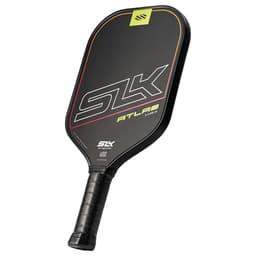
Selkirk SLK Atlas Max. First, and the only paddle here we would recommend without a caveat. Selkirk’s own spec sheet publishes a premium carbon fiber face with Raw Spin Technology, a 16 mm Rev-Control polymer honeycomb core, a 7.6–8.1 oz weight range, a 4.25 in grip circumference, a 4.85 in handle, 16 x 7.85 in dimensions and a low-profile EdgeSentry edge guard. Read as a spin paddle, that is the ideal combination for an older player: a raw weave to bite the ball, the soft 16 mm core to absorb the pace, and the widest face in our registry as a target. One honest gap — no USA Pickleball approval statement appears anywhere on Selkirk’s page for it, which matters if you play sanctioned events. Full write-up in the SLK Atlas Max review.
Friday Challenger. Second, and the most modern build on the page: a double-layer T700 raw carbon fiber face on a thermoformed Gen-2 body with foam-injected walls, over a 16 mm polypropylene core, with a published 8.0 oz average weight and USA Pickleball approval per the listing. Two layers of raw carbon is the most face a paddle in our registry carries, and the thermoformed construction is what the performance end of the market has standardized on. It is second rather than first because Friday publishes no grip circumference and no dimensions, so we cannot tell you how it will sit in an arthritic hand or how wide the target is.
JOOLA Ben Johns Hyperion CAS 16. Third. The Carbon Abrasion Surface is JOOLA’s named spin face and the paddle is the one most spin-shopping players have already heard of. JOOLA publishes an 8.3 oz average weight, a 4.25 in grip, a 5.5 in grip length, 16.5 x 7.5 in, a 16 mm Response honeycomb polymer core and USA Pickleball approval. It is third because 8.3 oz on a 16.5 in elongated body is the heaviest-feeling paddle here, and because the two above it cost less. If it is the one you want, the Hyperion review covers it in full and our Hyperion alternatives page lines it up against the cheaper raw-carbon options.
JOOLA Graf Edge 16mm. The budget pick, and a genuinely surprising one: a textured carbon fiber face over a 16 mm polypropylene honeycomb core, with a published 7.6–8.0 oz range, a 5.5 in handle, 16.5 x 7.5 in dimensions and both USA Pickleball and UPA-A approval, at a price that usually sits under fifty-five dollars. You give up the raw weave for a textured one and you give up grip size — 4.125 in is small, so plan on an overgrip — but the face-plus-core combination is the same idea as the Selkirk for a fraction of the money. It leads our under-$50 list for the same reasons.
Selkirk SLK Halo Power XL. Fifth, and the pick only if you want spin and drive together. T700 CarbonFusion face, 13 mm Rev-Power core, 7.7–8.0 oz, 4.25 in grip, a long 5.75 in handle, 16.4 x 7.4 in — the fullest spec sheet of any paddle on this page. The 13 mm core is why it is last: thinner, stiffer, more vibration into the hand, which is the opposite of what we usually recommend here. The 13 mm roundup makes that case properly.
Three things that will change your spin more than the paddle
- A clean face. A raw carbon weave fills with ball residue, dust and court grit, and a clogged weave is a smooth weave. Wiping it between games with a damp cloth costs nothing and is the single cheapest spin upgrade available; our paddle care guide has the rest.
- A ball that is still round. Outdoor balls soften and go out of round, and a soft ball grips the face differently. Our ball roundup covers measured stiffness, which is the figure nobody prints on the box.
- A grip you are not strangling. Spin is a brushing motion, and a tight hand cannot brush. If your grip is too small for your hand you will squeeze, and you will lose both the spin and your elbow; see pickleball grip size.
What we left off
Every paddle whose listing claims spin without naming a surface treatment. That is most of the budget market, and on a page about faces it is disqualifying. We also left off the Franklin Signature Pro paddles, whose MaxGrit coated fiberglass is a real spin surface — they lead our fiberglass roundup and the Franklin 16 mm is our pick for arthritic hands — because a grit coating over fiberglass is a different mechanism from a carbon weave and wears differently, and mixing the two in one ranking would make the order dishonest. And we did not publish a spin score, a revolutions-per- minute figure or a friction reading, because we have not measured one and neither has any maker on this page.