What the Hyperion is known for, feature by feature
- A named spin face. Carbon Abrasion Surface is JOOLA’s own term for the textured carbon face that grips the ball. Two alternatives below publish a raw carbon face, which is the same mechanism — unpainted weave as texture — and one publishes a textured carbon face.
- A 16 mm control core. The Response honeycomb polymer core at 16 mm is the arm-friendly part of the paddle: a thicker core absorbs more of the ball’s pace, so less of each impact reaches your hand. Three of the five alternatives publish a 16 mm core too.
- An elongated 16.5 x 7.5 in body with a 5.5 in handle. Reach at the net and room for a second hand on the backhand. Two alternatives publish an elongated shape; one of them publishes a longer handle than the Hyperion’s.
- A published 8.3 oz average. The heaviest published weight in our registry. That mass is part of how the paddle generates pace — and it is also the single feature most likely to send an older player looking for something else.
- USA Pickleball approval, stated by the maker. Worth noting because two of the alternatives below publish no approval statement at all, which matters if you play sanctioned events.
The five alternatives
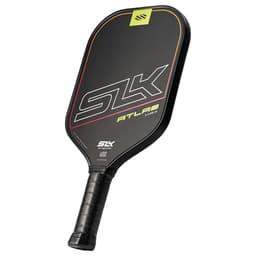
Selkirk SLK Atlas Max. The closest alternative overall, and the one we would hand to most readers of this site. Selkirk publishes a premium raw carbon fiber face with Raw Spin Technology, a 16 mm Rev-Control polymer honeycomb core, a 7.6–8.1 oz weight range, a 4.25 in grip circumference, a 4.85 in handle, 16 x 7.85 in dimensions and a low-profile EdgeSentry edge guard. Against the Hyperion: the same core thickness, the same grippy-carbon approach to spin, a published range instead of a single average, up to three quarters of an ounce lighter at the bottom of the range, and a wider and more forgiving face at the cost of the Hyperion’s reach. It is usually around a third of the price. Two honest caveats: the shorter 4.85 in handle will not take a comfortable two-handed backhand, and no USA Pickleball approval statement appears anywhere on Selkirk’s page for it. Full write-up in the SLK Atlas Max review.
Friday Challenger. The closest on build, and the most modern construction in our registry: a double-layer T700 raw carbon fiber face on a thermoformed Gen-2 body with foam-injected walls, over a 16 mm polypropylene honeycomb core, with a published 8.0 oz average weight and USA Pickleball approval per the listing. Two layers of raw carbon is more face than the Hyperion carries, and thermoforming is the technique the performance end of the market has standardized on since the Hyperion line launched. Slightly lighter on the published average, and usually well under the Hyperion’s price. What it does not publish is a grip circumference or dimensions, so we cannot tell you how it sits in the hand or how long it is — on a paddle you are buying partly for reach, that is a real gap.
Selkirk SLK Halo Power XL. The closest on shape and handle, and the pick if the elongated geometry is the specific thing you want. Selkirk publishes a T700 CarbonFusion carbon face, a 13 mm Rev-Power polymer honeycomb core, 7.7–8.0 oz, a 4.25 in grip, a 5.75 in handle — a quarter-inch longer than the Hyperion’s — and 16.4 x 7.4 in dimensions, which is within a tenth of an inch of the Hyperion’s footprint in both directions. The substantive difference is the core: 13 mm rather than 16 mm, which means stiffer, faster off the face and more vibration into the hand. If you liked the Hyperion’s shape and wanted more drive, this is the paddle; if you liked its control, it is not. Full write-up in the SLK Halo review, and our Selkirk Halo vs JOOLA Hyperion comparison takes the two head to head.
ProKennex Ovation Speed II. The alternative at the same price, for a player whose arm is the constraint rather than the budget. A Toray T700 carbon fiber face and ProKennex’s cushioned Comfort Pro grip, from the brand arm-sensitive racket-sport players reach for first. This is not a Hyperion equivalent and we are not going to present it as one: ProKennex publishes neither a core thickness nor a weight, and the paddle is positioned on comfort rather than on spin or drive. It is here because a lot of people shopping the Hyperion are 60-year-olds whose elbow is already talking, and for them the right answer at $160 is this paddle rather than that one. Full write-up in the Ovation Speed II review.
JOOLA Graf Edge 16mm. The budget pick, and the most direct answer to “like the Hyperion but cheaper”: same brand, a textured carbon fiber face, a 16 mm polypropylene honeycomb core, the same 16.5 x 7.5 in elongated footprint, a 5.5 in handle identical to the Hyperion’s, a published 7.6–8.0 oz range — lighter than the Hyperion in every part of it — and both USA Pickleball and UPA-A approval, usually for under a third of the price. What you give up is the CAS face for a textured one, the premium build, and grip size: 4.125 in is small, so plan on an overgrip or two. It leads our under-$50 list for the same reasons it is here.
Which alternative, for which reason
- “I want the same paddle for less.” The Selkirk Atlas Max first, the JOOLA Graf Edge if the budget is tighter. Both keep the 16 mm core, which is the feature that matters most.
- “8.3 oz is too much paddle for me.” The Graf Edge (7.6–8.0 oz published) or the Atlas Max (7.6–8.1 oz). If the weight is bothering your shoulder specifically, read paddles for shoulder pain, which ranks on published weight and length together.
- “I want the newest build.” The Friday Challenger, thermoformed with foam-injected walls and a double raw carbon face.
- “I want the reach and a two-handed backhand.” The Selkirk SLK Halo Power XL, with the longest published handle here at 5.75 in — accepting the thinner core. Our elongated roundup covers the shape in full.
- “My elbow already hurts.” The ProKennex, and read our tennis-elbow roundup before you spend anything. A performance paddle will not help a sore arm, whichever brand makes it.
What we are not claiming about the Hyperion
Nothing beyond what JOOLA publishes. We own no Hyperion, have not played with one, and have not measured its spin, its swing weight or its ball speed — and neither has anyone else we could cite, because no maker in this category publishes those figures. The paddle is a genuinely well-specified, USA Pickleball-approved performance paddle from a maker that discloses more than most of its competitors do, and if you want it, buy it. This page exists because the three most common reasons people go looking for something else — price, weight and a sore arm — each have a clear answer in our registry, and because comparing those answers on published specs is more useful than a ranking that pretends we tested them.
Every price here comes from the live price layer and carries the date it was checked, so a paddle that moves overnight shows its real number. Every one of the five had a live Amazon offer the day we wrote this. The ranking is on published specs and buyer fit, so a price change does not reorder it.