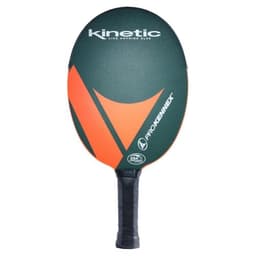
What the last fifty dollars buys, honestly
Not a better spec sheet. Both ProKennex paddles decline to publish a core thickness or a weight, which is the one thing that genuinely irritates us about them — two of the most expensive paddles we list disclose less than a fifty-dollar JOOLA does. What the money buys is design intent: a Toray T700 carbon face and a cushioned Comfort Pro grip, from a brand that has spent two decades selling vibration control to arm-sensitive racket-sport players rather than selling drive to young ones. That following is real, and it is the reason these paddles top this page. It is not a test we ran, and we say so on every ProKennex page we publish.
What the money does not buy is forgiveness or grip size. The widest published face in our registry is on a paddle that costs around sixty dollars, and the only published 4.5 in grip is on one that costs around sixty too. If your limiting factor is a hand that cannot hold a 4.25 in handle without clenching, no amount of money on this page fixes that — the arthritis roundup does.
The picks in order
ProKennex Ovation Speed II. First. A Toray T700 carbon fiber face over ProKennex’s Kinetic construction, with the cushioned Comfort Pro grip and USA Pickleball approval per the listing. This is the paddle we recommend first to anyone whose elbow or wrist flares up after a session, and the recommendation rests on two things we can defend: the carbon face is a controlled, muted surface rather than a lively one, and the grip is cushioned at the handle rather than hard under a wrap. The gaps are real — no published core thickness, no published weight — and they are the price of this brand. Full write-up in the Ovation Speed II review, and the ProKennex vs Selkirk comparison puts it against the cheaper option directly.
ProKennex Pro Flight. Second, and the most expensive paddle we list. Same Toray T700 carbon face and Comfort Pro grip, aimed at the player who wants drive as well as comfort — it is the ProKennex for someone who still likes to put the ball away. Second rather than first because the extra thirty dollars over the Ovation buys a shift in intent rather than a shift in comfort, and comfort is what this site optimizes for. If drive is the point, our power roundup ranks it first for exactly that reason. Full write-up in the Pro Flight review.
JOOLA Ben Johns Hyperion CAS 16. Third, and the one that publishes the most of any paddle in this band: an 8.3 oz average weight, a 4.25 in grip circumference, a 5.5 in grip length, 16.5 x 7.5 in dimensions, a 16 mm Response honeycomb polymer core, a Carbon Abrasion Surface face and USA Pickleball approval. The 16 mm core is the arm-friendly part; the 8.3 oz average on a 16.5 in elongated body is the part a shoulder notices, and it is the heaviest published figure in our registry. A genuinely excellent paddle for an improving player with a healthy arm. Full write-up in the Hyperion review; if you are comparing it against cheaper builds, our Hyperion alternatives page does that work.
Gamma Obsidian 13. Fourth, and the pick if your hands rather than your elbow are the problem. Gamma publishes a 13 mm core and a carbon fiber face, and the handle is a molded foam piece instead of a hard handle under a wrapped grip — the only construction like it in our registry, and a real difference for a palm that aches. It is fourth because the 13 mm core is the stiffer, more vibration-prone kind, which pulls against everything else the paddle is doing. Gamma publishes no weight figure (it ships with an adjustable weight system) and no USA Pickleball approval statement on the listing we read. Full write-up in the Gamma Obsidian review.
Selkirk SLK Atlas Max. The budget pick, and the paddle that should make you think twice about spending two hundred dollars. Selkirk publishes everything: a raw carbon fiber face with Raw Spin Technology, a 16 mm Rev-Control polymer honeycomb core, a 7.6–8.1 oz range, a 4.25 in grip, a 4.85 in handle, 16 x 7.85 in dimensions and a low-profile EdgeSentry edge guard. That is a thick soft core, a grippy raw face and the widest body we list, for roughly a third of the price of the paddle at the top of this page. The honest caveat: no USA Pickleball approval statement appears anywhere on Selkirk’s page for it, which matters only if you play sanctioned events. Full write-up in the SLK Atlas Max review.
Which one, for which arm
- Tennis elbow, or an arm that is sore the next morning. The ProKennex Ovation Speed II, and size the grip before you do anything else. Our tennis-elbow roundup has the full list.
- Arthritic hands. The Gamma for the foam handle, or the 4.5 in-grip Franklin from the under-$100 list if circumference is the real issue. Grip size beats price here.
- Healthy arm, improving fast. The JOOLA Hyperion, or the Selkirk if you would rather keep the hundred dollars.
- You want drive and your arm is fine. The ProKennex Pro Flight.
- You are not sure yet. The Selkirk Atlas Max, honestly. Nothing on this page is three times better than it.
Is a $200 paddle worth it?
For a player over 55, sometimes — and the honest test is whether the extra money is buying something your body needs or something your game wants. Vibration control is a body thing and it is worth paying for if your arm hurts; a stiffer, faster, more demanding paddle is a game thing and it is worth paying for only if your arm is fine. We work through the full version of that argument in are expensive paddles worth it, and the short answer there has not changed: the comfort features have a price floor of about a hundred dollars, and above that you are mostly buying brand, build and marginal refinement.
Prices on this page come from the live price layer and carry the date they were checked, so a paddle that moves overnight shows its real number rather than a rounded promise. Every paddle above had a live offer on the day we wrote this. The ranking is on published specs and buyer fit, so a price swing does not reorder it. And we own none of these paddles and have not tested them — every spec is read from the maker’s or retailer’s published sheet named in each product’s table.