Kitchen & Court

Best Pickleball Paddles Under $150

Raising your ceiling from $100 to $150 adds very few paddles to the shelf - but the ones it adds are the comfort-engineered ones. That is the whole argument for this price band.

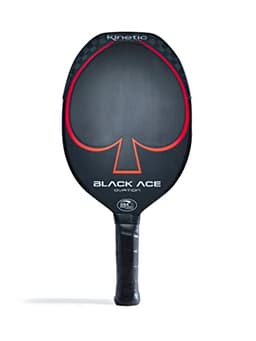
ProKennex Black Ace Ovation

Our pick

ProKennex Black Ace Ovation

The cheapest way onto ProKennex’s comfort line, and the single clearest reason to spend past $100 if your elbow or hand is the thing holding you back. Toray 700 carbon face, cushioned Comfort Pro grip, and a price that sits in the middle of this band rather than at the top of it.

$104.99 · View on Amazon

Price as of October 20, 2026. #ad How we’re funded

Read the full write-up
By Stephen V.Last updated How we research

The verdict first. Under $150, buy the ProKennex Black Ace Ovation — it is for the player whose arm, not whose game, is the limiting factor. If your hands are the problem rather than your elbow, buy the Gamma Obsidian 13 instead: it is the only paddle we list with a molded foam handle rather than a wrapped grip.

Now the honest version of what a $150 ceiling actually does, because every other page with this title implies you are unlocking a different class of paddle. You are not. We list twenty paddles. Going from a $100 budget to a $150 budget adds exactly twoof them to what you can buy. The interesting part is which two: the ProKennex Black Ace Ovation and the Gamma Obsidian 13 — and both of them are there for the same reason. They are the two paddles whose makers engineered the handle rather than the face.

That is not a coincidence. Below $100, makers compete on the things that photograph well: a carbon face, a thermoformed edge, a big published sweet spot. Comfort hardware — a cushioned grip compound, a molded foam handle, a weight system that lets you move mass off the head — is what gets cut first to hit a price. If you are 55+ and shopping around an elbow, a wrist or an arthritic hand, that is the single most useful thing to know about this price band, and it is why the two paddles the extra fifty dollars buys are the two we put at the top.

Here is the order we rank on, and why:

  1. What the maker publishes about the handle. A cushioned or molded grip is the only part of a paddle that touches you, and grip comfort is the lever that decides how hard you squeeze. Squeeze force is what an inflamed forearm tendon feels.
  2. A published core thickness, 16 mm preferred. A thicker polymer core deforms more on contact and sends less shock up the handle. We only count it when the number is printed.
  3. A published weight. Three of the five below print one. The other two do not, and we say so in the table rather than estimating from a photo.
  4. Shape, and where the mass sits. A standard 16 x 8 in head keeps weight near your hand. An elongated head moves it forward, which reads as heavier to a sore wrist even at the same ounces.
  5. Price last, not first. Everything here is under $150 at the price we last read, so the number is a filter, not a ranking.

We have not tested any of these paddles and we do not pretend to. Every spec below is the maker’s or the listing’s own published figure, every price is a live daily read with its date shown, and where a maker publishes nothing we print “Not published.”

How this is funded: we earn a commission if you buy through our links, at no extra cost to you. It never changes which product we recommend, and we’ll tell you plainly when to skip one. Full disclosure.

Quick picks

Ranked on published specs, grip and build, and honest buyer fit. Select a row to jump to the full write-up. We have not lab-tested these — here is exactly what we do instead.

#ProductBest forPrice
1
ProKennex Black Ace Ovation

ProKennex Black Ace Ovation

The most affordable way into ProKennex's comfort-first design. It carries the Toray carbon face and Comfort Pro grip at a price closer to a mainstream paddle, so it's the one to pick if the brand appeals but the flagship prices don't.

Best overall under $150
$104.99 · View on Amazon

Price as of October 20, 2026. #ad How we’re funded

2
Gamma Obsidian 13

Gamma Obsidian 13

The standout for hands that hurt: Gamma gives this one a molded foam handle instead of a hard wrapped grip, plus a system that lets you add handle weight to balance the paddle. Softer to hold and easier to customize is exactly what an arthritic grip wants.

Best for arthritic hands
$129.99 · View on Amazon

$159.9919% off

Price as of October 20, 2026. #ad How we’re funded

3
Friday Challenger

Friday Challenger

Friday's Gen 2 paddle, and the cheapest way into the brand's thermoformed carbon build. Two layers of T700 raw carbon over a 16mm honeycomb core with foam-injected walls give a stiff, stable, big-sweet-spot feel that flatters a developing game — and unlike most makers here, Friday actually publishes what the paddle weighs.

Best published spec sheet
$99.99 · View on Amazon

Price as of October 20, 2026. #ad How we’re funded

4
JOOLA Ben Johns Hyperion CAS 16

JOOLA Ben Johns Hyperion CAS 16

The performance benchmark on this list — a carbon-surface, 16mm-core paddle with an elongated handle built for spin and reach. It's more paddle than a beginner needs, but for an improving player the extra sweet spot and control are the payoff. Note the elongated handle suits a two-handed backhand.

Best for an improving player
$103.13 · View on Amazon

$119.9514% off

Price as of October 20, 2026. #ad How we’re funded

5
Paddletek Bantam EX-L

Paddletek Bantam EX-L

A long-running paddle from an established American maker, and the most settled reputation on this list. Paddletek publishes its weight range and handle length, the Bantam PolyCore is a proper polymer honeycomb, and the standard 16 x 8-inch shape keeps the weight close to your hand rather than out at the tip. It is the closest thing under $100 to buying a serious club player's paddle.

Best standard-shape all-rounder
$89.99 · View on Amazon

$99.9910% off

Price as of October 20, 2026. #ad How we’re funded

The picks in full

#1Best overall under $150

ProKennex Black Ace Ovation

The most affordable way into ProKennex's comfort-first design. It carries the Toray carbon face and Comfort Pro grip at a price closer to a mainstream paddle, so it's the one to pick if the brand appeals but the flagship prices don't.

Easier on the joints: Same comfort recipe as the flagship ProKennex paddles — carbon face, cushioned grip — for players who want the arm-friendly feel on a smaller budget.

What we like

  • ProKennex comfort design at a mid-market price
  • Toray carbon face and cushioned Comfort Pro grip
  • Good bridge from a beginner paddle to a comfort-focused one

Skip it if

  • Fewer published specs than the pricier ProKennex models
  • Still costs more than a budget fiberglass paddle
Face materialToray 700 carbon fiber
CoreNot published
GripComfort Pro (cushioned)
WeightNot published
USA Pickleball approvedNot published

Specs read from the product listing, on July 22, 2026. “Not published” means the maker does not state that figure.

#2Best for arthritic hands

Gamma Obsidian 13

The standout for hands that hurt: Gamma gives this one a molded foam handle instead of a hard wrapped grip, plus a system that lets you add handle weight to balance the paddle. Softer to hold and easier to customize is exactly what an arthritic grip wants.

Easier on the joints: The molded foam handle spreads pressure across your palm instead of concentrating it, and the weight system lets you keep the paddle light — both directly reduce hand and wrist strain.

What we like

  • Molded foam handle is genuinely softer to grip than a standard wrap
  • Customizable handle-weight system lets you tune the balance
  • 13mm carbon-fiber build for a controlled, forgiving feel

Skip it if

  • Foam handle is a love-it-or-not feel — try before committing if you can
  • Exact weight isn't published
Face materialCarbon fiber
Core thickness13 mm
GripMolded foam handle
WeightNot published (adjustable via weight system)
USA Pickleball approvedNot published

Specs read from the product listing, on July 22, 2026. “Not published” means the maker does not state that figure.

#3Best published spec sheet

Friday Challenger

Friday's Gen 2 paddle, and the cheapest way into the brand's thermoformed carbon build. Two layers of T700 raw carbon over a 16mm honeycomb core with foam-injected walls give a stiff, stable, big-sweet-spot feel that flatters a developing game — and unlike most makers here, Friday actually publishes what the paddle weighs.

Easier on the joints: Foam-injected walls stiffen the paddle's edges, which widens the area that answers the same way on contact — and more centered-feeling contact is the single biggest thing you can do to keep harsh off-center vibration out of your elbow.

What we like

  • Double-layer T700 raw carbon face with a gritty surface for spin
  • Thermoformed Gen 2 build with foam-injected walls — a stable, large sweet spot
  • USA Pickleball approved, and Friday publishes the weight when most brands won't

Skip it if

  • Thermoformed paddles feel stiffer, which not every sore arm loves
  • At 16.5 in it's an elongated shape, which sits heavier in the hand than a standard head
Face materialDouble-layer T700 raw carbon fiber
ConstructionThermoformed (Gen 2), foam-injected walls
Core16 mm polypropylene honeycomb
Weight8.0 oz average (published)
USA Pickleball approvedYes (per listing)

Specs read from the product listing, on August 24, 2026. “Not published” means the maker does not state that figure.

#4Best for an improving player

JOOLA Ben Johns Hyperion CAS 16

The performance benchmark on this list — a carbon-surface, 16mm-core paddle with an elongated handle built for spin and reach. It's more paddle than a beginner needs, but for an improving player the extra sweet spot and control are the payoff. Note the elongated handle suits a two-handed backhand.

Easier on the joints: The thick 16mm core is the soft, control-oriented kind that muffles impact well — but the elongated head puts a little more weight out front, so it's better for elbows than for a weak wrist.

What we like

  • Carbon abrasion surface generates real spin and control
  • Thick 16mm polypropylene honeycomb core for a soft, muted feel
  • Elongated handle helps two-handed backhands and reach

Skip it if

  • The elongated head can feel heavier in the hand — not ideal for a sore wrist
  • More paddle (and price) than a casual player needs
Face materialCarbon abrasion surface
Core thickness16 mm polypropylene honeycomb
HandleElongated (sure-grip)
Weight8.3 oz average (published)
Grip circumference4.25 in
Handle length5.5 in
Dimensions16.5 x 7.5 in
USA Pickleball approvedYes (per listing)

Specs read from the product listing, on September 18, 2026. “Not published” means the maker does not state that figure.

#5Best standard-shape all-rounder

Paddletek Bantam EX-L

A long-running paddle from an established American maker, and the most settled reputation on this list. Paddletek publishes its weight range and handle length, the Bantam PolyCore is a proper polymer honeycomb, and the standard 16 x 8-inch shape keeps the weight close to your hand rather than out at the tip. It is the closest thing under $100 to buying a serious club player's paddle.

Easier on the joints: A standard 16 x 8-inch shape carries its weight close to the handle rather than out at the tip, so it feels lighter to swing than the number suggests - and that balance matters more to a sore wrist than the raw ounces do.

What we like

  • Established brand with a long production history behind this exact model
  • Bantam PolyCore polymer honeycomb core, not a cheap stiff core
  • Standard 16 x 8-inch shape keeps weight near the hand - easier on the wrist than an elongated paddle

Skip it if

  • 7.8-8.4 oz is the heaviest published range on this list
  • The 12.7 mm core is thinner than the 16 mm picks, so the feel is firmer
  • Paddletek does not publish a grip circumference
Face materialPolycarbonate (per listing)
Core12.7 mm Bantam PolyCore honeycomb
Weight7.8-8.4 oz (published range)
Grip circumferenceNot published
Handle length5 in
Dimensions16 x 8 in (standard)
USA Pickleball approvedYes (per listing)

Specs read from the product listing, on August 24, 2026. “Not published” means the maker does not state that figure.

The two paddles that only a $150 budget unlocks

It is worth being specific about this, because it is the reason the page exists. Our best pickleball paddles under $100list is a genuinely good list — a 16 mm Selkirk, a Franklin with a published weight range, a Paddletek with a production history. What it cannot contain, at that ceiling, is either of the two paddles built around a hand rather than a hitting surface.

The ProKennex Black Ace Ovationis the entry point to the line that arm-sensitive players have been passing around for years. It carries the same two things the flagship Ovation Speed II does — a Toray 700 carbon face and the brand’s cushioned Comfort Pro grip — at roughly two thirds of the flagship’s price. What it does not carry is a published weight or a published core thickness, and we put that in the cons rather than hiding it. If specs matter more to you than the comfort reputation, pick number three or four below.

The Gamma Obsidian 13solves a different problem. Almost every paddle on the market finishes the handle with a wrapped grip over a hard core. Gamma molds the handle itself out of foam. For a hand with base-of-thumb arthritis or stiff finger joints, that changes how pressure is distributed across the palm — and Gamma pairs it with a weight system that lets you add mass at the handle, which is the end of the paddle that does not punish your wrist. The trade is that the foam feel is polarising and that Gamma does not publish a finished weight.

What $150 does not buy you, and why that is good news

It does not buy a lighter paddle. Of the paddles here that publish a weight, the range runs 7.8–8.4 oz, which is the same range as our under-$50 picks. Paddle weight is not a price feature — it is a design choice, and budget paddles are often the lightest things on the market. If low weight is your actual requirement, go to lightweight pickleball paddles and ignore price entirely.

It does not buy a thicker core either. A 16 mm polypropylene honeycomb core is available under $75 — see our 16 mm ranking— and two of the five paddles on this page have one. Core thickness has become a commodity.

What it does buy is the handle, the brand’s production history, and in the Friday Challenger’s case a maker willing to publish an actual average weight when most will not. Those are smaller gains than the price jump suggests, and you should know that before you spend the money. On a site aimed at players managing a joint, we would rather tell you the extra fifty dollars is optional than imply it is required.

Where to spend the money instead, if your arm is the problem

A genuinely useful piece of arithmetic: a cushioned overgripcosts under $15, and wrapping one over your existing handle increases grip circumference and adds cushion — the two mechanical changes a cushioned-grip paddle is selling you. If your current paddle is otherwise fine, that is a far cheaper experiment than a new paddle, and it is reversible in ten minutes. We walk through it in how to wrap a pickleball paddle grip, including how to use the wrap to build the handle out to the size your hand actually wants.

If the pain is specifically on the outside of the elbow, the paddle is only one of three levers and probably not the first one. Read tennis elbow from pickleball and best pickleball paddles for tennis elbow, which ranks on vibration control rather than on price.

What we would buy, in one paragraph

If your arm flares up and you want to stop reading: the ProKennex Black Ace Ovation. If your hands are the problem, the Gamma Obsidian 13. If you want the most published specification for your money — a named carbon face, a 16 mm core, a thermoformed build and an actual average weight in ounces — the Friday Challenger. If you are improving fast and want reach and spin, the JOOLA Ben Johns Hyperion CAS 16, with the caveat that its elongated head sits heavier in the hand than its 8.3 oz suggests. And if none of that moves you, you can spend eighty dollars less on our under-$100 listand lose very little. Nothing here was tested by us; nothing here is medical advice; and every number on this page is the maker’s, not ours. Our methodology is here.

Two of the paddles above now have full write-ups of their own. If the Paddletek is the one you keep coming back to, our Paddletek Bantam EX-L review covers the 16 x 8 in face in detail — including why a bigger face does less for a sore elbow than a thicker core does, which is the whole argument of this price band.
Frequently asked questions

What is the best pickleball paddle under $150?

For a player 55 or over who is shopping around an elbow, wrist or hand, the ProKennex Black Ace Ovation. It is the cheapest paddle on the ProKennex comfort line, carrying the same Toray 700 carbon face and cushioned Comfort Pro grip as the brand's flagship at a lower price. If your hands rather than your arm are the problem, the Gamma Obsidian 13 instead - it is the only paddle we list with a molded foam handle rather than a wrapped grip over a hard core.

Is a $150 pickleball paddle better than a $75 one?

Not in the ways most people assume. It is not lighter - the published weights in this band, 7.8 to 8.4 oz, are the same as the sub-$50 band. It is not thicker-cored - 16 mm polypropylene cores are available under $75. What the extra money reliably buys is handle engineering (a cushioned compound or a molded foam handle), an established brand's production history, and in some cases a maker willing to publish a real average weight. If none of those three things matter to you, the cheaper paddle is the better buy.

How many paddles does going from $100 to $150 actually add?

On our registry of twenty paddles, two: the ProKennex Black Ace Ovation and the Gamma Obsidian 13. That is a small number and we would rather say so. The reason the page is still worth reading is which two they are - both are paddles whose makers engineered the handle rather than the hitting face, which is exactly the feature that gets cut first to hit a lower price and exactly the feature a sore hand or elbow feels.

Should a senior buy a heavier or lighter paddle under $150?

Lighter for a wrist, heavier for an elbow, and balance matters more than either. A lighter paddle is less load to start and stop, which protects a weak or painful wrist. A slightly heavier paddle absorbs more of the ball's energy instead of passing it to your arm, which can suit an elbow. Where the weight sits matters more than the number: a standard 16 x 8 in head keeps mass near your hand, while an elongated head moves it forward and feels heavier at the same ounces.

Do any paddles under $150 publish their weight?

Three of our five picks do: the Friday Challenger at a published 8.0 oz average, the JOOLA Ben Johns Hyperion CAS 16 at 8.3 oz average, and the Paddletek Bantam EX-L at a published 7.8 to 8.4 oz range. The ProKennex Black Ace Ovation and the Gamma Obsidian 13 do not, and we print 'Not published' in those cells rather than estimating. Gamma's figure is genuinely variable because the Obsidian ships with a handle weight system.

Is a cheaper overgrip a real alternative to a comfort paddle?

It is a real alternative to trying one, which is not the same thing. A cushioned overgrip costs under $15, adds cushioning and increases grip circumference - the two mechanical changes a comfort-grip paddle is selling. If your existing paddle is otherwise fine, rewrapping it is the cheaper experiment and it takes ten minutes to undo. What an overgrip cannot change is the core, the face material or the balance point, so if the shock you feel is coming through the face rather than the handle, the paddle is still the lever.

Sources

  • Paddletek — Bantam EX-L product page (manufacturer specifications) — Paddletek publishes: 7.8-8.4 oz weight range, 5 in handle length, a 'Standard - 16 x 8' shape, 12.7 mm core thickness, Bantam PolyCore interior, $89.99. Grip circumference, face material and USA Pickleball approval are not stated on the page (accessed September 18, 2026)
  • JOOLA — Ben Johns Hyperion CAS 16 product page (manufacturer specifications) — JOOLA publishes: average weight 8.3 oz (no range stated), grip circumference 4.25 in ('may vary slightly'), grip length 5.5 in, paddle length 16.5 in, width 7.5 in, 16 mm Response honeycomb polymer core, Carbon Abrasion Surface (CAS) face, Ridge grip, USA Pickleball approved: yes (accessed September 18, 2026)
  • Pickleball Studio — How Thick Should Your Pickleball Paddle Be? (Chris Olson, Aug 31, 2022) — Thicker cores (16 mm and above) are for control: 'less power but usually improves your blocks, resets, and drop shots', 'helps absorb more of the pace from the ball', and they 'usually feel like they have a better sweet spot'. Thinner cores (13 mm and below) 'feel stiffer when the ball hits the paddle', the core 'doesn't absorb as much energy, so the ball comes off faster', and 'thinner paddles usually provide more vibration and worse off-center shot performance'. Recommendation: 'If you are a new player up to about 3.5, I would usually tell you to opt for a thicker paddle.' The article does not address arm pain or older players specifically (accessed September 18, 2026)
  • USA Pickleball — Approved Paddles list — The searchable database of paddles that have passed USA Pickleball certification testing (accessed July 22, 2026)
  • A Review of Physiotherapy Techniques Used in the Treatment of Tennis Elbow — PMC (2023) — Lateral epicondylitis is an overuse tendinopathy of the forearm extensors; conservative care — rest, bracing/counterforce straps and graduated loading — is the mainstay (accessed July 22, 2026)

Keep reading