The picks, joint by joint
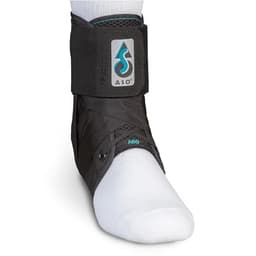
Ankle: Med Spec ASO Ankle Stabilizer. The brace athletic trainers hand out, and by some distance the most support on this page. Med Spec publishes a lace-up stabilizing orthosis with figure-eight straps and a circumferential elastic cuff, CoolFlex padding with spandex, a spacer-mesh tongue and Achilles panel, eight sizes running from XX-Small (a 9–10 in ankle) to 3X-Large (16 in and up), and a bilateral fit so one brace works on either foot. The figure-eight strapping is the point — it mimics a taping job and restrains the inversion movement that rolls an ankle, which is the mechanism behind most pickleball sprains. Published senior-injury data puts sprains near the top of the list for this age group, which is why this is our overall pick under $50 even if your ankle has never gone over. Measure before you order; the sizing is by circumference, not shoe size. Full write-up in the ASO review.
Wrist: FUTURO Deluxe Wrist Stabilizer. The firmest wrist support under $50, and the one to buy if your wrist needs limiting rather than warming. The listing publishes a removable splint, a firm support level, a hand-specific (left or right) fit, and targeting for carpal tunnel and wrist strain. The removable splint is what makes it versatile: in for the hours the wrist needs holding still, out when you want support you can still move in. AAOS describes wrist splinting as a standard first step for carpal tunnel symptoms, with night-time wear the usual pattern — which is exactly what this one is for, and not what you play in. Full write-up in the FUTURO review, and the FUTURO vs Mueller comparison covers the play-in alternative.
Elbow: Mueller Tennis Elbow Brace with Gel Pad. A counterforce strap with a gel pressure pad, one size, adjustable, and the top pick of our full elbow-brace roundup. A counterforce strap works differently from a sleeve: instead of compressing the joint, it applies targeted pressure to the forearm muscle a couple of inches below the elbow, which changes where the load lands on the tendon. The gel pad spreads that pressure rather than concentrating it on a seam, which is the difference between a strap you keep wearing and one that ends up in a drawer. Our how to wear an elbow brace guide covers placement, which matters more than the product does.
Knee: Shock Doctor Knee Compression Sleeve. For a knee that wants warmth, mild support and all-day wearability rather than real stabilization. Shock Doctor publishes a compression sleeve rated for compression and warmth, targeted at arthritis, tendonitis and patella alignment, from a sports-medicine brand rather than a marketplace one. If your knee is genuinely unstable — it gives way, or it worries you on a side-to-side push — a sleeve is the wrong product and a hinged brace is the right one, which costs more than this page allows; our GenuTrain alternatives page covers that step up, and knee sleeve vs brace explains the difference properly.
Hands: IMAK Compression Arthritis Gloves. Our first-choice arthritis glove for the paddle hand. A fingerless compression glove with mild compression over the palm and hand and open fingers, so you can still feel the handle and still do up a zip. The open-finger design is what makes it wearable on court rather than only on the sofa. The CDC is clear that staying active is part of managing arthritis rather than something to be endured around it, and a glove that lets you hold the paddle without clenching is equipment in service of that. Full write-up in the IMAK gloves review.
Budget pick: CAMBIVO Tennis Elbow Brace Strap, two-pack. Under ten dollars for two adjustable counterforce straps, and the cheapest thing on this page that does a real job. We recommend it for one specific purpose: finding out whether a counterforce strap helps your elbow at all before spending more. Plenty of people find a strap transforms a sore elbow and plenty find it does nothing, and there is no way to know which you are except by wearing one. Two in the pack means one lives in the bag. If it works, the Mueller gel version above is the one to upgrade to.
What $50 does not buy
- A hinged knee brace with side stabilizers. The cheapest real one in our registry sits around sixty dollars. If your knee is unstable rather than sore, save for it — a sleeve will not do that job however long you wear it.
- Medical-grade knitted supports. Bauerfeind’s GenuTrain (knee), EpiTrain (elbow) and MalleoTrain (ankle) all sit at roughly double this ceiling. They are measured, anatomically knitted and genuinely different products; our GenuTrain alternatives page sets out what you give up by not buying one.
- A braced ankle with a rigid guard. The Zamst A2-DX, which Zamst rates “strong” and builds left- and right-specific, is well above $50 and is the step up from the ASO for chronic instability. The ASO vs Zamst A2-DX comparison is the page for that decision.
- Graduated compression with a published mmHg figure. Two of the compression socks we list publish one and sit above thirty dollars; most of the cheap ones publish nothing. See best compression socks for pickleball.
Buy one, not five
The most common mistake we see in this category is buying a support for every joint that has ever ached. Don’t. A brace changes how a joint loads, and loading five joints differently at once means you cannot tell what helped. Buy the one for the joint that is actually limiting your play, wear it for a few sessions, and see what happens. If it helps, keep it; if it does nothing, the problem is probably somewhere else in the chain — often the shoes, often the paddle grip. Our senior injury-prevention gear guide puts the whole kit in order of what actually prevents the injuries 55-plus players get, and the braces are not at the top of it.
Sizing, finally, is the thing that decides whether any of this works. The ASO is sold by ankle circumference in eight sizes, the FUTURO is hand-specific, the Shock Doctor and the gloves are sold by size, and a support that is too big does nothing while one that is too small comes off. Measure with a tape before you order rather than guessing from your shoe or glove size.
Every price on this page comes from the live price layer and carries the date it was checked, so a support that drifts over $50 shows its real number rather than a rounded promise. We own none of these products and have not tested them — every specification above is read from the maker’s own published page or the listing named in each product’s spec table, on the date shown there.