Kitchen & Court

Best Pickleball Paddles for Tennis Players

Long handles for the two-handed backhand, elongated faces for reach, and a published weight so the switch is kind to a shoulder and elbow that already have tennis miles on them.

JOOLA Ben Johns Hyperion CAS 16

Our pick

JOOLA Ben Johns Hyperion CAS 16

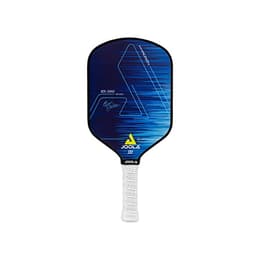
The paddle that feels most like a racket in the hand: a 16.5-inch elongated face, a 5.5-inch handle with room for a second hand, a textured carbon surface that rewards the topspin you already have, and a 16 mm core that softens the ball. JOOLA publishes the weight (8.3 oz average) and the grip (4.25 in), so you know what you are getting.

$119.95 · View on Amazon

Price as of September 17, 2026. #ad How we’re funded

Read the full write-up
By Stephen V.Last updated How we research

If you played tennis for thirty years, pickleball will feel familiar for about a week and then start correcting you. The strokes are shorter, the ball is slower and lighter, the paddle has no strings to bail out a late swing, and the “kitchen” takes away the one thing tennis taught you to do at the net. Most tennis converts we hear from want two things from a first paddle: a handle long enough for the two-handed backhand they are not about to give up, and a face long enough that the reach they are used to is still there. Both of those describe an elongated paddle, and that is what this page leads with.

The catch is that this site exists for players over 55, and the tennis players who switch late tend to arrive with a history — a shoulder that has served a hundred thousand balls, an elbow that has already had one round of tennis elbow. An elongated paddle moves weight away from the hand, and a heavy one asks more of exactly those joints. So every paddle here had to publish its weight, or be a ProKennex, and we say plainly which ones an arm with miles on it should avoid. The good news, from the American Academy of Orthopaedic Surgeons, is that the sport you are moving to is the easier one: AAOS lists doubles tennis and pickleball together as lower-impact activities, against singles tennis on the high-impact side.

How this is funded: we earn a commission if you buy through our links, at no extra cost to you. It never changes which product we recommend, and we’ll tell you plainly when to skip one. Full disclosure.

Quick picks

Ranked on published specs, grip and build, and honest buyer fit. Select a row to jump to the full write-up. We have not lab-tested these — here is exactly what we do instead.

#ProductBest forPrice
1
JOOLA Ben Johns Hyperion CAS 16

JOOLA Ben Johns Hyperion CAS 16

The performance benchmark on this list — a carbon-surface, 16mm-core paddle with an elongated handle built for spin and reach. It's more paddle than a beginner needs, but for an improving player the extra sweet spot and control are the payoff. Note the elongated handle suits a two-handed backhand.

Best overall for tennis converts
$119.95 · View on Amazon

Price as of September 17, 2026. #ad How we’re funded

2
Franklin Sports Signature Series Pro 16mm

Franklin Sports Signature Series Pro 16mm

The one on this list built for a hand that hurts. Its published grip circumference is 4.5 inches - the largest we found on any paddle under $100 - and a larger grip is what lets an arthritic hand hold the paddle loosely instead of squeezing it. Add a 16 mm polypropylene core and USA Pickleball approval and that is a lot of comfort for the money.

Longest handle, biggest grip, under $70
$64.85 · View on Amazon

Price as of September 17, 2026. #ad How we’re funded

3
Selkirk SLK Halo Power XL

Selkirk SLK Halo Power XL

A carbon-fiber Selkirk that still lands under most premium paddles. The XL shape adds reach and a generous sweet spot; the carbon face gives a cleaner, more controlled response than the fiberglass Evo. A strong mid-tier step up.

Best carbon XL under $100
$99.99 · View on Amazon

$149.9933% off

Price as of September 17, 2026. #ad How we’re funded

4
Paddletek Bantam EX-L

Paddletek Bantam EX-L

A long-running paddle from an established American maker, and the most settled reputation on this list. Paddletek publishes its weight range and handle length, the Bantam PolyCore is a proper polymer honeycomb, and the standard 16 x 8-inch shape keeps the weight close to your hand rather than out at the tip. It is the closest thing under $100 to buying a serious club player's paddle.

Best standard shape for a sore shoulder
$89.99 · View on Amazon

$99.9910% off

Price as of September 17, 2026. #ad How we’re funded

5
Selkirk SLK Evo Hybrid XL

Selkirk SLK Evo Hybrid XL

Selkirk is a top-tier pickleball name, and the SLK Evo Hybrid is its most affordable way in. A fiberglass XL shape gives you extra reach and a bigger sweet spot for the money — a lot of forgiveness for a budget paddle.

Best budget XL
$59.88 · View on Amazon

Price as of September 17, 2026. #ad How we’re funded

6
ProKennex Ovation Speed II

ProKennex Ovation Speed II

ProKennex built its whole reputation on arm comfort, and the Ovation Speed II is the clearest expression of it — a Toray carbon face and the brand's cushioned Comfort Pro grip, aimed squarely at players whose elbow or wrist flares up. If a paddle has ever left your arm sore, this is the brand to try first.

Best if tennis left you with tennis elbow
$159.99 · View on Amazon

Price as of September 17, 2026. #ad How we’re funded

The picks in full

#1Best overall for tennis converts

JOOLA Ben Johns Hyperion CAS 16

The performance benchmark on this list — a carbon-surface, 16mm-core paddle with an elongated handle built for spin and reach. It's more paddle than a beginner needs, but for an improving player the extra sweet spot and control are the payoff. Note the elongated handle suits a two-handed backhand.

Easier on the joints: The thick 16mm core is the soft, control-oriented kind that muffles impact well — but the elongated head puts a little more weight out front, so it's better for elbows than for a weak wrist.

What we like

  • Carbon abrasion surface generates real spin and control
  • Thick 16mm polypropylene honeycomb core for a soft, muted feel
  • Elongated handle helps two-handed backhands and reach

Skip it if

  • The elongated head can feel heavier in the hand — not ideal for a sore wrist
  • More paddle (and price) than a casual player needs
Face materialCarbon abrasion surface
Core thickness16 mm polypropylene honeycomb
HandleElongated (sure-grip)
Weight8.3 oz average (published)
Grip circumference4.25 in
Handle length5.5 in
Dimensions16.5 x 7.5 in
USA Pickleball approvedYes (per listing)

Specs read from the product listing, on September 18, 2026. “Not published” means the maker does not state that figure.

#2Longest handle, biggest grip, under $70

Franklin Sports Signature Series Pro 16mm

The one on this list built for a hand that hurts. Its published grip circumference is 4.5 inches - the largest we found on any paddle under $100 - and a larger grip is what lets an arthritic hand hold the paddle loosely instead of squeezing it. Add a 16 mm polypropylene core and USA Pickleball approval and that is a lot of comfort for the money.

Easier on the joints: Grip size is the one paddle spec that changes how hard your hand has to work, and a too-small grip is the classic self-inflicted cause of hand and elbow pain. At 4.5 inches this is the rare affordable paddle you can hold loosely without building it up with overgrips first.

What we like

  • 4.5-inch grip circumference - the largest published grip in this price range
  • 16 mm polypropylene honeycomb core for a soft, stable, quiet feel
  • USA Pickleball approved, so it is legal for club and tournament play

Skip it if

  • At 7.9-8.3 oz it is one of the heavier paddles here - not the pick for a weak wrist
  • That 4.5-inch grip is genuinely large; smaller hands will find it a stretch
  • The fiberglass face is livelier than carbon, so it transmits a little more feel
Face materialMaxGrit coated fiberglass
Core16 mm polypropylene honeycomb
Weight7.9-8.3 oz (published range)
Grip circumference4.5 in (large)
Handle length5.6 in
Dimensions16.5 x 7.5 in
USA Pickleball approvedYes

Specs read from the product listing, on August 24, 2026. “Not published” means the maker does not state that figure.

#3Best carbon XL under $100

Selkirk SLK Halo Power XL

A carbon-fiber Selkirk that still lands under most premium paddles. The XL shape adds reach and a generous sweet spot; the carbon face gives a cleaner, more controlled response than the fiberglass Evo. A strong mid-tier step up.

Easier on the joints: Carbon faces tend to feel more muted and predictable than fiberglass, so the ball comes off cleanly — easier on the arm than a lively, unpredictable budget face.

What we like

  • Carbon-fiber face for cleaner control than fiberglass
  • XL shape adds reach and forgiveness
  • Priced well below premium carbon paddles

Skip it if

  • The Power build leans toward drive, not pure touch
  • Elongated shape isn't for everyone
Face materialT700 CarbonFusion carbon fiber
Core13 mm Rev-Power polymer honeycomb
ShapeXL (elongated)
Weight7.7-8.0 oz (published range)
Grip circumference4.25 in
Handle length5.75 in
Dimensions16.4 x 7.4 in
USA Pickleball approvedNot published

Specs read from the product listing, on September 18, 2026. “Not published” means the maker does not state that figure.

#4Best standard shape for a sore shoulder

Paddletek Bantam EX-L

A long-running paddle from an established American maker, and the most settled reputation on this list. Paddletek publishes its weight range and handle length, the Bantam PolyCore is a proper polymer honeycomb, and the standard 16 x 8-inch shape keeps the weight close to your hand rather than out at the tip. It is the closest thing under $100 to buying a serious club player's paddle.

Easier on the joints: A standard 16 x 8-inch shape carries its weight close to the handle rather than out at the tip, so it feels lighter to swing than the number suggests - and that balance matters more to a sore wrist than the raw ounces do.

What we like

  • Established brand with a long production history behind this exact model
  • Bantam PolyCore polymer honeycomb core, not a cheap stiff core
  • Standard 16 x 8-inch shape keeps weight near the hand - easier on the wrist than an elongated paddle

Skip it if

  • 7.8-8.4 oz is the heaviest published range on this list
  • The 12.7 mm core is thinner than the 16 mm picks, so the feel is firmer
  • Paddletek does not publish a grip circumference
Face materialPolycarbonate (per listing)
Core12.7 mm Bantam PolyCore honeycomb
Weight7.8-8.4 oz (published range)
Grip circumferenceNot published
Handle length5 in
Dimensions16 x 8 in (standard)
USA Pickleball approvedYes (per listing)

Specs read from the product listing, on August 24, 2026. “Not published” means the maker does not state that figure.

#5Best budget XL

Selkirk SLK Evo Hybrid XL

Selkirk is a top-tier pickleball name, and the SLK Evo Hybrid is its most affordable way in. A fiberglass XL shape gives you extra reach and a bigger sweet spot for the money — a lot of forgiveness for a budget paddle.

Easier on the joints: A bigger sweet spot means more clean, centered hits — and a centered hit sends far less jarring vibration into your arm than a mis-hit off the edge.

What we like

  • Selkirk quality at an entry price
  • XL shape gives a larger, more forgiving sweet spot
  • Good reach for defending the kitchen line

Skip it if

  • Fiberglass face over carbon at this tier
  • Elongated shape can feel head-heavy to some hands
Face materialFiberglass
CoreNot published
ShapeXL (elongated)
WeightNot published
USA Pickleball approvedNot published

Specs read from the product listing, on July 22, 2026. “Not published” means the maker does not state that figure.

#6Best if tennis left you with tennis elbow

ProKennex Ovation Speed II

ProKennex built its whole reputation on arm comfort, and the Ovation Speed II is the clearest expression of it — a Toray carbon face and the brand's cushioned Comfort Pro grip, aimed squarely at players whose elbow or wrist flares up. If a paddle has ever left your arm sore, this is the brand to try first.

Easier on the joints: ProKennex designs its comfort line around vibration control, and pairs it with an extra-cushioned grip — the two things that most reduce the shock and squeeze your elbow and hand feel on every hit.

What we like

  • Toray T700 carbon-fiber face — a controlled, muted feel rather than a harsh pop
  • Cushioned Comfort Pro grip takes pressure off the palm and fingers
  • ProKennex is the brand arm-sensitive players reach for — that following is real

Skip it if

  • Among the pricier paddles here for its category
  • Exact weight and grip circumference are not published on the listing
Face materialToray T700 carbon fiber
CoreNot published
GripComfort Pro (cushioned)
WeightNot published
USA Pickleball approvedYes (per listing)

Specs read from the product listing, on July 22, 2026. “Not published” means the maker does not state that figure.

What is different in your hand, and why it matters for your arm

A pickleball paddle is a solid face on a short handle, and under USA Pickleball’s equipment rules (2.E.3) its length plus width cannot exceed 24 inches, with a maximum length of 17 inches. There is no rule on weight or thickness, which is why makers are free not to publish them — and many don’t. The paddles here that publish a weight run from roughly 7.7 to 8.4 ounces, and none is strung, so there is no trampoline: the ball comes off a paddle faster and with less dwell than off a string bed, and the shock of contact goes straight into the handle.

That last point is the one a tennis player’s arm notices. Strings absorb a lot of the impact in tennis. In pickleball the core does that job, and a thicker core does it better — which is why four of the six paddles here publish a polymer honeycomb core between 12.7 and 16 mm thick, and two of those are the full 16 mm. If your elbow is a known quantity, read our core-thickness explainer before you decide, and read the ProKennex entry below.

Handle length: the two-handed backhand question

Most pickleball handles are around 5 inches. A second hand needs something closer to 5.5 inches to sit comfortably, and the three paddles here with the longest published handles are the Selkirk Halo Power XL at 5.75 in, the Franklin Signature Pro at 5.6 in and the JOOLA Hyperion at 5.5 in. The Paddletek is a 5-inch handle on a standard shape, and it is here for the tennis player whose shoulder has told them to stop swinging long things; it is the most maneuverable paddle on the list and the one we would hand to a former player with a rotator-cuff history. Our paddle shapes guide goes through the trade in detail.

One honest observation: a lot of tennis converts abandon the two-hander within a season, because the ball is so much lighter that a one-handed block or a “dink” from the kitchen line does the job. If you think that might be you, the longer handle is still worth having — it costs nothing on the forehand — but do not pay a premium for it.

Grip size: smaller than you are used to

Tennis grips run larger than pickleball grips, and every paddle here that publishes a grip circumference is between 4.25 and 4.5 inches. That is a deliberate filter. A grip that is too small makes you clench, and clenching for two hours is the most reliable way we know to wake up a dormant tennis elbow. If you played with a 4 3/8 or larger tennis grip, the Franklin’s 4.5 in handle is the closest thing on this page to what your hand knows, and it is also the paddle we recommend first for arthritic hands. Everything else here that publishes a grip is 4.25 in, and you can build that up with an overgrip or two; our grip-size guide shows the measurement.

The picks in order, and who each is for

JOOLA Ben Johns Hyperion CAS 16. The obvious choice and, for most tennis players, the right one. Elongated, a 5.5 in handle, a textured carbon face that takes the topspin you already know how to generate, and a 16 mm core that keeps the ball soft. At a published 8.3 oz average it sits at the top of the published weights on this page, which is the trade for the reach — and why a weak wrist should look further down the list.

Franklin Signature Pro 16mm. The value pick, and the one with the longest handle-plus-grip combination for a former tennis player: 5.6 in long and 4.5 in around, on a 16.5 in elongated face with a 16 mm core, at a published 7.9-8.3 oz. A fiberglass face rather than carbon, which is livelier and a little less forgiving, and the honest reason it is second rather than first.

Selkirk SLK Halo Power XL. Selkirk’s own spec sheet lists it at 7.7-8.0 oz — the lightest published range on this page — with the longest handle, 5.75 in, on a 16.4 in XL face. The trade is a 13 mm core, which is the firmer, livelier kind: more pop off the face, a touch more feedback into the arm. Good for a tennis player who wants to keep some drive; less good for one whose elbow is the reason they switched. Full write-up in the Halo Power XL review.

Paddletek Bantam EX-L. The one standard-shape paddle here, 16 x 8 inches with a 5 in handle and a published 7.8-8.4 oz. No room for a second hand, but the weight sits closer to your fist than on any elongated paddle, and that is what a sore shoulder feels. If you are switching because of a shoulder, this is our pick, and our shoulder-pain roundup explains why.

Selkirk SLK Evo Hybrid XL. The cheapest way to try an elongated Selkirk. Fiberglass, and Selkirk does not publish a weight or core for this one on any page we could find, so it is here on shape and price rather than on a spec sheet. A sensible first paddle for a tennis player who is not yet sure they will stay.

ProKennex Ovation Speed II. Not elongated, no long handle, and ProKennex does not publish the weight. It is on this page for one reason: it is the paddle arm-sensitive players reach for, built around the brand’s vibration control and a cushioned grip. If tennis left you with a tennis elbow that still grumbles, skip the reach and buy this; our tennis-elbow roundup and the cheaper Black Ace are the follow-up reading.

Three tennis habits to unlearn, for your joints as much as your game

  • The overhead smash. Tennis rewards it. Pickleball lobs are slow and often better let bounce, and the repeated overhead is the single shoulder motion AAOS names when it lists repetitive stress as a rotator cuff risk. Let more of them bounce.
  • Backpedaling for the lob. Falls are the dominant injury mechanism for players over 60 in the published data, and backpedaling is how most of them start. Turn and run, or let your partner take it.
  • The death grip. Tennis players squeeze on contact. A pickleball paddle needs a relaxed hand, and the smaller grips make squeezing worse. Size the grip up before you size the paddle up.

One more thing you can keep: your court shoes. A tennis shoe is a court shoe, and it is far better for this sport than a running shoe — our tennis shoes vs pickleball shoes guide covers the small differences. And if you want the whole picture of how the two sports compare on your joints, start with pickleball vs tennis for older players.

Every spec above is the maker’s own published figure or marked as not published; every price is checked daily and stamped with the date. We have not tested these paddles and do not claim to have.
Frequently asked questions

What pickleball paddle is best for a tennis player?

For most, an elongated paddle with a handle of 5.5 inches or more, so a two-handed backhand still fits, and a thick (16 mm) core so the un-strung face does not send tennis-racket levels of shock into the arm. The JOOLA Ben Johns Hyperion CAS 16 is our pick: 16.5 in long, a 5.5 in handle, a published 8.3 oz average weight and a 4.25 in grip. A tennis player with a sore shoulder should choose a standard shape like the Paddletek Bantam EX-L instead, because it keeps the weight closer to the hand.

Can I use a two-handed backhand in pickleball?

Yes, and plenty of players do. You need a handle long enough for the second hand — the Selkirk Halo Power XL (5.75 in), Franklin Signature Pro (5.6 in) and JOOLA Hyperion (5.5 in) are the three on this page with published handle lengths that work. Be aware that many tennis converts drop the two-hander within a season, because the ball is light enough that a one-handed block or dink does the job at the kitchen line.

Are pickleball grips smaller than tennis grips?

Generally, yes. The paddles here that publish a grip circumference are 4.25 in, with the Franklin Signature Pro at 4.5 in. If you played with a large tennis grip, the Franklin is the closest match and the one to try first, because a grip that is too small makes you clench — which is how a dormant tennis elbow comes back. Any of the 4.25 in grips can be built up with an overgrip.

Is pickleball easier on the joints than tennis?

Broadly, yes. The American Academy of Orthopaedic Surgeons lists doubles tennis and pickleball together as lower-impact activities and puts singles tennis with jogging and racquetball on the high-impact side. The court is smaller, the ball is lighter and the serve is underhand. It is not risk-free — falls and wrist fractures are the big injuries for players over 60 — but the load on hips, knees and shoulders is lower than singles tennis.

Should a tennis player with tennis elbow buy an elongated paddle?

We would not lead with one. Elongated paddles move weight away from the hand, and the firmer 13 mm cores send more feedback into the arm. If your elbow is the reason you switched, the ProKennex Ovation Speed II — built around vibration control and a cushioned grip — is the safer first paddle even though it has neither the reach nor the long handle. Fix the grip size first in either case.

Do I need new shoes to switch from tennis to pickleball?

No. A tennis shoe is a court shoe with the lateral support pickleball needs, and it is far better for the sport than a running shoe. Pickleball-specific models tend to be a little lighter with more toe-drag reinforcement, but your existing tennis shoes are fine to start, as long as the outsole still grips.

Sources

  • USA Pickleball — Equipment Standards ManualThe manufacturing specifications and testing (including the PBCoR power test) paddles must meet to be approved (accessed July 22, 2026)
  • American Academy of Orthopaedic Surgeons (OrthoInfo) — Activities After Total Hip ReplacementAAOS names pickleball directly: 'lower impact fitness activities such as golfing, bicycling, and doubles tennis or pickleball put less stress on your hip joint and are preferable to high-impact activities such as singles tennis, jogging, racquetball, basketball, and skiing.' Also: continue the physical therapist's exercises for at least 2 months after surgery; hip precautions (no crossing the legs at the knee, no bending past 90 degrees) typically last 6 to 8 weeks; 'Don't fall' — if you feel unsteady or have fall risk factors, talk to your doctor. The surgeon decides when specific activities resume (accessed September 18, 2026)
  • American Academy of Orthopaedic Surgeons (OrthoInfo) — Rotator Cuff TearsThe rotator cuff is four muscles whose tendons form a covering around the head of the humerus. 'Most tears are the result of a wearing down of the tendon that occurs slowly over time'; people over 40 are at greater risk, and blood supply to the tendons decreases with age. 'Repeating the same shoulder motions again and again can stress your rotator cuff muscles and tendons' — tennis, baseball, rowing and weightlifting are named as overuse risks, as is overhead work. Symptoms include pain at rest and at night lying on the shoulder, pain lifting or lowering the arm, and weakness. Nonsurgical care: rest and limiting overhead activity, activity modification, NSAIDs, physical therapy (strengthening and flexibility), steroid injection (accessed September 18, 2026)
  • Pickleball-Related Geriatric Fractures — Arthroscopy, Sports Medicine & Rehabilitation (2025)Adults 60+ account for 74.1% of pickleball ED visits and are 1.6x more likely to fracture; 56.1% of geriatric injuries are ground-level falls; women 3x higher fracture odds (accessed July 22, 2026)
  • JOOLA — Ben Johns Hyperion CAS 16 product page (manufacturer specifications)JOOLA publishes: average weight 8.3 oz (no range stated), grip circumference 4.25 in ('may vary slightly'), grip length 5.5 in, paddle length 16.5 in, width 7.5 in, 16 mm Response honeycomb polymer core, Carbon Abrasion Surface (CAS) face, Ridge grip, USA Pickleball approved: yes (accessed September 18, 2026)
  • Selkirk Sport — SLK Halo Power product page (manufacturer specifications, XL and Max variants)Selkirk publishes a full spec sheet for the Halo Power XL: 7.7-8.0 oz weight range, 4.25 in grip circumference, 5.75 in handle length, 16.4 in x 7.4 in, 13 mm Rev-Power polymer honeycomb core, T700 CarbonFusion carbon fiber face, SLK Ultra-Comfort grip. The Max variant on the same page: 7.7-8.0 oz, 4.25 in grip, 4.85 in handle, 16 in x 7.85 in, 16 mm Rev-Control core, 18k UltraWeave carbon face. No USA Pickleball approval statement appears on the page (accessed September 18, 2026)
  • Paddletek — Bantam EX-L product page (manufacturer specifications)Paddletek publishes: 7.8-8.4 oz weight range, 5 in handle length, a 'Standard - 16 x 8' shape, 12.7 mm core thickness, Bantam PolyCore interior, $89.99. Grip circumference, face material and USA Pickleball approval are not stated on the page (accessed September 18, 2026)

Keep reading