The four things to check under $100
- A named outsole compound and tread. “Durable rubber” is marketing. “Non-marking Aosta 7.0 rubber, modified herringbone” is a specification. Herringbone is the pattern that grips on a sideways stop, and a named compound is the only evidence you have that the sole will last a season. Four of the six shoes here name theirs.
- Midfoot support you can point at. A shank or a TPU chassis under the arch is what stops the shoe folding when you push off sideways. K-Swiss publishes a midfoot shank on the Express Light and a molded TPU 360 Plantar Support Chassis on the Ultrashot 4; ASICS publishes TRUSSTIC on both Gel models; Fila publishes a TPU shank. That is the spec a running shoe does not have.
- A removable insole, if you use an orthotic. Both Skechers Viper Court models publish a removable Arch Fit EVA insole and Fila publishes a removable molded EVA sockliner — which means your own insert goes in without the shoe becoming too tight. If you already use an insole, this is the first thing to check.
- A published width. Both Skechers models publish Medium and Wide. K-Swiss publishes a medium on the men’s Express Light and a W on the women’s. ASICS publishes “Regular” on the Gel-Renma and nothing at all on the Gel-Dedicate. If you have wide feet, that cell decides the purchase.
The picks in order
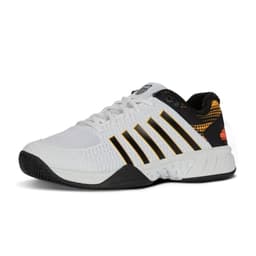
K-Swiss Express Light Pickleball. First, and the shoe we recommend most often on this site. It is pickleball-specific rather than a tennis crossover, and it publishes the most complete build in this price band: a K-EVA midsole with a midfoot shank, a non-marking Aosta 7.0 rubber outsole with modified herringbone tread, a seamless synthetic-and-mesh upper with a DuraWrap toe, an OrthoLite liner, and a measured 12.4 oz at men’s 10.5 — the lightest published weight of any court shoe we list. Light matters to an older player for a specific reason: less mass to lift on every one of the few thousand small steps a session takes. The limitation is the width — the men’s listing publishes medium only. Full write-up in the Express Light review.
ASICS Gel-Renma 2 Pickleball. Second, and the pick if you feel the pounding in your knees. ASICS publishes GEL cushioning in the forefoot, a TRUSSTIC midfoot support with synthetic leather overlays, and a wrap-up outsole with a wider gauge and flex grooves. Forefoot GEL is placed where a pickleball player actually loads the foot — on the toes, split-stepping and pushing off — which is a more useful placement than a heel-only cushioning package. ASICS does not publish the outsole compound or a non-marking statement for it, and lists one width (regular). A women’s version is also under $100. Full write-up in the Gel-Renma 2 review, and the K-Swiss vs Gel-Renma comparison puts the top two here head to head.
K-Swiss Ultrashot 4 Pickleball. Third, and the most structured shoe under $100 by a clear margin. K-Swiss publishes a molded TPU 360 Plantar Support Chassis through the midfoot, a separate molded TPU shock frame under the heel, a Surge 7.0 CMEVA midsole, an Aosta 7.0 rubber outsole with multi-directional herringbone, and DragGuard 7.0 thicker rubber in the high-wear regions. If your heel is the thing that flares up during and after a session, that is the build to read about — see shoes for plantar fasciitis. The cost is weight: a measured 16.2 oz at men’s 10.5, nearly four ounces more than the Express Light, in one published width described as a generous medium. Full write-up in the Ultrashot 4 review.
Skechers Pickleball Viper Court Pro 2.0 (Women’s). Fourth, and the best women’s shoe in the band for anyone who hates breaking shoes in. Skechers publishes a removable Arch Fit EVA insole with a podiatrist-certified shape, an ULTRA GO foam midsole, a Goodyear Gold compound outsole described as suiting controlled slides, a mesh upper with a rubber toe guard, a 1 1/4 in heel height, and both Medium and Wide widths. Removable insole plus two widths is the most accommodating fit package under $100. Skechers publishes no heel-to-toe drop and no non-marking statement. Full write-up in the Viper Court Pro 2.0 women’s review.
Fila Volley Zone Pickleball (Women’s). Fifth, and the best value women’s option. Fila publishes an energized EVA midsole, a non-marking one-piece high-abrasion rubber outsole with herringbone and a forefoot pivot circle, a removable molded EVA sockliner and a TPU shank. That is a real court-shoe spec sheet in the seventy-dollar region, and the pivot circle is a genuinely useful detail for a player who turns on the forefoot. Fila publishes no width options and no weight. Fifth rather than fourth because the Skechers adds a second width and a podiatrist-shaped insole for not much more.
ASICS Gel-Dedicate 8 (Tennis). The budget pick, and the cheapest shoe we are willing to recommend. It is a tennis shoe rather than a pickleball one, which matters less than it sounds — the movement patterns overlap almost entirely, and our tennis-crossover page explains where they do not. ASICS publishes GEL cushioning and an entry-level court-support build, and discloses less about it than about the Gel-Renma: no width options, no outsole compound. Worth knowing before you buy: the Gel-Dedicate 9 has shipped, which is usually why the 8 is cheap, and it pairs the same GEL and TRUSSTIC. Full write-up in the Gel-Dedicate 8 review.
Which one, for which foot
- Knees or hips that feel the pounding. The Gel-Renma 2, for the forefoot GEL. Then read shoes for bad knees.
- Heel pain during or after play. The Ultrashot 4, for the molded TPU shock frame under the heel.
- Wide feet, or your own orthotic. The Skechers Viper Court Pro 2.0 — two published widths and a removable insole. The men’s version sits just above this page’s line.
- You want the lightest thing that still supports you. The Express Light, at a published 12.4 oz. See lightest pickleball shoes by published weight.
- You are buying your first court shoe and want to spend the least. The Gel-Dedicate 8.
The two we left off, and why
The Skechers Viper Court Smash was under $100 and we left it out. It is the cheaper Skechers and the spec table tells you why: insole, midsole, outsole, width and heel-to-toe drop are all unpublished. Skechers publishes a full sheet for the Viper Court Pro 2.0 and almost nothing for the Smash, and on a page ranked by published construction that is disqualifying — particularly when the shoe above it in the same line publishes a podiatrist-shaped removable insole for about thirty dollars more. The second omission is the ASICS Gel-Renma 2 women’s model, which is simply the women’s cut of our number two and would have been a duplicate; it is featured on best women’s pickleball shoes.
What we do not claim: we have not worn any of these shoes, measured a drop, or tested an outsole. We own no units and run no lab. Every figure above is read from the maker’s or retailer’s published spec page named in each product’s table, on the date shown there — including the measured weights, which come from Tennis Warehouse at the sizes stated rather than from us. Where a maker publishes nothing, the cell says “Not published”, which is information too. Prices come from the live price layer with an “as of” date, so a shoe that drifts over $100 on a given day shows its real number; the ranking is on published specs and fit, so a price swing does not reorder it.
One thing this band cannot give you, and it is worth knowing before you settle: no shoe under $100 on this site publishes a width wider than “Wide”, and none publishes a named lateral stability frame. Both of those appear in the band immediately above — the only 4E extra-wide court shoe we list sits near $120. If a broad forefoot or an unsteady ankle is the reason you are shopping, best pickleball shoes under $150 is the page to read next; it is written as a straight answer to what the extra fifty dollars buys.