Kitchen & Court

Best Pickleball Paddle Sets

Two-player sets ranked on what is actually in the box and what each maker will put in writing about the paddles inside it. Only one of the five publishes a paddle weight, and that is the spec a 55-plus hand cares about most.

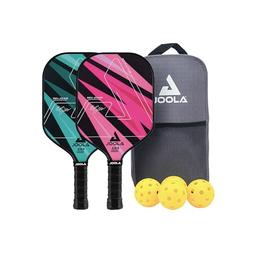
JOOLA Ben Johns Pickleball Paddle Set (2 Paddles, 4 Balls, Bag)

Our pick

JOOLA Ben Johns Pickleball Paddle Set (2 Paddles, 4 Balls, Bag)

The set to buy for two older players, for one reason that took five listings to find: JOOLA publishes a 6.8 oz paddle weight and names a cushioned grip. Nobody else on this page publishes either. Four balls covering indoor and outdoor play and a carry bag come in the box, so the kit is complete on arrival. The cheapest sensible set is the Niupipo Set of 2, which costs about as much as a single mid-range paddle and is the only set here that states a USA Pickleball approval. If you already know you are staying with the sport, the SLK Neo is the only set with a raw carbon face.

$45.00 · View on Amazon

$79.9544% off

Price as of November 20, 2026. #ad How we’re funded

Read the full write-up
By Stephen V.Last updated How we research

A paddle set is a different purchase from a paddle. You are buying a box — usually two identical paddles, some balls and a bag — and the sales pitch is almost always about the box rather than the paddles in it. That is the trap for an older beginner. The ball count is the easiest thing in the world to verify and the cheapest thing in the box to replace. The paddle weight and the grip size, which are what your wrist and elbow will actually live with, are the two things most set listings never mention at all.

So we ranked these five on disclosure as much as on contents. Of the five two-player sets we could verify as in stock and price live, exactly one publishes a paddle weight, exactly one states a USA Pickleball approval, and not one publishes a grip circumference. Two of them do not even name the face material. When a maker will not tell you what a paddle weighs, that is not a small gap in a product you are about to swing a few hundred times an afternoon — and on this site the missing cell counts against the set.

One thing we will say before the list: a set is the right buy when two people need paddles at the same time — a couple joining a 55-plus league together, a grandparent keeping a spare for visits, a pair splitting the cost of starting. If only one of you is playing, a single paddle at the same money is always the better paddle. Start instead with best pickleball paddles for seniors or, if the budget is the point, best pickleball paddles under $50.

How this is funded: we earn a commission if you buy through our links, at no extra cost to you. It never changes which product we recommend, and we’ll tell you plainly when to skip one. Full disclosure.

Quick picks

Ranked on published specs, grip and build, and honest buyer fit. Select a row to jump to the full write-up. We have not lab-tested these — here is exactly what we do instead.

#ProductBest forPrice
1
JOOLA Ben Johns Pickleball Paddle Set (2 Paddles, 4 Balls, Bag)

JOOLA Ben Johns Pickleball Paddle Set (2 Paddles, 4 Balls, Bag)

The only two-player set we found that publishes a paddle weight — 6.8 oz — and names a cushioned grip, which are the two specs that decide whether a starter paddle is kind to an older wrist. It also arrives with four balls covering indoor and outdoor play, so nothing else needs buying on day one. If you are kitting out two players at once and one of them has a sore arm, start here.

Best overall — the only published paddle weight
$45.00 · View on Amazon

$79.9544% off

Price as of November 20, 2026. #ad How we’re funded

2
Selkirk Sport SLK Neo Pickleball Paddles Set of 2 (Raw Carbon Fiber)

Selkirk Sport SLK Neo Pickleball Paddles Set of 2 (Raw Carbon Fiber)

The only set here with a raw carbon fiber face, which is the material difference arm-sensitive players notice most: carbon reads as muted and controlled where fiberglass reads as lively. Two paddles, two outdoor balls and a sling bag, at roughly four times the cheapest set. Buy it if you already know you are staying with the sport and want to skip the upgrade.

Best for committed players — the only carbon face
$119.99 · View on Amazon

Price as of November 20, 2026. #ad How we’re funded

3
Selkirk Sport SLK Club Paddle Set of 2 (with Sling Bag)

Selkirk Sport SLK Club Paddle Set of 2 (with Sling Bag)

The cheapest way into Selkirk, the brand behind three of the individual paddles we recommend, and the only set here whose core carries a name — SX3 honeycomb. The catch is in the box: the listing names two paddles and a sling bag, and does not mention balls, so budget a pack separately. Worth it if you want a brand you can stay with rather than a set you replace.

Best brand to start on
$32.29 · View on Amazon

$39.9919% off

Price as of November 20, 2026. #ad How we’re funded

4
Niupipo Pickleball Set of 2 with 4 Balls and Bag

Niupipo Pickleball Set of 2 with 4 Balls and Bag

The cheapest set here from a brand that also sells paddles on their own, and the only one under fifty dollars that states a USA Pickleball approval on the listing. Fiberglass faces over a polypropylene honeycomb core — the same construction as sets costing twice as much — with four balls and a bag included. If the plan is to find out whether you even like the game, this is the sensible amount to spend.

Budget pick — cheapest brand-name set
$28.49 · View on Amazon

$39.9929% off

Price as of November 20, 2026. #ad How we’re funded

5
HEAD Kickstarter Pickleball Starter Set

HEAD Kickstarter Pickleball Starter Set

Two HEAD Kickstarter Plus paddles, two outdoor balls and a carry bag from a tennis brand already in this registry — and a listing that publishes nothing else at all. No face material, no core, no weight, no grip. That is a real strike against it at this price, and the reason it ranks below two cheaper sets that tell you what you are buying.

Known brand, thinnest spec sheet
$52.93 · View on Amazon

Price as of November 20, 2026. #ad How we’re funded

The picks in full

#1Best overall — the only published paddle weight

JOOLA Ben Johns Pickleball Paddle Set (2 Paddles, 4 Balls, Bag)

The only two-player set we found that publishes a paddle weight — 6.8 oz — and names a cushioned grip, which are the two specs that decide whether a starter paddle is kind to an older wrist. It also arrives with four balls covering indoor and outdoor play, so nothing else needs buying on day one. If you are kitting out two players at once and one of them has a sore arm, start here.

Easier on the joints: Light paddle, padded handle. Those are the two things that reduce what a swing and a mis-hit ask of an arthritic wrist or a tender elbow, and this is the only set on the page that publishes either of them.

What we like

  • Publishes 6.8 oz — the only set here that states a weight at all, and a light one for a paddle
  • Cushioned grip is named on the listing, which matters more to a sore hand than the face material does
  • Four balls for indoor and outdoor play, plus a carry bag, so the box is genuinely complete

Skip it if

  • No grip circumference published, so you cannot check the handle against your hand before it arrives
  • No USA Pickleball approval statement on this listing — fine for rec play, a problem if you enter a sanctioned event
  • Roughly twice the price of the cheapest set here, for paddles a fast-improving player will outgrow
In the box2 paddles, 4 balls, carry bag (per listing)
Face materialFiberglass
CorePolypropylene honeycomb
Weight6.8 oz (per listing; bare or gripped is not stated)
GripCushioned (circumference not published)
Balls4, for indoor and outdoor play (per listing)
USA Pickleball approvedNot published

Specs read from the product listing, on November 15, 2026. “Not published” means the maker does not state that figure.

#2Best for committed players — the only carbon face

Selkirk Sport SLK Neo Pickleball Paddles Set of 2 (Raw Carbon Fiber)

The only set here with a raw carbon fiber face, which is the material difference arm-sensitive players notice most: carbon reads as muted and controlled where fiberglass reads as lively. Two paddles, two outdoor balls and a sling bag, at roughly four times the cheapest set. Buy it if you already know you are staying with the sport and want to skip the upgrade.

Easier on the joints: A raw carbon face grips and deadens the ball rather than springing it back, so contact feels softer in the hand than fiberglass at the same weight — the reason our tennis-elbow paddle picks are nearly all carbon.

What we like

  • Raw carbon fiber face — the only carbon in any set we list, and the quieter, more muted face material
  • Two outdoor balls and a sling bag included
  • Cheaper than buying two carbon paddles one at a time, which is the honest reason to buy a set at this level

Skip it if

  • The most expensive set here by a wide margin
  • Selkirk publishes no weight, no core thickness and no grip circumference on this listing
  • Two balls rather than four, and both outdoor — nothing for indoor play
In the box2 paddles, 2 outdoor balls, sling bag (per listing)
Face materialRaw carbon fiber (per listing)
CoreNot published
WeightNot published
GripNot published
Balls2, outdoor (per listing)
USA Pickleball approvedNot published

Specs read from the product listing, on November 15, 2026. “Not published” means the maker does not state that figure.

#3Best brand to start on

Selkirk Sport SLK Club Paddle Set of 2 (with Sling Bag)

The cheapest way into Selkirk, the brand behind three of the individual paddles we recommend, and the only set here whose core carries a name — SX3 honeycomb. The catch is in the box: the listing names two paddles and a sling bag, and does not mention balls, so budget a pack separately. Worth it if you want a brand you can stay with rather than a set you replace.

Easier on the joints: Selkirk's SX3 core is the same family of honeycomb construction as its single paddles, so the feel you learn on here is the feel you keep when you upgrade — which saves your arm the re-learning a wholly different paddle demands.

What we like

  • A named core — SX3 honeycomb — which no other set at this price publishes
  • From the maker of the SLK Halo and SLK Atlas Max we recommend on their own, so your next paddle is a step up, not a restart
  • Sling bag included, and a sling is easier on a shoulder than a shoulder-slung duffel

Skip it if

  • The listing does not mention balls, so plan on buying a pack with it
  • Nothing published about weight or grip circumference — the two specs that decide fit
  • The listing's 'Graphite Fiberglass' wording leaves the face material genuinely ambiguous, and we will not guess which it is
In the box2 paddles, sling bag (per listing; no balls named)
Face materialListed as 'Graphite Fiberglass' — ambiguous on the listing
CoreSX3 honeycomb (per listing)
WeightNot published
GripNot published
BallsNot named on the listing
USA Pickleball approvedNot published

Specs read from the product listing, on November 15, 2026. “Not published” means the maker does not state that figure.

#4Budget pick — cheapest brand-name set

Niupipo Pickleball Set of 2 with 4 Balls and Bag

The cheapest set here from a brand that also sells paddles on their own, and the only one under fifty dollars that states a USA Pickleball approval on the listing. Fiberglass faces over a polypropylene honeycomb core — the same construction as sets costing twice as much — with four balls and a bag included. If the plan is to find out whether you even like the game, this is the sensible amount to spend.

Easier on the joints: A honeycomb core is not a comfort feature a budget set has to skip: it is the standard construction, and it is why even the cheapest composite paddle here is kinder to a wrist than a wooden one.

What we like

  • The lowest price of any brand-name set we list, with four balls and a bag in the box
  • Polypropylene honeycomb core rather than a solid plank — the construction that absorbs part of the hit
  • USA Pickleball approval stated on the listing, which not even the pricier sets here claim

Skip it if

  • No weight figure published — the listing says only 'lightweight'
  • No grip circumference published either, so handle size is a surprise
  • A fiberglass face is livelier than carbon, so a mis-hit sends more feedback up your arm
In the box2 paddles, 4 balls, bag (per listing)
Face materialFiberglass
CorePolypropylene honeycomb
WeightLightweight (exact figure not published)
GripNot published
Balls4 (per listing)
USA Pickleball approvedYes (per listing)

Specs read from the product listing, on November 15, 2026. “Not published” means the maker does not state that figure.

#5Known brand, thinnest spec sheet

HEAD Kickstarter Pickleball Starter Set

Two HEAD Kickstarter Plus paddles, two outdoor balls and a carry bag from a tennis brand already in this registry — and a listing that publishes nothing else at all. No face material, no core, no weight, no grip. That is a real strike against it at this price, and the reason it ranks below two cheaper sets that tell you what you are buying.

Easier on the joints: There is nothing published here to assess, which is the point: on a paddle you will hold for two hours, an undisclosed weight and an undisclosed grip size are the two blanks you can least afford.

What we like

  • From HEAD, whose Radical Elite and Extreme Elite paddles we recommend individually
  • Complete enough to play on the day it arrives — two paddles, two balls, a bag
  • Outdoor balls, which is what most 55+ league and open-play sessions use

Skip it if

  • The listing publishes no face material, no core, no weight and no grip size — the thinnest spec sheet of any set here
  • Priced above two sets that DO publish a core, which is hard to justify
  • Two balls rather than four
In the box2 Kickstarter Plus paddles, 2 outdoor pickleballs, carry bag (per listing)
Face materialNot published
CoreNot published
WeightNot published
GripNot published
Balls2, outdoor (per listing)
USA Pickleball approvedNot published

Specs read from the product listing, on November 15, 2026. “Not published” means the maker does not state that figure.

The five things to check before you buy any set

In the order they matter for a player over 55, not in the order the listings present them.

  • Paddle weight, if it is published at all. Weight is the single spec that decides how much a paddle asks of a wrist, an elbow and a shoulder, because you accelerate it and stop it on every shot. Most modern composite paddles land somewhere between 7.3 and 8.4 oz; a figure below about 7.8 oz is what the lightweight end looks like. The JOOLA set publishes 6.8 oz. Three of the other four publish nothing, and Niupipo publishes the word “lightweight” without a number. If you want the long version of why this matters more than anything else on the spec sheet, read pickleball paddle weight explained.
  • Grip circumference — and the fix when it is missing. Nobody here publishes one. That is worth knowing rather than worrying about, because grip is the one dimension you can change after the fact: an overgrip adds roughly a sixteenth to an eighth of an inch per layer, so a handle that is a size too small is a three-dollar problem. A handle that is too large cannot be fixed, which is why we would rather a set ran small. See how to find your pickleball grip size and the overgrips we recommend.
  • Core and face material. Every composite paddle on this page uses a honeycomb core, which is the part that absorbs a share of the impact before your hand feels it. The face is the other half: fiberglass is livelier and sends more feedback up the arm on a mis-hit, raw carbon is more muted and more controlled. Four of these sets are fiberglass; the SLK Neo is carbon. That difference is the whole reason our tennis-elbow paddle picks are nearly all carbon, and it is laid out in full in carbon vs fiberglass paddles.
  • What is really in the box. Read the contents line, not the product name. “Set” means two paddles and a bag on the SLK Club listing, with no balls named; it means two paddles, two outdoor balls and a bag on the SLK Neo and HEAD listings; it means two paddles, four balls and a bag on the JOOLA and Niupipo ones. Balls are cheap, but they are not free, and indoor and outdoor balls are not interchangeable — see indoor vs outdoor pickleballs and the balls we recommend.
  • USA Pickleball approval, if you intend to compete. USA Pickleball runs a certification program and publishes a searchable list of every paddle that has passed it, along with the equipment standards paddles are tested against. For open play at a rec center, approval is irrelevant. For a sanctioned tournament or a league that follows the rulebook, an unapproved paddle is not legal equipment. Only the Niupipo listing claims approval; the other four say nothing either way, and we are not going to infer it for them.

Why there is no wooden set on this page

Search for a pickleball set and the cheapest results are wooden: poplar-wood starter kits from real brands — the Recruit by ONIX and the Franklin Activator among them — usually for the price of two large coffees. They are genuinely the cheapest way to get two paddles and a ball into a car trunk, and for a family picnic or a holiday rental they are fine.

They are the wrong buy for the reader of this site, and the reason is structural rather than a matter of taste. A wooden paddle is a solid plank. There is no honeycomb core inside it, because there is no inside. Every composite paddle above puts a honeycomb layer between the ball and your hand specifically to absorb part of the hit; a plank has nothing to absorb it with, and it is also the heaviest construction still sold. For a 60-year-old wrist — the single most-injured body part among players over 60, at 13.2% of emergency-department visits in the published senior-injury data — that is the wrong place to save twenty dollars.

It is also worth knowing that equipment choice is part of the medical advice, not just marketing. In the AAOS treatment guidance for tennis elbow, alongside rest and bracing, is an equipment check: stiffer and more forgiving racquets “reduce the stress on the forearm, which means that the forearm muscles do not have to work as hard”. The same logic is why we would rather you spent thirty dollars on a composite set than twenty on wood. If your elbow is already sore, read tennis elbow from pickleball before you buy anything.

Two paddles, or one good one?

This is the question the sets category never asks, so we will. At the price of the most expensive set here you could buy one genuinely good single paddle. At the price of the cheapest you could buy one decent budget paddle and nothing else. The maths only favors a set when two people are starting at once, because the second paddle in a set costs far less than a second paddle bought separately.

The other honest case for a set is the spare. If you host visiting family, or you are the person in your group who brings gear for whoever turns up, a cheap composite set in the trunk solves a social problem rather than a performance one — and it is a better guest paddle than the wooden thing most people keep for that job.

Where a set stops making sense is the moment one of the two players improves faster than the other. Set paddles are identical by definition, and two players over 55 very rarely want the same paddle: one wants the lightest thing they can hold, the other wants the biggest face they can find. When that happens, buy one paddle each and keep the set paddles as spares. Nobody needs to replace a whole kit.

How we ranked these, and what we do not claim

We own no units, run no lab, and have not played with any of these sets. Every spec in every table above is read from the Amazon listing named in that product’s source row, on the date shown there, and verified in stock on that date through Amazon’s own Creators API. We tried JOOLA’s, Selkirk’s and Franklin’s own product pages first, as we always do; all three refused an automated fetch, which is why the listing is the published source here.

Where a maker publishes nothing, the cell reads “Not published” rather than a plausible number, and the ranking reflects that: the HEAD Kickstarter set sits last not because we think the paddles are bad — we have no idea, and neither does anyone reading the listing — but because it costs more than two sets that tell you what is inside them. Prices come from the live price layer with an “as of” date attached, so a discount cannot reorder the list.
Frequently asked questions

What is the best pickleball paddle set?

The JOOLA Ben Johns set, for two players over 55. It is the only two-player set we could verify that publishes a paddle weight (6.8 oz, which is light for a paddle) and names a cushioned grip, and those are the two specs that decide how much a starter paddle asks of an older wrist and elbow. It also includes four balls covering both indoor and outdoor play plus a carry bag. If you want to spend as little as possible, the Niupipo Set of 2 is the cheapest brand-name set here and the only one that states a USA Pickleball approval.

Are pickleball sets worth it, or should I buy paddles separately?

A set is worth it when two people need paddles at the same time, because the second paddle costs far less than it would bought alone. It is not worth it for one player: at the same money, a single paddle is always the better paddle, with a published weight, a published grip size and usually a thicker core. The other good reason to own a set is as spares for guests. The reason to avoid one is that both paddles are identical, and two players rarely want the same paddle for long.

How much should a beginner spend on a pickleball set?

Enough to get a composite paddle with a honeycomb core rather than a wooden plank, which in practice means the thirty-dollar bracket rather than the twenty-dollar one. Spending more than about seventy buys a better face material and better disclosure rather than a fundamentally different paddle. We would rather see a beginner put the difference toward a proper pair of court shoes, because the published senior-injury data is dominated by falls and sprains, not by paddle problems.

Are wooden pickleball paddle sets OK for older beginners?

They work, but they are the one construction we would steer an older player away from. A wooden paddle is a solid plank with no honeycomb core, so nothing inside it absorbs the impact before your hand does, and wood is the heaviest material still sold for paddles. With the wrist being the most-injured body part among players over 60 in the published injury data, and with equipment choice appearing in the AAOS guidance for tennis elbow, the twenty dollars you save is the wrong twenty dollars. A composite set costs about ten more.

Do pickleball paddle sets come with balls?

Usually, but not always, and it is worth checking the contents line rather than the name. Of the five sets on this page, two include four balls, two include two outdoor balls, and the Selkirk SLK Club listing names two paddles and a sling bag without mentioning balls at all. Indoor and outdoor balls are also not interchangeable: outdoor balls are harder with smaller holes for wind, indoor balls are softer with larger ones. If your set includes only outdoor balls and you play in a gym, you will need a pack either way.

Are the paddles in a set USA Pickleball approved?

Some are, most listings do not say, and the difference only matters if you intend to play sanctioned events. USA Pickleball certifies paddles against its published equipment standards and keeps a searchable approved-paddle list, so you can check a specific model yourself. On this page only the Niupipo listing claims approval. The other four say nothing either way, and we will not infer approval that a maker has not stated — for rec play and most 55-plus open play it makes no practical difference.

Sources

  • USA Pickleball — Approved Paddles list — The searchable database of paddles that have passed USA Pickleball certification testing (accessed July 22, 2026)
  • USA Pickleball — Equipment Standards Manual — The manufacturing specifications and testing (including the PBCoR power test) paddles must meet to be approved (accessed July 22, 2026)
  • American Academy of Orthopaedic Surgeons (OrthoInfo) - Tennis Elbow (Lateral Epicondylitis) — AAOS: tennis elbow 'involves the degeneration (wearing down) or, in some cases, microtearing of the tendons that join the forearm muscles on the outside of the elbow', specifically the extensor carpi radialis brevis (ECRB) where it attaches to the lateral epicondyle. Symptoms: 'Pain or burning on the outer part of your elbow', 'Weak grip strength', 'Sometimes, pain at night', 'often worsened with forearm activity, such as holding a racquet, turning a wrench, or shaking hands'. Most people who get it are 'between the ages of 30 and 50'. THE PLACEMENT SENTENCE: 'Using a brace centered over the back of your forearm may also help relieve symptoms of tennis elbow. This can reduce symptoms by resting the muscles and tendons.' AAOS calls this a counterforce brace - it is NOT worn on the elbow joint itself. 'Approximately 80 to 95% of patients have success with nonsurgical treatment', beginning with rest: 'you will have to stop or decrease participation in sports, heavy work activities, and other activities that cause painful symptoms for several weeks'. AAOS also lists an EQUIPMENT CHECK as treatment: 'Stiffer racquets and looser-strung racquets often can reduce the stress on the forearm, which means that the forearm muscles do not have to work as hard.' Steroid injections 'should be used very sparingly for lateral epicondylitis, as excessive use can weaken the lateral epicondyle'. Surgery is considered only 'if your symptoms do not respond after 6 to 12 months of nonsurgical treatments' (accessed October 17, 2026)
  • Non-fatal senior pickleball and tennis injuries in US EDs, 2010–2019 — Injury Epidemiology (2021) — For players 60+: strains/sprains 31.0%, fractures 30.4%; the wrist is the single most-injured body part (13.2%); women 3.7x more likely to fracture (accessed July 22, 2026)
  • Pickleball Studio — How Thick Should Your Pickleball Paddle Be? (Chris Olson, Aug 31, 2022) — Thicker cores (16 mm and above) are for control: 'less power but usually improves your blocks, resets, and drop shots', 'helps absorb more of the pace from the ball', and they 'usually feel like they have a better sweet spot'. Thinner cores (13 mm and below) 'feel stiffer when the ball hits the paddle', the core 'doesn't absorb as much energy, so the ball comes off faster', and 'thinner paddles usually provide more vibration and worse off-center shot performance'. Recommendation: 'If you are a new player up to about 3.5, I would usually tell you to opt for a thicker paddle.' The article does not address arm pain or older players specifically (accessed September 18, 2026)

Keep reading