Kitchen & Court

Best K-Swiss Pickleball Shoes

K-Swiss is the brand this sport grew up on, and the two models we can price live sit 3.8 ounces apart — the widest published weight gap between any two shoes of one brand in our registry. That gap is the whole decision, and this page makes it for you.

K-Swiss Express Light Pickleball

Our pick

K-Swiss Express Light Pickleball

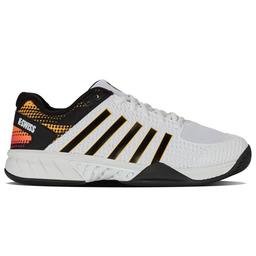
The K-Swiss to buy for most players over 55, and the reason is a number: 12.4 oz at size 10.5, against 16.2 oz for its stablemate. It is a purpose-built pickleball shoe with a published non-marking Aosta 7.0 outsole — which is what makes it legal on a gym floor — a K-EVA midsole with a midfoot shank, and a DuraWrap toe for the dragging this sport does to sneakers. If your feet or heels hurt rather than tire, step up to the Ultrashot 4, which publishes a molded TPU support chassis and a shock frame under the heel. The women’s Express Light is the only K-Swiss we can buy in a published wide.

$79.94 · View on Amazon

$110.0027% off

Price as of November 20, 2026. #ad How we’re funded

Read the full write-up
By Stephen V.Last updated How we research

If you have been around a 55-plus league for more than a season you have seen more K-Swiss on court than anything else. The brand was making court shoes before pickleball had a rulebook, it sponsors the sport heavily, and “just get K-Swiss” is the single most common piece of shoe advice handed to new players at open play. That advice is not wrong. It is just incomplete, because K-Swiss is not a shoe — and the two models we can currently price are about as different from each other as two court shoes get.

Here is the gap, stated plainly, because it is the most useful thing on this page. The Express Light weighs 12.4 oz at size 10.5. The Ultrashot 4 weighs 16.2 oz at the same size. That is 3.8 ounces per foot — nearly a quarter of a pound — and it is the widest published weight gap between two shoes of the same brand anywhere in our registry. You are not choosing between a good K-Swiss and a better one. You are choosing between a light shoe and a structured one, and which is right depends on whether your legs tire or your feet hurt.

A note on where these numbers come from, since it matters here more than on most brands. K-Swiss publishes very little technical detail on its own listings; every outsole, midsole, weight and width row below was read from Tennis Warehouse’s spec pages for these exact models and is credited in the sources at the foot of the page. Where even that source is silent — heel-to-toe drop on both shoes, the non-marking status of the Ultrashot 4 — the cell says “Not published” rather than carrying a number we would have had to guess.

How this is funded: we earn a commission if you buy through our links, at no extra cost to you. It never changes which product we recommend, and we’ll tell you plainly when to skip one. Full disclosure.

Quick picks

Ranked on published specs, grip and build, and honest buyer fit. Select a row to jump to the full write-up. We have not lab-tested these — here is exactly what we do instead.

#ProductBest forPrice
1
K-Swiss Express Light Pickleball

K-Swiss Express Light Pickleball

The all-rounder for a 55+ player: a purpose-built pickleball court shoe that's lightweight but stable, with reinforced toe protection for all the toe-dragging the sport does to sneakers. Stable and light is exactly the combination that keeps you balanced and reduces stumbles.

Best overall — 12.4 oz and a published non-marking outsole
$79.94 · View on Amazon

$110.0027% off

Price as of November 20, 2026. #ad How we’re funded

2
K-Swiss Ultrashot 4 Pickleball

K-Swiss Ultrashot 4 Pickleball

The one shoe here that was designed around the two things a sore plantar fascia actually needs, and says so on the spec sheet: a molded TPU support chassis that stops the midfoot folding, and a shock frame sitting under the heel. It is also a genuine pickleball shoe rather than a tennis shoe pressed into service, which shows in the outsole. If you want one recommendation and no further reading, this is it.

Most supportive — TPU chassis and a heel shock frame
$89.00 · View on Amazon

Price as of November 20, 2026. #ad How we’re funded

3
K-Swiss Express Light Pickleball (Women's)

K-Swiss Express Light Pickleball (Women's)

The women's version of our best all-round court shoe: a purpose-built pickleball shoe that's lightweight yet stable, with reinforced toe protection. Light-and-stable is the combination that keeps an older player balanced and reduces stumbles.

Best women's — and the only wide we can buy
$115.00 · View on Amazon

Price as of November 20, 2026. #ad How we’re funded

The picks in full

#1Best overall — 12.4 oz and a published non-marking outsole

K-Swiss Express Light Pickleball

The all-rounder for a 55+ player: a purpose-built pickleball court shoe that's lightweight but stable, with reinforced toe protection for all the toe-dragging the sport does to sneakers. Stable and light is exactly the combination that keeps you balanced and reduces stumbles.

Easier on the joints: A stable, low-to-the-ground court shoe keeps your ankle and knee tracking straight during side-to-side moves — the situation where older players most often roll an ankle or tweak a knee.

What we like

  • Purpose-built for pickleball's lateral movement, not a running shoe
  • Lightweight yet stable — the balance most older players want
  • Durable toe protection where court shoes usually wear out

Skip it if

  • Not the most cushioned option if your knees need maximum padding
  • Color/size availability varies
TypePickleball court shoe
Key featuresLightweight, stable support, durable toe
OutsoleNon-marking Aosta 7.0 rubber, modified herringbone tread
MidsoleK-EVA, with a midfoot shank
UpperSeamless synthetic and mesh, DuraWrap toe, OrthoLite liner
Weight12.4 oz (size 10.5, per Tennis Warehouse)
Width optionsMedium (per Tennis Warehouse)
Cushioning techNot published

Specs read from the product listing, on July 22, 2026. “Not published” means the maker does not state that figure.

#2Most supportive — TPU chassis and a heel shock frame

K-Swiss Ultrashot 4 Pickleball

The one shoe here that was designed around the two things a sore plantar fascia actually needs, and says so on the spec sheet: a molded TPU support chassis that stops the midfoot folding, and a shock frame sitting under the heel. It is also a genuine pickleball shoe rather than a tennis shoe pressed into service, which shows in the outsole. If you want one recommendation and no further reading, this is it.

Easier on the joints: The plantar fascia is a band under your arch that gets loaded every time the midfoot flattens and spreads. A shoe with a rigid chassis under that arch takes some of that load before your fascia has to, which is the entire mechanical argument for buying a supportive court shoe instead of a soft one.

What we like

  • Molded TPU support chassis — the midfoot resists the twisting that loads the fascia
  • Shock frame under the heel, which is where plantar fasciitis actually hurts
  • Surge 7.0 CMEVA midsole is cushioned without going soft and unstable
  • DragGuard 7.0 reinforcement in the drag zones, so it survives a pickleball toe drag

Skip it if

  • K-Swiss does not publish a heel-to-toe drop, so we cannot tell you what it is
  • No wide width listed for this model — a real problem if you need 2E or 4E
  • Mid-pack weight; it is a supportive shoe, not a light one
TypePickleball court shoe (men's)
Midfoot supportMolded TPU 360 Plantar Support Chassis
HeelShock frame (molded TPU under the heel)
MidsoleSurge 7.0 CMEVA
OutsoleAosta 7.0 rubber, multi-directional herringbone; DragGuard 7.0 thicker rubber in high-wear regions
Non-markingNot published
UpperDuraMesh and DuraPrint
Weight16.2 oz (size 10.5, per Tennis Warehouse)
Heel-to-toe dropNot published
Width optionsOne width, a “generous medium” (per Tennis Warehouse)

Specs read from the product listing, on August 31, 2026. “Not published” means the maker does not state that figure.

#3Best women's — and the only wide we can buy

K-Swiss Express Light Pickleball (Women's)

The women's version of our best all-round court shoe: a purpose-built pickleball shoe that's lightweight yet stable, with reinforced toe protection. Light-and-stable is the combination that keeps an older player balanced and reduces stumbles.

Easier on the joints: A stable, low-to-the-ground court shoe keeps your ankle and knee tracking straight through side-to-side moves — where older players most often roll an ankle.

What we like

  • Purpose-built for pickleball, not a repurposed runner
  • Lightweight yet stable — the balance most players want
  • Durable toe protection where court shoes wear out

Skip it if

  • Less cushioned than a GEL or FuelCell shoe
  • Color/size availability varies
TypePickleball court shoe (women's)
Key featuresLightweight, stable support, durable toe
OutsoleNon-marking Aosta 7.0 rubber, modified herringbone tread
MidsoleK-EVA, with a midfoot shank
UpperSeamless synthetic and mesh, DuraWrap toe, OrthoLite liner
WeightNot published
Width optionsWide (W) sold — the linked listing is a W
Cushioning techNot published

Specs read from the product listing, on July 22, 2026. “Not published” means the maker does not state that figure.

The two K-Swiss platforms, and who each one is for

Everything in the line we can buy today comes down to two builds. They share an outsole compound and almost nothing else.

  • Express Light — the light, stable one. Purpose-built for pickleball. A K-EVA midsole with a midfoot shank for stability, a seamless synthetic and mesh upper, an OrthoLite liner, a DuraWrap toe, and 12.4 oz on the scale. The midfoot shank is the specification that separates a court shoe from a running shoe: it stops the shoe folding through the middle when you push off sideways. Buy this one if your complaint after a session is that your legs are tired, or if you need one shoe that works indoors and out.
  • Ultrashot 4 — the structured one. Also pickleball-specific, and specified for a different reader entirely: a molded TPU 360 Plantar Support Chassis under the midfoot, a Shock Frame of molded TPU under the heel, a Surge 7.0 CMEVA midsole, and DragGuard 7.0 — thicker rubber laid into the high-wear regions rather than across the whole outsole. That is a lot of named structure for a mid-priced court shoe, and it comes at 16.2 oz. Buy this one if your heels or arches hurt during and after play rather than merely tiring. It is our top pick on best pickleball shoes for plantar fasciitis for exactly that reason.

Four ounces per foot does not sound like much until you count the steps. Published senior-injury data makes falls and sprains, not cushioning complaints, the dominant problem for players over 60 — strains and sprains at 31.0% of emergency visits and fractures at 30.4%, with ground-level falls behind more than half of geriatric pickleball injuries. A shoe you can still pick up cleanly in the third game is a fall-prevention feature. So is a shoe stable enough not to roll. The Express Light is our default because it is the one that does both at once; the Ultrashot 4 wins when a specific foot problem outranks fatigue.

What both shoes share: the outsole

Both are built on Aosta 7.0 rubber in a herringbone tread — modified herringbone on the Express Light, multi-directional herringbone on the Ultrashot 4. Herringbone is the pattern that grips on a hard court without grabbing, and it is why neither of these shoes behaves like a running shoe on a side-to-side push.

One difference inside that similarity is worth real money. The Express Light’s outsole is published as non-marking. The Ultrashot 4’s is not described either way. If you play in a school gym, a church hall or a community center, non-marking is often the written condition of entry, and the Express Light is the one we can point at a published statement for. We are not claiming the Ultrashot 4 marks floors — we have no idea, and neither does its spec page. We are telling you which one you can prove.

The second difference is wear. DragGuard 7.0 on the Ultrashot 4 adds thicker rubber exactly where a pickleball player drags a toe, which is the first place court shoes die on abrasive outdoor concrete. If you play outdoors three or four times a week, that is the shoe more likely to survive the season. One caveat we want to be precise about: Tennis Warehouse attaches a six-month outsole durability guarantee to Ultrashot 4 purchases, but that guarantee belongs to that retailer, covers the rubber outsole only, and does not travel with a purchase made anywhere else. It is not a K-Swiss warranty.

The width problem, and the one exception

This is the honest weakness of the line for our readers. Both men’s K-Swiss models are sold in a single width: medium on the Express Light, and what Tennis Warehouse describes as a “generous medium” on the Ultrashot 4. There is no 2E and no 4E. Feet broaden and swell with age, and a brand that offers one width is a brand a broad-footed 70-year-old cannot shop properly.

The exception is the women’s Express Light, and it is the reason that shoe is on this page rather than mentioned in passing: the listing we link is a W — a published wide. Same platform as the men’s shoe — Aosta 7.0 outsole, K-EVA midsole and shank, DuraWrap toe, OrthoLite liner — in the width the rest of the line does not offer. K-Swiss does not publish a weight for the women’s cut, and we have not carried over the men’s 12.4 oz, because that figure is a men’s size 10.5 and would be wrong here.

If width is your deciding factor and you are shopping men’s sizes, this is the point at which we would send you out of the brand entirely. The only court shoe in our registry sold in a published 4E is the New Balance 1007, and the comparison is laid out on best pickleball shoes for wide feet.

The K-Swiss we are not recommending, and why

Our registry carries a fourth K-Swiss: the Hypercourt Express 2 women’s wide, which used to be the answer to the width question above. It is not a pick on this page because we could not find a live offer for it — K-Swiss has moved on to the Hypercourt Express 3, and the women’s wide listings for both generations have been offerless every time we have checked since September. A shoe you cannot buy is not a recommendation, so its buy button falls back to a search rather than a dead listing. If the Express 3 arrives in a women’s wide with a live price, it belongs on this page immediately.

We also have not included any K-Swiss tennis model that gets borrowed for pickleball. The two Express Light listings and the Ultrashot 4 are the models K-Swiss itself describes as pickleball shoes, and on a brand page we would rather rank what the brand built for the sport than pad the list with crossovers. If you want to see how the borrowed-tennis-shoe question plays out, that is tennis shoes for pickleball.

How this page is ranked, and what we do not claim

We own no units, run no lab, and have not worn any of these shoes. We have not measured a drop, timed an outsole or weighed a sample. Every figure above is read from the Tennis Warehouse spec page named in the sources below, or from the Amazon listing each product’s own source row points at, on the date shown there. Where K-Swiss and its retailers publish nothing — heel-to-toe drop, the women’s weight, the Ultrashot’s non-marking status — the table says so.

There is no separate budget pick on this page, and that is worth stating rather than quietly omitting: the cheapest K-Swiss we can price live is our number one. The Express Light is both the lightest and the least expensive of the three, which is unusual enough in court shoes that we would rather point at it than invent a lower-priced alternative out of a shoe we cannot buy. The ranking is on published specs and buyer fit rather than price, so a discount cannot reorder it. Prices come from the live price layer with an “as of” date attached. And if you would rather compare across brands than within one, the brand-agnostic version of this page is best pickleball shoes for seniors, with the price-capped version at best pickleball shoes under $100.
Frequently asked questions

What is the best K-Swiss shoe for pickleball?

The Express Light for most players over 55. It is purpose-built for the sport, weighs 12.4 oz at size 10.5, and is the only K-Swiss we list with a published non-marking Aosta 7.0 outsole, which is what makes it legal on most gym floors. It also carries a midfoot shank, a K-EVA midsole, an OrthoLite liner and a DuraWrap toe. Choose the Ultrashot 4 instead if your heels or arches hurt rather than tire, because it publishes a molded TPU support chassis and a shock frame under the heel.

Express Light or Ultrashot 4?

Weight decides it. The Express Light is 12.4 oz at size 10.5 and the Ultrashot 4 is 16.2 oz, a 3.8 ounce difference per foot. Take the Express Light if your legs are what tire during a long session, if you play indoors and need a published non-marking outsole, or if you want the lighter shoe to pick up cleanly late in a game. Take the Ultrashot 4 if you have plantar fasciitis or arch pain, or if you play on abrasive outdoor concrete often enough that DragGuard reinforcement in the drag zones matters.

Do K-Swiss pickleball shoes come in wide widths?

Not in the men's models we list. Both the Express Light and the Ultrashot 4 are sold in one width — medium, described as a 'generous medium' on the Ultrashot — with no 2E or 4E option. The one exception is the women's Express Light, where the listing we link is a published W. If you need a genuine wide in men's sizing, the only court shoe in our registry sold in a published 4E is the New Balance 1007, which is covered on our wide-feet page.

Are K-Swiss pickleball shoes non-marking and gym legal?

The Express Light is published as non-marking, in both the men's and women's cut — its Aosta 7.0 rubber outsole is described that way on the spec page we cite. The Ultrashot 4's outsole is the same compound family but its non-marking status is not stated anywhere we could read, so we leave that cell as 'Not published' rather than assume it. If your venue has a written non-marking rule, buy the shoe whose claim you can point at.

Is K-Swiss still a good brand for pickleball?

Yes, with one caveat that has nothing to do with how the shoes are built. K-Swiss makes genuine pickleball-specific models rather than rebadged tennis shoes, publishes real technology names for its midsoles and chassis, and sits in the middle of the market on price. The caveat is sizing: one width across the men's line, and a women's wide platform (the Hypercourt Express 2) that we have not been able to find in stock since September. If your foot is broad, the brand is harder to recommend than the shoes are.

How heavy is too heavy for a pickleball shoe?

There is no published threshold, and we are not going to invent one. What we will say is that the two shoes on this page bracket the useful range: 12.4 oz reads as light for a court shoe and 16.2 oz reads as heavy, and the extra weight in the heavier shoe buys named structure rather than padding. For a player whose main risk is a fall — and published data puts ground-level falls behind more than half of pickleball injuries in older adults — the lighter shoe that you can still place precisely late in a session is usually the safer buy.

Sources

  • Tennis Warehouse - K-Swiss Express Light Pickleball (spec page) — Outsole: 'Non-marking Aosta 7.0 rubber outsole in a modified herringbone tread pattern provides excellent traction and good durability on any court surface.' Midsole: 'K-EVA midsole for cushion and support under foot' plus a 'Midfoot shank for added stability and unwanted twisting.' Upper: 'Seamless synthetic materials and mesh for comfort and breathability. DuraWrap protection in the toe for extra durability. An Ortholite liner for added cushioning.' Weight 12.4 oz (size 10.5); medium width only. No outsole durability guarantee listed and no indoor-vs-outdoor statement beyond 'any court surface' (accessed October 11, 2026)
  • Tennis Warehouse - K-Swiss Ultrashot 4 (spec page) — Outsole: 'Aosta 7.0 durable rubber outsole in a multi-directional herringbone pattern; Dragguard 7.0 thicker rubber in high wear regions' to extend outsole life. Midsole: 'Surge 7.0 cushioning feels plush for increased comfort. Shock Frame molded TPU under the heel for shock absorption and support. 360 Plantar Support Chassis for mid-foot and heel stability.' Upper: 'DuraMesh and DuraPrint combine for comfort, support, and a high level of breathability.' Weight 16.2 oz (size 10.5); one width, a 'Generous Medium'. Tennis Warehouse (the retailer, not K-Swiss) attaches a one-time 6-month outsole durability guarantee to purchases made from Tennis Warehouse: it covers the rubber outsole only, requires the shoe to be worn completely through into the midsole or insole, and excludes toe-guard and upper damage (accessed October 11, 2026)
  • Non-fatal senior pickleball and tennis injuries in US EDs, 2010–2019 — Injury Epidemiology (2021) — For players 60+: strains/sprains 31.0%, fractures 30.4%; the wrist is the single most-injured body part (13.2%); women 3.7x more likely to fracture (accessed July 22, 2026)
  • Pickleball-Related Geriatric Fractures — Arthroscopy, Sports Medicine & Rehabilitation (2025) — Adults 60+ account for 74.1% of pickleball ED visits and are 1.6x more likely to fracture; 56.1% of geriatric injuries are ground-level falls; women 3x higher fracture odds (accessed July 22, 2026)
  • American Academy of Orthopaedic Surgeons (OrthoInfo) — Plantar Fasciitis and Bone Spurs — AAOS: plantar fasciitis is most common between ages 40 and 60, and repetitive high-impact activity is a named risk factor; more than 90% of patients improve within 10 months of starting simple treatment. Footwear guidance: 'Shoes with thick soles and extra cushioning can reduce pain with standing and walking', soft silicone heel pads work by elevating and cushioning the heel, pre-made or custom shoe inserts are also helpful, and old athletic shoes should be replaced before they wear out (accessed August 31, 2026)
  • American Academy of Orthopaedic Surgeons (OrthoInfo) — Sprained Ankle — An ankle sprain is 'an injury to one or more of the ligaments that stabilize the ankle'; about 90% are inversion injuries to the lateral ligaments (ATFL and CFL). Causes named: walking or exercising on an uneven surface, falling or tripping, and 'high-risk sports that require cutting or jumping actions, such as trail running, basketball, tennis, football, and soccer'. Footwear risk factors: 'wearing shoes that do not provide enough foot and ankle support' and 'shoes with slippery soles'. Prevention: 'warm up thoroughly before exercise and physical activity', strengthening exercises for ankle stability, 'choose footwear with appropriate support for your activity', and balance (proprioception) training, often on a balance board (accessed September 18, 2026)

Keep reading