Kitchen & Court

ASO Ankle Brace Alternatives

The ASO is the default lace-up ankle brace, and people look for an alternative for three predictable reasons: it is slow to put on, it needs a roomier shoe, and it has rigid parts. Three replacements we can price live, each matched to one of those complaints.

Zamst A2-DX

Our pick

Zamst A2-DX

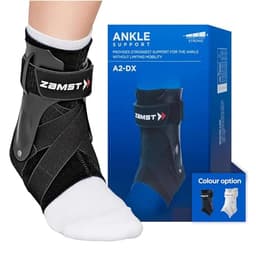
The best all-round alternative to the ASO is the Zamst A2-DX, and it is the one to buy if you wanted the ASO because your ankle has rolled badly: protective guards plus a dual X-strap across the front, outside and inside of the joint, a left/right specific build so the structure sits where your anatomy is, and a support level Zamst itself rates “Strong” — the only maker-published rating at that level in our registry. If what you disliked about the ASO was the rigid, laced construction rather than the support, go to the MalleoTrain, a knitted support with no rigid parts. The budget pick is the Mueller Adjustable Ankle Stabilizer at around a third of the ASO’s price — a slip-on wrap with figure-eight strapping, and mild support only, which Mueller says plainly and so do we. Prices are live, with the “as of” date on every row.

$80.00 · View on Amazon

Price as of November 23, 2026. #ad How we’re funded

Read the full write-up
By Stephen V.Last updated How we research

The Med Spec ASO is the brace a trainer hands you. It is a lace-up stabilising orthosis with angled figure-eight straps and a circumferential elastic cuff, it is bilateral — one brace fits either foot — and Med Spec publishes an unusually serious size run: eight sizes by ankle circumference, from 9–10 in up to 16 in and over, each with its own part number, plus a PDAC-verified HCPCS code. It is a good product and we rank it as our overall ankle pick on best ankle braces for pickleball. This page is not an argument against it.

It is an argument about fit. In practice players look for an ASO alternative for three reasons, and they are all legitimate:

  • It takes real time to put on. Laces, then straps, then the cuff, then your shoe. That is fine before a league match and irritating before a casual session.
  • It takes up room in the shoe. A lace-up orthosis adds bulk over the instep, and Med Spec’s own product page publishes nothing at all about wearing the brace inside footwear or about adjusting your shoe size for it. That is a real gap when you are buying both.
  • It is more brace than some ankles need. If your ankle is stiff and arthritic rather than unstable, a laced stabiliser is the wrong tool entirely.

So the three alternatives below are not three versions of the same thing. Each answers one of those complaints, and the right one depends on which complaint is yours. We own none of these braces, have worn nothing, and nothing on this page treats a condition — an ankle that keeps giving way should be seen by a clinician, not just strapped.

How this is funded: we earn a commission if you buy through our links, at no extra cost to you. It never changes which product we recommend, and we’ll tell you plainly when to skip one. Full disclosure.

Quick picks

Ranked on published specs, grip and build, and honest buyer fit. Select a row to jump to the full write-up. We have not lab-tested these — here is exactly what we do instead.

#ProductBest forPrice
1
Zamst A2-DX

Zamst A2-DX

The most brace on this page. Zamst rates the A2-DX at its 'Strong' support level and builds it around protective guards plus a dual X-strap stabilizer giving three-way (anterior, lateral, medial) support, and it applies from the rear so you are not threading laces. It is specified for Grade III high ankle sprains and chronic ankle instability - which is more than a recreational player needs unless that description is you.

Best alternative overall — more support than the ASO
$80.00 · View on Amazon

Price as of November 23, 2026. #ad How we’re funded

2
Bauerfeind MalleoTrain

Bauerfeind MalleoTrain

The arthritis answer, from the same maker as our top knee pick. The MalleoTrain is a knitted compression support with viscoelastic pads sitting behind each ankle bone, and Bauerfeind lists osteoarthritis and joint effusions among its indications alongside sprains. Critically it has 'no rigid parts' - it supports and de-swells rather than restricting, so it is the one brace here you could wear all morning. It is also by far the most expensive and the fussiest to size.

Best if you want no rigid parts — arthritis and swelling
$95.92 · View on Amazon

$119.9020% off

Price as of November 23, 2026. #ad How we’re funded

3
Mueller Adjustable Ankle Stabilizer

Mueller Adjustable Ankle Stabilizer

The cheapest honest answer, and the right first purchase if your ankle aches rather than wobbles. It is a neoprene wrap with a figure-eight strapping system, one size fits most, bilateral - and Mueller names arthritic ankles in its own stated indications, which almost nothing else in this category does. It will not hold a genuinely unstable ankle, and Mueller does not claim it will.

Budget pick — slip-on wrap at a third of the price
$13.45 · View on Amazon

$16.9521% off

Price as of November 23, 2026. #ad How we’re funded

The picks in full

#1Best alternative overall — more support than the ASO

Zamst A2-DX

The most brace on this page. Zamst rates the A2-DX at its 'Strong' support level and builds it around protective guards plus a dual X-strap stabilizer giving three-way (anterior, lateral, medial) support, and it applies from the rear so you are not threading laces. It is specified for Grade III high ankle sprains and chronic ankle instability - which is more than a recreational player needs unless that description is you.

Easier on the joints: Chronic ankle instability is the state an untreated sprain leaves behind - an ankle that rolls on nothing. This is the brace that mechanically stops the roll rather than reminding you about it, and the honest trade is bulk, price and having to order the correct side.

What we like

  • Zamst's own 'Strong' support rating - the highest tier in its ankle range
  • Protective guards that 'prevent excessive inward and outward movements' of the high ankle
  • A dual X-strap giving three-way support: anterior, lateral and medial
  • Rear application 'enables easy application and adjustment' - no lace threading

Skip it if

  • Left and right specific AND size specific, so the linked ASIN is one side in one size
  • Specified for Grade III sprains and chronic instability - overkill for a merely achy ankle
  • Costs several times the ASO and is the bulkiest fit inside a court shoe
  • Zamst markets it for basketball and quick-turnaround sports; it publishes no pickleball guidance
TypeGuarded ankle brace, rear application
Support level'Strong' (Zamst's own rating)
StabilizersProtective guards + dual X-strap (anterior/lateral/medial)
FitsLeft/right specific design
SizingSmall, Medium, Large, Extra Large
Indicated forHigh ankle sprains (Grade III) and chronic ankle instability

Specs read from the product listing, on October 4, 2026. “Not published” means the maker does not state that figure.

#2Best if you want no rigid parts — arthritis and swelling

Bauerfeind MalleoTrain

The arthritis answer, from the same maker as our top knee pick. The MalleoTrain is a knitted compression support with viscoelastic pads sitting behind each ankle bone, and Bauerfeind lists osteoarthritis and joint effusions among its indications alongside sprains. Critically it has 'no rigid parts' - it supports and de-swells rather than restricting, so it is the one brace here you could wear all morning. It is also by far the most expensive and the fussiest to size.

Easier on the joints: For an arthritic ankle the enemy is swelling and stiffness, not instability - and a rigid brace makes both worse by taking away the movement that keeps the joint lubricated. Bauerfeind's pads massage the joint as you move while the knit holds compression, which is the opposite approach and the right one for an aching rather than a wobbling ankle.

What we like

  • Bauerfeind names osteoarthritis, arthritis, joint effusions and swelling in its own indications
  • A 'contoured viscoelastic cushion' with soft pads behind each ankle bone to reduce pain and swelling
  • 'No rigid parts - comfortable to wear and allows full range of motion'
  • A breathable three-dimensional knit, so it is the least sweaty option here

Skip it if

  • The most expensive support on this page by a wide margin
  • Left/right specific and sized 1-6 by ankle measurement (17-29 cm) - you must measure first
  • Compression and de-swelling, NOT mechanical stability: it will not stop a bad roll
  • The linked ASIN is one side in one size; check Bauerfeind's chart before ordering
TypeKnitted active support with viscoelastic pads
Support levelMedical compression, no rigid parts
PadsContoured viscoelastic cushion behind each ankle bone
FitsLeft/right specific
Sizing6 sizes, ankle circumference 17-29 cm (measure first)
Indicated forOsteoarthritis, arthritis, ligament insufficiency, joint effusions, sprain, swelling

Specs read from the product listing, on October 4, 2026. “Not published” means the maker does not state that figure.

#3Budget pick — slip-on wrap at a third of the price

Mueller Adjustable Ankle Stabilizer

The cheapest honest answer, and the right first purchase if your ankle aches rather than wobbles. It is a neoprene wrap with a figure-eight strapping system, one size fits most, bilateral - and Mueller names arthritic ankles in its own stated indications, which almost nothing else in this category does. It will not hold a genuinely unstable ankle, and Mueller does not claim it will.

Easier on the joints: Compression and warmth are the whole mechanism here, and for an arthritic ankle that is often enough - the same reason we send people to a compression sleeve before a hinged brace for a sore knee. Start here; if it does nothing, you have learned something cheaply and the ASO is the next step up.

What we like

  • The least you can spend to find out whether a support helps your ankle at all
  • One size fits most - Mueller publishes US Men's 3-13 / Women's 4-14 / Euro 36-46
  • Bilateral, so there is no left/right decision to get wrong
  • A neoprene blend retains body heat, which is what a stiff arthritic joint actually wants

Skip it if

  • Mild support only - this is not a brace for an ankle that gives way
  • Neoprene is warm by design, which is a drawback on a hot outdoor court
  • A wrap-and-strap design loosens over a long session and needs re-tightening
TypeNeoprene wrap with figure-eight strapping
Support levelMild - 'firm and even support' per Mueller
FitsBilateral - either foot
SizingOne size fits most (US M 3-13 / W 4-14, Euro 36-46)
MaterialsNeoprene 53%, nylon 21%, PE 12%, natural rubber 8%, polyester 4%, spandex 2%
Indicated for'Sore, weak, sprained, strained, and arthritic ankles'

Specs read from the product listing, on October 4, 2026. “Not published” means the maker does not state that figure.

Match the alternative to your actual complaint

Read the column that describes you and ignore the other two. This is the whole page.

  • “I want MORE support than the ASO” → Zamst A2-DX. Zamst publishes it as a guarded brace applied from the rear, with protective guards and a dual X-strap working across the front, lateral and medial sides, in four sizes and in left/right specific builds, and indicated for high ankle sprains (Grade III) and chronic ankle instability. Its support rating — Zamst’s own — is “Strong”. If you have rolled the same ankle more than once, this is the upgrade, and it costs roughly double the ASO.
  • “I want the SAME help with no laces and no rigid bits” → Bauerfeind MalleoTrain. A knitted active support with contoured viscoelastic pads behind each ankle bone and no rigid parts at all, left/right specific, in six sizes by ankle circumference (17–29 cm). Bauerfeind publishes it as indicated for osteoarthritis, arthritis, ligament insufficiency, joint effusions, sprain and swelling. It pulls on like a thick sock, which solves both the time problem and much of the shoe-room problem. It will not hold a badly unstable ankle the way a laced or guarded brace does, and we are not going to pretend it will.
  • “I want to spend a lot less” → Mueller Adjustable Ankle Stabilizer. A neoprene wrap with figure-eight strapping, bilateral, one size fitting most (US men’s 3–13, women’s 4–14), with a published material breakdown and Mueller’s own description of what it delivers: “firm and even support” for “sore, weak, sprained, strained, and arthritic ankles”. Note the honest ceiling — this is mild support. It is the right buy for a stiff or achy ankle that wants warmth and a reminder; it is the wrong buy if you are replacing an ASO because the ASO was not holding you.

The shoe problem, which is the real reason people switch

More ASO replacements happen for this reason than any other, and almost nobody writes about it. A lace-up ankle orthosis occupies volume inside the shoe that the shoe was not designed to give up. You end up either lacing the shoe loose — which undoes the stability you bought the brace for — or going up a half size and sliding around inside it.

Med Spec publishes a full eight-size chart and a lot of construction detail, but on this specific question its own page is silent: there is nothing about wearing the brace inside footwear and nothing about shoe sizing, and the application and fitting guidance exists only as a linked PDF and video rather than as text. So the practical rules are ours, and they are simple. Buy your court shoes with the brace already on your foot. Prefer a shoe published in a wide — the Skechers Viper Court Pro 2.0 publishes Medium and Wide, and the New Balance 1007 publishes a 4E, both ranked on best pickleball shoes for wide feet. And if the shoe you already own is the one you are keeping, the MalleoTrain is the alternative here that takes the least room.

What a brace is not going to fix

Published senior-injury data puts strains and sprains at 31.0% of pickleball emergency visits in older adults and fractures at 30.4%, with ground-level falls behind more than half of geriatric pickleball injuries. That is the case for taking an ankle seriously. It is not a case for a brace being the whole answer.

Published orthopaedic guidance on sprained ankles is consistent that recovery is about progressive loading and balance work, not external support alone — and a brace worn instead of rehabilitation can let a weak ankle stay weak. If you are coming back from a sprain, read pickleball ankle sprain and pickleball and balance before you spend a hundred dollars on hardware. If the ankle is stiff rather than loose, the warm-up matters more than the brace: pickleball warm-up.

And consider whether the problem is the ankle at all. A court shoe with real midfoot structure addresses the chain from the bottom — our picks for that are on best pickleball shoes for ankle support.

How this page is ranked, and what we do not claim

We own none of these braces, run no lab and have worn nothing. Every published figure above is read from the maker’s own page — medspec.com for the ASO and its size chart, zamst.us for the A2-DX, bauerfeind.co.uk for the MalleoTrain, muellersportsmed.com for the wrap — or from the listing named in each product’s source row, on the date shown there. There are no scores and no awards we invented, because a score would imply a test we did not run.

The ASO itself is not a pick on this page, deliberately: you came here having already considered it, and the comparison you need is between the things you could buy instead. Its own write-up is on the ASO ankle brace review, the head-to-head with our top alternative is on ASO vs Zamst A2-DX, and the brace-by-brace ranking of the whole field is on best ankle braces for pickleball. Prices come from the live price layer with an “as of” date attached, so a discount cannot silently reorder the page.
Frequently asked questions

What is the best alternative to the ASO ankle brace?

The Zamst A2-DX, if you wanted the ASO for support. Zamst publishes protective guards plus a dual X-strap across the front, lateral and medial sides, a left/right specific build, four sizes, and a support level it rates 'Strong' — the only maker-published rating at that level in our registry — indicated for high ankle sprains and chronic instability. It costs roughly double the ASO. If what you disliked was the laces and the rigid construction rather than the support, the Bauerfeind MalleoTrain is the knitted alternative with no rigid parts at all.

Is there an ASO alternative that is easier to put on?

Yes — the Bauerfeind MalleoTrain. It is a knitted active support with contoured viscoelastic pads behind each ankle bone and no rigid parts, so it pulls on like a thick sock instead of being laced and strapped. That also makes it the alternative that takes the least room inside a shoe, which is the other common reason people give up on a lace-up brace. The trade is real: it will not hold a badly unstable ankle the way a laced or guarded brace does.

Is there a cheaper alternative to the ASO?

The Mueller Adjustable Ankle Stabilizer, at around a third of the price. It is a neoprene wrap with figure-eight strapping, bilateral, one size fitting most US men's 3-13 and women's 4-14, with a published material breakdown. Be clear about its ceiling, which Mueller states itself: this is mild support — 'firm and even support' for sore, weak, strained and arthritic ankles. Buy it for a stiff, achy ankle that wants warmth. Do not buy it if you are replacing an ASO because the ASO was not holding you.

Why do people look for an alternative to the ASO at all?

Three reasons, in our experience of what players actually complain about. It takes real time to put on — laces, then straps, then cuff, then shoe. It occupies room inside the shoe over the instep, and Med Spec's own page publishes nothing about wearing it inside footwear or adjusting shoe size for it. And it is more brace than some ankles need: if yours is stiff and arthritic rather than unstable, a laced stabiliser is the wrong tool. None of those is a quality complaint about the ASO, which is a good product and our overall ankle pick.

Will an ankle brace fit inside my pickleball shoes?

A knitted support like the MalleoTrain usually will. A lace-up orthosis like the ASO often will not without compromise — you either lace the shoe loose, which undoes the stability, or go up a half size and slide. The rule that works: buy your court shoes with the brace already on your foot, and prefer a shoe published in a wide. The Skechers Viper Court Pro 2.0 publishes Medium and Wide; the New Balance 1007 publishes a 4E, the only one in our registry.

Do I need a brace or rehab?

Probably both, in that order of importance. Published orthopaedic guidance on sprained ankles is consistent that recovery turns on progressive loading and balance work rather than external support alone, and a brace worn instead of rehabilitation can let a weak ankle stay weak. Senior-injury data does justify taking an ankle seriously — strains and sprains are 31.0% of pickleball emergency visits in older adults — but the brace is the short-term tool, not the fix, and an ankle that keeps giving way belongs in front of a clinician.

Sources

  • Med Spec - ASO Ankle Stabilizer product page (manufacturer specifications) — Med Spec publishes: an 'ankle stabilizing orthosis' with 'angled stabilizing straps' that 'form a complete figure-eight', plus a 'circumferential woven elastic cuff' and a lace closure; 'CoolFlex' padding with spandex fiber and 'spacer mesh fabric' in the tongue and along the Achilles tendon area; the brace 'is bilateral and fits either the left or right foot'; eight sizes from XX-Small (9-10 in ankle circumference) through 3X-Large (16 in+); an 'invisible seam' at the rear boot and a shoe lace 'attached to the tongue to ensure lace is always centered'. Published indications: 'inversion or eversion ankle sprains', 'medial or lateral ankle instability' and 'subtalar joint instability'. PDAC Verified HCPCS code L1902 (accessed October 4, 2026)
  • Med Spec - ASO Ankle Stabilizer product page, re-read for the size chart and application material — Re-read live on this date for the sizing and fitting detail the review turns on. THE FULL SIZE CHART, by ankle circumference: XX-Small 9-10 in, X-Small 10-11 in, Small 11-12 in, Medium 12-13 in, Large 13-14 in, X-Large 14-15 in, XX-Large 15-16 in, 3X-Large 16 in and over - eight sizes, each with a black and a white part number. STRAP DESIGN, in Med Spec's words: 'Angled stabilizing straps contour above the malleoli for enhanced comfort and migration resistance' and they 'form a complete figure-eight to help stabilize the subtalar and talocrural joints'. Construction: a 'circumferential woven elastic cuff', 'CoolFlex' padding containing spandex fiber, 'spacer mesh fabric' in the tongue and boot interior, an 'invisible seam' at the rear boot, and a shoe lace 'attached to the tongue to ensure lace is always centered'. The brace 'is bilateral and fits either the left or right foot'. Regulatory: 'PDAC Verified HCPCS: L1902'. Patents US 8,808,215, US 9,375,339 and US 10,383,404. WHAT THE PAGE DOES NOT CONTAIN: the application instructions, the sizing-and-fitting guidance and the washing instructions exist only as a linked PDF and a linked video, not as text on the page - and nothing at all is published about wearing the brace inside a shoe or about shoe sizing (accessed November 1, 2026)
  • Zamst - A2-DX Ankle Brace product page (manufacturer specifications) — Zamst publishes a 'Strong' support level for the A2-DX, built around 'Protective Guards' that 'prevent excessive inward and outward movements' plus a 'Dual X-Strap Stabilizer' offering 'three-way support (Anterior, Lateral, Medial)'; 'Rear Application' that 'enables easy application and adjustment'; 'low-profile material with excellent breathability and anti-microbial properties'; sizes Small, Medium, Large and Extra Large; a 'Left and Right Specific Design' to 'provide a better fit'. Indications: 'For high ankle sprains (Grade III) & chronic ankle instability' and 'Reduces inversion & eversion movements'. Zamst recommends it for basketball and sports requiring quick turnaround movements; it publishes no pickleball-specific guidance (accessed October 4, 2026)
  • Bauerfeind - MalleoTrain Ankle Support product page (manufacturer specifications) — Bauerfeind publishes: a 'contoured viscoelastic cushion' whose 'soft pads behind each ankle bone helps to reduce pain and swelling'; a 'breathable Train active knit', 'gentle on the skin and extremely comfortable to wear', with a 'three-dimensional knit' that conforms to the ankle; six sizes covering ankle measurements from 17-29 cm, with the guidance 'Between two sizes? Take the smaller one - a support needs to sit snug'; left/right specific (side selected at order). Listed indications: osteoarthritis, arthritis, ligament insufficiency, joint effusions, irritation, ankle sprain, swelling, supination prophylaxis and 'prophylaxis against relapses'. Construction note: 'No rigid parts - comfortable to wear and allows full range of motion' (accessed October 4, 2026)
  • Mueller Sports Medicine - Adjustable Ankle Stabilizer, SKU 6518 (manufacturer specifications) — Mueller publishes: 'The patented strapping system provides firm and even support to your ankle'; a 'soft neoprene blend' with composition neoprene 53%, nylon 21%, PE 12%, natural rubber 8%, polyester 4%, spandex 2%; one size fits most, accommodating US Men's 3-13, US Women's 4-14 and Euro 36-46; 'Fits: Bilateral'. Stated indications: to 'help support and protect sore, weak, sprained, strained, and arthritic ankles' and to 'provide support and protection to weak, injured, or arthritic ankles' (accessed October 4, 2026)
  • American Academy of Orthopaedic Surgeons (OrthoInfo) — Sprained Ankle — An ankle sprain is 'an injury to one or more of the ligaments that stabilize the ankle'; about 90% are inversion injuries to the lateral ligaments (ATFL and CFL). Causes named: walking or exercising on an uneven surface, falling or tripping, and 'high-risk sports that require cutting or jumping actions, such as trail running, basketball, tennis, football, and soccer'. Footwear risk factors: 'wearing shoes that do not provide enough foot and ankle support' and 'shoes with slippery soles'. Prevention: 'warm up thoroughly before exercise and physical activity', strengthening exercises for ankle stability, 'choose footwear with appropriate support for your activity', and balance (proprioception) training, often on a balance board (accessed September 18, 2026)
  • Non-fatal senior pickleball and tennis injuries in US EDs, 2010–2019 — Injury Epidemiology (2021) — For players 60+: strains/sprains 31.0%, fractures 30.4%; the wrist is the single most-injured body part (13.2%); women 3.7x more likely to fracture (accessed July 22, 2026)
  • Pickleball-Related Geriatric Fractures — Arthroscopy, Sports Medicine & Rehabilitation (2025) — Adults 60+ account for 74.1% of pickleball ED visits and are 1.6x more likely to fracture; 56.1% of geriatric injuries are ground-level falls; women 3x higher fracture odds (accessed July 22, 2026)

Keep reading