Kitchen & Court

Best HEAD Pickleball Paddles

Three HEAD paddles we can price live, and the ranking is upside down from what you would expect: the cheapest one publishes a weight, a grip size, a handle length and its dimensions, and the two that cost more publish almost nothing. On a brand page, disclosure is the finding.

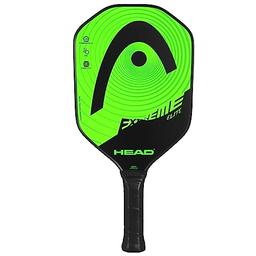
HEAD Extreme Elite

Our pick

HEAD Extreme Elite

The HEAD to buy is the Extreme Elite, and we want to be upfront that it is also the cheapest paddle in our entire registry — that is not a coincidence, it is the finding. It is the only HEAD that publishes a 7.7–7.9 oz weight range (the lightest floor and tightest range of anything we list under $50), a 4.25 in medium grip, a 5 in handle and a forgiving standard 16 x 7.875 in shape that keeps the mass close to your hand. Light, short, standard, held without a clench — that is the profile a sore wrist or shoulder wants. It is both our top pick and our budget pick, and the write-up below says plainly what it gives up: HEAD does not publish its core thickness, so we cannot tell you how soft contact is. Step up to the Radical Elite only for its cushioned comfort grip; the Kickstarter set is there for two players starting together. Prices are live, with the “as of” date on every row.

$24.99 · View on Amazon

Price as of November 23, 2026. #ad How we’re funded

Read the full write-up
By Stephen V.Last updated How we research

HEAD came to pickleball from tennis, and for a lot of players over 55 that badge is the whole appeal: it is the name on the racquet they played with for thirty years. The brand sells sensibly priced, easy-swinging composite paddles that will not punish a new player’s arm, and we recommend two of them individually elsewhere on this site.

But a brand page has to answer a narrower question than “are these any good”, and on HEAD the answer runs in an unusual direction. The cheapest paddle in the line is the only one that tells you what you are buying. The Extreme Elite publishes a weight range, a grip circumference, a handle length and its dimensions — four figures, all of them useful. The Radical Elite, which costs more, publishes a face material, a core type and the words “comfort grip”. The Kickstarter set, which costs more still, publishes what is in the box and nothing else at all.

That matters because of what those missing numbers are. Weight decides how hard your shoulder works on every swing, and the effect compounds across a season rather than announcing itself on day one. Grip circumference decides whether you hold the handle or clench it, and clenching is what loads the forearm tendons behind tennis elbow. A maker that will not state either is asking you to buy blind on the two specs an older arm most needs — and in this line, the more you spend, the more blind you are.

One structural note on HEAD, and it is a genuine point in the brand’s favour. The Extreme Elite is a standard 16 x 7.875 in shape with a short 5 in handle, which is the forgiving geometry: a wide face and a short handle put the sweet spot close to your hand, so an off-center hit twists the paddle less and sends less shock into the wrist holding it. That is the opposite of what the elongated specialists sell, and it is why this paddle appears on more of our constraint pages than its price suggests. We own no paddles, run no lab and have hit no balls with any of these; every figure below is read from the retailer spec table or Amazon listing named in each product’s source row.

How this is funded: we earn a commission if you buy through our links, at no extra cost to you. It never changes which product we recommend, and we’ll tell you plainly when to skip one. Full disclosure.

Quick picks

Ranked on published specs, grip and build, and honest buyer fit. Select a row to jump to the full write-up. We have not lab-tested these — here is exactly what we do instead.

#ProductBest forPrice
1
HEAD Extreme Elite

HEAD Extreme Elite

The cheapest paddle on the site that still comes with a real spec sheet: a published 7.7-7.9 oz - the lightest and tightest range of anything under $50 - on a 16 x 7 7/8 in standard shape with a 5 in handle and a medium 4 1/4 in grip. Fiberglass over a polymer honeycomb, from the tennis brand. For a first paddle, or a spare in the bag, it is hard to argue with at the price.

Best overall and budget pick — the only HEAD with a real spec sheet
$24.99 · View on Amazon

Price as of November 23, 2026. #ad How we’re funded

2
HEAD Radical Elite

HEAD Radical Elite

A dependable budget paddle from a name you know from tennis. Fiberglass face, honeycomb polymer core and a comfort grip — nothing exotic, but a sensible, easy-swinging option for recreational play that won't punish a new player's arm.

Best comfort grip out of the box
$44.95 · View on Amazon

Price as of November 23, 2026. #ad How we’re funded

3
HEAD Kickstarter Pickleball Starter Set

HEAD Kickstarter Pickleball Starter Set

Two HEAD Kickstarter Plus paddles, two outdoor balls and a carry bag from a tennis brand already in this registry — and a listing that publishes nothing else at all. No face material, no core, no weight, no grip. That is a real strike against it at this price, and the reason it ranks below two cheaper sets that tell you what you are buying.

Best for two players — the complete box, with the thinnest spec sheet
$52.70 · View on Amazon

Price as of November 23, 2026. #ad How we’re funded

The picks in full

#1Best overall and budget pick — the only HEAD with a real spec sheet

HEAD Extreme Elite

The cheapest paddle on the site that still comes with a real spec sheet: a published 7.7-7.9 oz - the lightest and tightest range of anything under $50 - on a 16 x 7 7/8 in standard shape with a 5 in handle and a medium 4 1/4 in grip. Fiberglass over a polymer honeycomb, from the tennis brand. For a first paddle, or a spare in the bag, it is hard to argue with at the price.

Easier on the joints: Light and short with a medium grip is the profile a sore wrist or shoulder wants: less mass, kept close to the hand, held without a clench. What it gives up is a thick core, so it is the pick for the swing rather than for contact shock.

What we like

  • Published 7.7-7.9 oz - the lightest floor and narrowest range on this page
  • Standard 16 x 7 7/8 in shape with a 5 in handle keeps the mass close to the hand
  • 4 1/4 in medium grip - the size most adult hands land on without an overgrip
  • Typically the lowest price of any paddle we list

Skip it if

  • Core thickness is not published, so we cannot say how soft it is
  • Fiberglass face is livelier than carbon - more feedback into the arm on a mis-hit
  • No USA Pickleball approval statement on the spec sheet we read
Face materialFiberglass
CorePolymer honeycomb (thickness not published)
Weight7.7-7.9 oz (published range; 7.8 oz average)
Grip circumference4.25 in (medium)
Handle length5 in
Dimensions16 x 7.875 in (standard)
USA Pickleball approvedNot published

Specs read from the product listing, on September 20, 2026. “Not published” means the maker does not state that figure.

#2Best comfort grip out of the box

HEAD Radical Elite

A dependable budget paddle from a name you know from tennis. Fiberglass face, honeycomb polymer core and a comfort grip — nothing exotic, but a sensible, easy-swinging option for recreational play that won't punish a new player's arm.

Easier on the joints: The honeycomb polymer core softens impact compared with a stiff budget paddle, which means less shock traveling into your hand and elbow.

What we like

  • Established brand at a budget price
  • Honeycomb polymer core gives a softer feel than cheap solid cores
  • Comfort grip out of the box

Skip it if

  • Fiberglass face is less refined than carbon
  • Weight and grip circumference aren't published
Face materialFiberglass
CoreHoneycomb polymer
GripComfort grip
WeightNot published
USA Pickleball approvedNot published

Specs read from the product listing, on July 22, 2026. “Not published” means the maker does not state that figure.

#3Best for two players — the complete box, with the thinnest spec sheet

HEAD Kickstarter Pickleball Starter Set

Two HEAD Kickstarter Plus paddles, two outdoor balls and a carry bag from a tennis brand already in this registry — and a listing that publishes nothing else at all. No face material, no core, no weight, no grip. That is a real strike against it at this price, and the reason it ranks below two cheaper sets that tell you what you are buying.

Easier on the joints: There is nothing published here to assess, which is the point: on a paddle you will hold for two hours, an undisclosed weight and an undisclosed grip size are the two blanks you can least afford.

What we like

  • From HEAD, whose Radical Elite and Extreme Elite paddles we recommend individually
  • Complete enough to play on the day it arrives — two paddles, two balls, a bag
  • Outdoor balls, which is what most 55+ league and open-play sessions use

Skip it if

  • The listing publishes no face material, no core, no weight and no grip size — the thinnest spec sheet of any set here
  • Priced above two sets that DO publish a core, which is hard to justify
  • Two balls rather than four
In the box2 Kickstarter Plus paddles, 2 outdoor pickleballs, carry bag (per listing)
Face materialNot published
CoreNot published
WeightNot published
GripNot published
Balls2, outdoor (per listing)
USA Pickleball approvedNot published

Specs read from the product listing, on November 15, 2026. “Not published” means the maker does not state that figure.

How we ranked these, before the picks

Four criteria, in this order, and on a brand this thinly specified the first two do most of the work:

  1. Published weight. The number that decides how much your shoulder and elbow do on every swing. One of the three paddles here states it.
  2. Published grip circumference. A grip you have to squeeze loads the forearm tendons. One of the three states it.
  3. Shape. Where the sweet spot sits relative to your hand. A standard or widebody outline with a short handle is the forgiving arrangement; an elongated one trades that for reach. One of the three states it.
  4. Core thickness. The amount of polymer between your hand and the ball, and the single most consequential spec for impact comfort — published work on lateral epicondylitis points at repeated impact loading as the mechanism, so reducing impact per shot is the lever you have. None of the three states it, which is the honest ceiling on this whole page.

You will notice that one paddle satisfies three of four and the other two satisfy none. That is why this ranking looks the way it does, and why we have not padded the order to make the more expensive paddles look like upgrades. If core thickness is the spec you want to shop on, the brands that publish it are on best 16 mm pickleball paddles and best Selkirk pickleball paddles.

HEAD Extreme Elite: the cheapest paddle we list, and our pick

Four published figures, and every one of them points the same way for an older player:

  • 7.7–7.9 oz. A range, not a vague average, and the lightest floor and narrowest range of any paddle we can price under $50. A narrow range matters more than people realize: it tells you the paddle that actually arrives will be close to the one described, where an 8-ounce-average paddle can turn up meaningfully heavier.
  • 16 x 7.875 in, standard shape, 5 in handle. Wide face, short handle, mass kept near the hand. This is the forgiving geometry, and it is the reason we send wrist-sore readers here rather than to the elongated paddles that dominate the mid-market.
  • 4.25 in grip circumference, medium. The size most adult hands land on without needing an overgrip at all — which is a small saving and a real convenience.
  • Fiberglass face over a polymer honeycomb core. Honeycomb rather than a stiff solid core, which is the softer construction at this price.

The honest cons. Three, and the first one is important. Core thickness is not published, so we cannot tell you how soft contact is — and on a paddle recommended partly for arm comfort, that is a real gap rather than a footnote. The fiberglass face is livelier than carbon, which means more feedback into the arm on a mis-hit; a textured carbon face on a thick core is the better build for a bad elbow, and it is what best carbon fiber pickleball paddles under $100 is for. And no USA Pickleball approval statement appears on the spec sheet we read.

Read in one line: this is the pick for the swing rather than for contact shock. If your complaint is a tired shoulder, a weak wrist or a paddle that feels like a brick by the third game, the light short standard profile is the right answer. If your complaint is the jolt at the moment of contact, buy a published 16 mm core from another brand instead.

HEAD Radical Elite: what the comfort grip buys, and what it costs

The Radical Elite is the paddle most people picture when they think of a HEAD pickleball paddle, and it is a perfectly sensible recreational paddle: a fiberglass face, a honeycomb polymer core — which gives a softer feel than the stiff solid cores you find on the cheapest paddles — and a comfort grip fitted out of the box.

That grip is the real reason to choose it, and it is worth more to this site’s readers than it sounds. A thicker, softer handle does two useful things at once: it damps what travels into the palm, and it enlarges the handle so you clamp down less. For an arthritic hand, a cushioned grip you do not have to fight is often worth more than any face material. It is also the reason this paddle turns up on our best pickleball paddles for beginners list as the known-brand budget option.

The honest cons. It costs more than the Extreme Elite and publishes less. No weight, no grip circumference, no core thickness, no dimensions and no USA Pickleball statement — five cells of our table read “Not published”. “Comfort grip” is a description, not a measurement, so we cannot tell you what circumference you are getting or whether it will suit your hand. And the fiberglass face is less refined than carbon: fine for recreational play, livelier than ideal for a sore arm. Our full write-up is the HEAD Radical Elite review, and if you are deciding between it and the other common first paddle, that is Niupipo vs HEAD Radical Elite.

HEAD Kickstarter set: the complete box, and the thinnest sheet in the line

Two Kickstarter Plus paddles, two outdoor balls and a carry bag. For two people starting together it is complete enough to play on the day it arrives, and outdoor balls are what most 55-plus league and open-play sessions actually use, so the box is matched to the reality rather than padded.

The honest cons, and they are the reason it is last. The listing publishes no face material, no core, no weight, no grip size and no USA Pickleball approval — the thinnest spec sheet of any two-player set we can price from any brand. It is also priced above two sets that do publish a core, which is hard to justify on anything except the badge. And it includes two balls rather than four, which is enough to start and not enough for long, because outdoor balls are a consumable that goes soft and cracks.

We are not telling you not to buy it. We are telling you what you are paying for: a tennis brand you trust, in a bag, with nothing published about what is in your hand for the next two hours. If that trade is worth it to you, it is a defensible purchase. If it is not, the sets that publish more are ranked on best pickleball sets for beginners and best pickleball paddle sets, and two Extreme Elites bought separately will cost about the same and tell you four things each.

Which HEAD, for which player

  • Your shoulder tires, or the paddle feels heavy late in a game. Extreme Elite, for the published 7.7–7.9 oz. The full field on this problem is best paddles for shoulder pain and best lightweight pickleball paddles.
  • Your wrist is the weak link. Extreme Elite again, and this time for the shape: a standard 16 x 7.875 in face on a 5 in handle keeps mass near the hand. See best paddles for wrist pain.
  • Your hands are arthritic or you grip too hard. Radical Elite for the cushioned comfort grip — accepting that HEAD will not tell you its circumference. The brand-agnostic ranking is best paddles for arthritis.
  • Your elbow is what limits you. Neither, honestly. No HEAD paddle in our registry publishes a core thickness, and core thickness is the lever for contact shock. Go to best paddles for tennis elbow instead.
  • Two of you are starting together. The Kickstarter set if the badge matters to you; two Extreme Elites and a sleeve of balls if published specs matter more.
  • You want reach and a two-handed backhand. Leave the brand. HEAD does not sell us an elongated paddle; best JOOLA paddles is built entirely on that shape.

What HEAD does not publish

Three gaps, named so you can price them in. No core thickness, on any of the three. That is the single most consequential paddle spec for impact comfort and it is absent across the whole line, which puts a hard ceiling on how strongly we can recommend any HEAD to a reader with a sore elbow. No weight or grip circumference on two of the three — and, oddly, on the two that cost more. No USA Pickleball approval statement on any of the three. An absence is not evidence a paddle is illegal; sanctioned play is decided by USA Pickleball’s official approved-equipment list rather than by a product page, so look your exact model up there before a tournament.

How this page is ranked, and what we do not claim

We own no paddles, run no lab, and nobody here has hit a ball with any of these. There are no scores on this page, because a score would dress spec-reading up as testing, and no awards we invented. Every figure above is read from the Pickleball Central spec table for the Extreme Elite or from the Amazon listing each product’s own source row points at, on the date shown there. Where a maker publishes nothing, our table says “Not published” rather than carrying a number we would have had to guess — and on this brand that is most of the sheet, which is exactly why we say so in the dek rather than at the bottom.

The ranking is published weight, published grip, shape and core thickness, in that order, for a player over 55. Prices come from the live price layer with an “as of” date attached, so a discount cannot silently reorder the page: our top pick is top on its spec sheet, and it happens to be the cheapest paddle we list. If you would rather compare across brands than inside one, start at best pickleball paddles for seniors or best pickleball paddles under $75; the other brand pages are best JOOLA pickleball paddles, best Selkirk pickleball paddles and best ProKennex pickleball paddles.
Frequently asked questions

What is the best HEAD pickleball paddle?

The Extreme Elite, and it is also the cheapest paddle in our whole registry — which is the finding rather than a coincidence. It is the only HEAD that publishes a weight range (7.7-7.9 oz, the lightest floor and tightest range of anything we list under $50), a 4.25 in medium grip circumference, a 5 in handle and a forgiving standard 16 x 7.875 in shape. The Radical Elite costs more and publishes a face material, a core type and the words 'comfort grip'. Choose the Radical Elite only if a cushioned grip out of the box is what you need.

Are HEAD pickleball paddles any good?

Yes, as sensibly priced recreational paddles that will not punish a new player's arm — fiberglass faces over honeycomb polymer cores, which is softer than the stiff solid cores you find on the cheapest paddles. The caveat is disclosure rather than quality: no HEAD paddle in our registry publishes a core thickness, and two of the three publish neither a weight nor a grip circumference. If you want to shop on published numbers, Selkirk and JOOLA tell you considerably more.

Extreme Elite or Radical Elite?

Extreme Elite for almost everyone, because it is the one with a spec sheet: a published 7.7-7.9 oz, a 4.25 in medium grip, a 5 in handle and a standard 16 x 7.875 in shape that keeps mass close to your hand. It is also typically the cheaper of the two. Take the Radical Elite only for its cushioned comfort grip, which genuinely helps an arthritic hand or anyone who grips too hard — accepting that HEAD publishes no circumference for it, so you cannot know in advance whether it suits your hand.

How much does the HEAD Extreme Elite weigh?

HEAD publishes 7.7-7.9 oz, with a 7.8 oz average. That is the lightest floor and the narrowest range of any paddle we can price under $50, and the narrowness is worth as much as the number: it tells you the paddle that actually arrives will be close to the one described. HEAD publishes no weight at all for the Radical Elite or for the paddles in the Kickstarter set, so our tables read 'Not published' for both.

Are HEAD pickleball paddles USA Pickleball approved?

None of the three on this page states it, which is why our tables read 'Not published' throughout. That absence is not evidence any of them is illegal — sanctioned play is decided by USA Pickleball's official approved-equipment list, not by a product page or a retailer spec table. For social play and most local leagues it never comes up. If you expect to enter a sanctioned tournament, look your exact model up on that list before buying.

Is the HEAD Kickstarter set worth it?

Only if the tennis badge is what you are buying, and we would rather say that than dress it up. The box is complete — two Kickstarter Plus paddles, two outdoor balls and a carry bag — but the listing publishes no face material, no core, no weight and no grip size, which is the thinnest spec sheet of any two-player set we can price. It is also priced above two sets that do publish a core, and includes two balls rather than four. Two Extreme Elites bought separately cost about the same and tell you four things each.

Sources

  • USA Pickleball - Official Rulebook (paddle dimensions) — USA Pickleball caps paddle size in the rulebook's equipment section, and repeats it as 2.E.3 ('Size') of the Equipment Standards Manual: the combined length and width of the paddle, INCLUDING any edge guard and butt cap, shall not exceed 24 inches (60.96 cm), and the paddle length alone shall not exceed 17 inches (43.18 cm). No restriction is placed on paddle thickness. This is the rule that makes face width and face length a zero-sum trade - a maker cannot add width without taking away length - and it is why no legal paddle is both long and wide (accessed October 18, 2026)
  • USA Pickleball — Approved Paddles list — The searchable database of paddles that have passed USA Pickleball certification testing (accessed July 22, 2026)
  • Pickleball Studio — How Thick Should Your Pickleball Paddle Be? (Chris Olson, Aug 31, 2022) — Thicker cores (16 mm and above) are for control: 'less power but usually improves your blocks, resets, and drop shots', 'helps absorb more of the pace from the ball', and they 'usually feel like they have a better sweet spot'. Thinner cores (13 mm and below) 'feel stiffer when the ball hits the paddle', the core 'doesn't absorb as much energy, so the ball comes off faster', and 'thinner paddles usually provide more vibration and worse off-center shot performance'. Recommendation: 'If you are a new player up to about 3.5, I would usually tell you to opt for a thicker paddle.' The article does not address arm pain or older players specifically (accessed September 18, 2026)
  • A Review of Physiotherapy Techniques Used in the Treatment of Tennis Elbow — PMC (2023) — Lateral epicondylitis is an overuse tendinopathy of the forearm extensors; conservative care — rest, bracing/counterforce straps and graduated loading — is the mainstay (accessed July 22, 2026)
  • American Academy of Orthopaedic Surgeons (OrthoInfo) - Tennis Elbow (Lateral Epicondylitis) — AAOS: tennis elbow 'involves the degeneration (wearing down) or, in some cases, microtearing of the tendons that join the forearm muscles on the outside of the elbow', specifically the extensor carpi radialis brevis (ECRB) where it attaches to the lateral epicondyle. Symptoms: 'Pain or burning on the outer part of your elbow', 'Weak grip strength', 'Sometimes, pain at night', 'often worsened with forearm activity, such as holding a racquet, turning a wrench, or shaking hands'. Most people who get it are 'between the ages of 30 and 50'. THE PLACEMENT SENTENCE: 'Using a brace centered over the back of your forearm may also help relieve symptoms of tennis elbow. This can reduce symptoms by resting the muscles and tendons.' AAOS calls this a counterforce brace - it is NOT worn on the elbow joint itself. 'Approximately 80 to 95% of patients have success with nonsurgical treatment', beginning with rest: 'you will have to stop or decrease participation in sports, heavy work activities, and other activities that cause painful symptoms for several weeks'. AAOS also lists an EQUIPMENT CHECK as treatment: 'Stiffer racquets and looser-strung racquets often can reduce the stress on the forearm, which means that the forearm muscles do not have to work as hard.' Steroid injections 'should be used very sparingly for lateral epicondylitis, as excessive use can weaken the lateral epicondyle'. Surgery is considered only 'if your symptoms do not respond after 6 to 12 months of nonsurgical treatments' (accessed October 17, 2026)
  • Non-fatal senior pickleball and tennis injuries in US EDs, 2010–2019 — Injury Epidemiology (2021) — For players 60+: strains/sprains 31.0%, fractures 30.4%; the wrist is the single most-injured body part (13.2%); women 3.7x more likely to fracture (accessed July 22, 2026)

Keep reading