The shape decision, which is the whole decision
Selkirk’s SLK line gives you a genuine choice of geometry, and for an older player it matters more than the face material does.
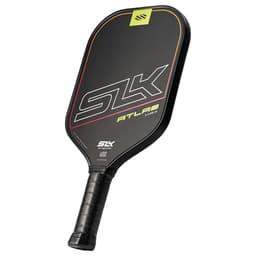
- Widebody (the Atlas Max): 16 x 7.85 in, 4.85 in handle. A short handle and a wide face put the sweet spot closer to your hand. That is the forgiving arrangement: off-centre hits twist the paddle less, so less of the shock reaches a wrist or an elbow. The trade is reach and leverage — you will not generate the same swing speed, and a two-handed backhand has less handle to hold.
- Elongated (the Halo Power XL): 16.4 x 7.4 in, 5.75 in handle. Nearly an inch more handle and a narrower face. More reach, more leverage, more power — and a sweet spot further from your hand, which means a mis-hit asks more of the joint holding it. Selkirk also sells the Atlas in an XL cut on exactly this geometry, so you can keep the core and change only the shape.
Our ranking puts the widebody first because this site is written for players shopping around a physical constraint rather than for a tournament ladder. If your arm is healthy and you want drive, invert the order: the Halo Power XL is the better paddle for you, and that argument is made at length on best pickleball paddles for power.
Core thickness, and what 16 mm is actually doing
Two core thicknesses across the specified paddles here: 16 mm on the Atlas Max (Rev-Control polymer honeycomb) and 13 mm on the Halo Power XL (Rev-Power polymer honeycomb). Selkirk names them differently on purpose, and the names are honest about the intent: control versus power.
The thicker core is the joint-friendly one. More polymer between your hand and the ball means a softer, slower, more muffled contact — less of the impact arrives at your elbow, and the ball sits on the face a fraction longer, which is what people mean when they say a paddle “feels controlled”. A 13 mm core does the opposite: faster, firmer, more pop, more feedback through the handle. If you have had tennis elbow from this sport — and published work on lateral epicondylitis is clear that repeated impact loading is the mechanism — the 16 mm core is not a preference, it is the specification you are shopping for. The full argument sits on 13 mm vs 16 mm pickleball paddles.
Grip circumference: the number almost nobody publishes
Both specified SLK paddles publish a 4.25 in grip circumference. That is a medium, and it is the single most useful figure on this page for an arthritic hand, because it tells you whether you will be able to hold the paddle without squeezing.
Squeezing is what hurts. A grip that is too small makes you clamp down to stop the paddle turning, and clamping is what loads the forearm tendons the elbow complains about. 4.25 in works for most adult hands; if yours is large, you can build it up with an overgrip (every wrap adds roughly a sixteenth of an inch to the circumference) and the options are on best pickleball overgrips. If your hand is small, the paddle you want is on best pickleball paddles for small hands, and if your problem is specifically arthritis then best pickleball paddles for arthritis is the page that ranks on grip and cushioning first.
The two-paddle sets, and when a set is the right buy
Two of our five picks are sets, which is unusual for a brand page. It is deliberate: couples and doubles partners over 55 buy together far more often than the paddle industry writes for.
The SLK Neo set is the one we would actually recommend to two committed players — raw carbon faces, two outdoor balls and a sling bag, at roughly what one mid-range carbon paddle costs on its own. The SLK Club set is the budget pick on this page and the cheapest route into the brand, and it comes with two disclosures we are not going to bury: its listing names no balls at all (the sling bag is included, the balls are not), and the face material is given as “Graphite Fiberglass”, which is two different materials and therefore not a specification we can rely on. Buy it as a starting point on a brand whose single paddles are worth upgrading into, not as a specified paddle. Both sets are compared against every other set we list on best pickleball paddle sets, and the beginner-first ordering is on best pickleball sets for beginners.
What Selkirk does not publish
Three gaps, named so you are not surprised by them. The Evo Hybrid XL publishes no core thickness and no weight — only a fiberglass face and the XL shape — so it is on this page as a forgiving, trusted starter shape rather than a paddle we can argue about numerically. Neither two-paddle set publishes a weight, which for a 55-plus buyer is the figure you would most want. And USA Pickleball approval is not stated on the Atlas Max, the Halo Power XL, the Evo Hybrid or either set. That absence is not evidence a paddle is illegal; it means Selkirk does not say so on the listings we read, and sanctioned play is decided by the official equipment list, not by a product page. Check your exact model there before a tournament.
How this page is ranked
We own no paddles, run no lab, and have hit no balls with any of these. Every number above is read from Selkirk’s own product pages for the Atlas Max, the Atlas XL and the SLK Halo Power XL, or from the Amazon listing each product’s own source row points at, on the date shown there. There are no scores, because a score implies a test. The order is argued on shape, core thickness, grip circumference and published disclosure, in that priority, for a player over 55.
Prices come from the live price layer with an “as of” date attached, so a discount cannot reorder the page. If you would rather compare across brands than inside one, the versions of this page without a brand filter are best pickleball paddles for seniors and best pickleball paddles under $100; the carbon-face comparison at the same ceiling is best carbon fiber pickleball paddles under $100.