How we ranked these, before the picks
Four criteria, in this order, and they are the same four we apply to every paddle on this site because they are the four that decide whether an older arm enjoys a session:
- Core thickness. The amount of polypropylene honeycomb between your hand and the ball. A 16 mm core deforms more on contact, returns less of the ball’s energy and holds it on the face a fraction longer — so less impact arrives at the elbow. Published work on lateral epicondylitis points squarely at repeated impact loading as the mechanism, which makes this the one spec with a direct line to whether you can still play next month.
- Published weight. Weight decides how hard your shoulder works on every swing, and the effect compounds over a season rather than announcing itself on day one. A maker that will not state a figure is asking you to buy blind.
- Grip circumference. A grip you have to squeeze is a grip that loads the forearm tendons. Published circumference tells you in advance whether you will be clamping.
- Shape. Where the sweet spot sits relative to your hand. On this brand, as covered above, there is effectively no choice to make.
Face material comes fifth, which surprises people. A carbon face is firmer and grittier than fiberglass, so it bites the ball and holds spin and feels more precise on a soft dink — but it is not a shock-absorbing feature. The core does that work. Carbon plus a thick core is the build worth paying for; carbon on a thin core is a performance paddle and will feed more into a sore tendon, not less.
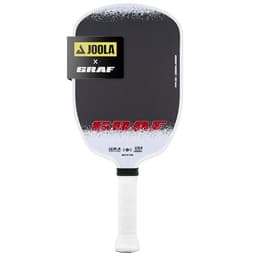
The Graf Edge 16mm: why the cheapest carbon JOOLA is our pick
This paddle is on top because it is the only one in the line that satisfies the first three criteria at once. JOOLA publishes a 16 mm polypropylene honeycomb core, a textured carbon fiber face, a 7.6–8.0 oz weight range (7.8 oz average — a range, not a vague average), a 4.125 in grip circumference, a 5.5 in handle and 16.5 x 7.5 in dimensions. It is also approved by both USA Pickleball and UPA-A, which is the most complete approval statement on any paddle in this line.
Getting a 16 mm core and a carbon face together at the bottom of a brand’s range is genuinely unusual. It is the combination our tennis elbow paddle picks and low-vibration list normally recommend at twice the money, and it is the reason this paddle also leads our best carbon fiber pickleball paddles under $100 on value.
The honest cons. Two, both of which matter. The 4 1/8 in grip is small — smaller than the 4.25 in medium most adult hands land on — so budget for an overgrip or two, each of which adds roughly a sixteenth of an inch to the circumference (options on best pickleball overgrips). And the elongated 16.5 in outline with a 5.5 in handle moves mass away from your hand, which is the one thing a weak or painful wrist does not want. If your wrist is the problem rather than your elbow, read best pickleball paddles for wrist pain before you buy this, because the answer there is a standard or widebody shape from another brand.
The Hyperion CAS 16: what the performance tier adds, and what it does not
The Ben Johns Hyperion CAS 16 is the paddle the brand is actually known for, and JOOLA publishes it properly: a Carbon Abrasion Surface face, a 16 mm Response honeycomb polymer core, an 8.3 oz average weight (JOOLA states an average, not a range), a 4.25 in grip circumference — noted on its own page as “may vary slightly” — a 5.5 in grip length, and 16.5 x 7.5 in dimensions, with USA Pickleball approval stated.
So it shares the Graf Edge’s core thickness and its outline, and differs in two ways that are worth money to the right reader: a more aggressive abrasion-textured face for spin, and a grip circumference that is a quarter-inch bigger and therefore closer to what most hands want out of the box. If you are playing competitively, improving fast, or you simply want the paddle people at open play will recognize, this is the one.
The honest cons. It is the most expensive paddle in this line by a clear margin, and on our four criteria it does not out-rank the Graf Edge — same core, same shape, heavier at a published 8.3 oz average, and an average rather than a range tells you less about the paddle that actually arrives. That extra half-ounce over the Graf Edge’s midpoint is not nothing when you count the swings in three games. Our full write-up, including what we would want JOOLA to publish and do not get, is the JOOLA Ben Johns Hyperion review, and if you like the paddle but not the price, that comparison lives on JOOLA Hyperion alternatives.
The Ben Johns set: the only complete box JOOLA sells us
Two paddles, four balls described as suitable for indoor and outdoor play, and a carry bag. On a 55-plus court, two people taking the sport up together is the normal story rather than the exception, and this is the only JOOLA listing that gets both of them playing without a second order.
It also publishes the single most useful number in the whole set category: a 6.8 oz paddle weight. Across the five two-player sets we can price from any brand, it is the only one that states a weight at all, and 6.8 oz is light by any standard — most singles we list sit between 7.5 and 8.4 oz. For a pair where one person has a sore wrist, elbow or shoulder, that figure is the reason to choose this box.
The honest cons. Three. The listing does not say whether 6.8 oz is bare or gripped, and an overgrip adds real weight, so read it conservatively. The face is fiberglass, not carbon, and the grip is described as cushioned with no circumference published — so you lose the two specs the Graf Edge gives you. And no USA Pickleball approval is stated, which is irrelevant for social play and the first thing to check against the official equipment list if you expect to enter a sanctioned tournament. The deeper point about sets, which we make on every set page: they hand you two identical paddles, and two hands of different sizes rarely want that. The beginner-first ranking across all brands is best pickleball sets for beginners, with the disclosure-first version on best pickleball paddle sets.
The Essentials Performance: the budget pick, and the one caveat on it
The Essentials is JOOLA’s entry tier: a reinforced fiberglass face on a polypropylene honeycomb core, and that is the entire published specification. It is a recognisable brand on a first paddle for not much money, and for a player who wants to find out whether they enjoy the sport before spending properly, that is a perfectly reasonable purchase.
The honest cons, and there are a lot of them. JOOLA publishes no weight, no grip circumference, no core thickness and no USA Pickleball approval for it. Four cells in our table read “Not published”, which is itself the information: at this tier you are buying the badge rather than the build. On our ranking criteria it scores on none of the first three, and that is why it is last on a page where it is also the cheapest at list.
Which brings us to the caveat we would rather state than bury. The Graf Edge frequently sits at or below the Essentials’ price, and when it does, buy the Graf Edge. You get a thicker published core, a carbon face instead of fiberglass, a stated weight range, a stated grip size and a full approval statement, for the same money or less. We cannot promise what the two will cost on the day you read this — every price on this page is read live from our price layer with its “as of” date attached, which is exactly so you can check rather than trust. Compare the two buy rows above before you decide.
Which JOOLA, for which player
- Your elbow is what limits you. Graf Edge 16mm, and add an overgrip to bring that 4 1/8 in grip up to something you can hold loosely. The 16 mm core is the lever that matters; the full field for this problem is best paddles for tennis elbow.
- Your wrist is what limits you. None of them, honestly. Every JOOLA single we can price is elongated, which moves mass away from the hand. Go to best paddles for wrist pain or straight to a widebody on paddles with the largest sweet spot.
- Your hands are large, or arthritic. The Hyperion, for its published 4.25 in grip — a quarter-inch more than the Graf Edge, which is the difference between holding and clenching. If arthritis is the constraint rather than size, the brand-agnostic ranking on grip and cushioning is best paddles for arthritis.
- You want reach and a two-handed backhand. Any of them, and that is genuinely JOOLA’s strength: a 5.5 in handle on a 16.5 in frame is built for it. More on best elongated pickleball paddles.
- Two of you are starting together. The Ben Johns set, for the 6.8 oz figure and the four balls.
- You want the most forgiving paddle your money can buy. Leave the brand. Our senior and arthritis pages both put widebody shapes from other makers above anything here, and we would rather say so than sell you a shape that fights you.
What JOOLA does not publish
Three gaps, named so you are not surprised. There is no widebody or standard-shape JOOLA in our registry at all — the entire buyable line is one outline, so the brand cannot serve a player who needs the sweet spot close to the hand. Disclosure collapses below the performance tier: the Graf Edge and Hyperion publish four to seven real figures each, and the Essentials and the set publish one or two between them. USA Pickleball approval is stated on only two of the four — the Graf Edge and the Hyperion — and an absence on the other two is not evidence anything is illegal, because sanctioned play is decided by the official equipment list rather than by a product page. Look your exact model up there before a tournament.
How this page is ranked, and what we do not claim
We own no paddles, run no lab, and nobody here has hit a ball with any of these. There are no scores on this page, because a score would dress spec-reading up as testing. Every figure above is read from JOOLA’s own product page for the Hyperion CAS 16, from the Pickleball Central spec table for the Graf Edge, or from the Amazon listing each product’s own source row points at, on the date shown there. Where a maker publishes nothing, the table says “Not published” rather than carrying a number we would have had to invent.
The ranking is core thickness, published weight, grip circumference and shape, in that order, for a player over 55 — argued above rather than asserted. Prices come from the live price layer with an “as of” date attached, so a discount cannot silently reorder the page. If you would rather compare across brands than inside one, the brand-agnostic versions are best pickleball paddles for seniors and best pickleball paddles under $100; the other two brand pages are best Selkirk pickleball paddles and best HEAD pickleball paddles.