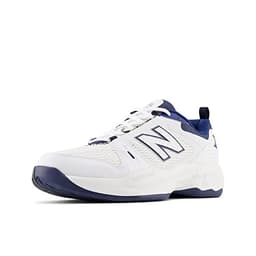
The two New Balance platforms, and who each is for
- Fresh Foam X 1007 — the wide, stable one. Fresh Foam X midsole, integrated midfoot stabilizers, a non-marking NDurance rubber outsole, 15.6 oz at size 10.5, a published low-arch design, and the 4E width that puts it on this page. For a reader who has spent years squeezing a broad foot into a medium court shoe, this is the single most useful listing on the site.
- FuelCell 996 V6 — the cushioned one. FuelCell foam with lateral stability, sold in men’s and women’s cuts. Softer underfoot than the 1007 and aimed at a player whose complaint is impact rather than width. The women’s listing we link is a published W; the men’s publishes no width at all.
Our ordering puts width above cushioning, and that is a deliberate judgement for this audience rather than a verdict on which shoe is better built. Published senior-injury data makes falls and sprains the dominant pickleball problem after 60 — strains and sprains at 31.0% of emergency visits, fractures at 30.4%, with ground-level falls behind more than half of geriatric pickleball injuries. A foot that is being pinched sideways cannot grip the inside of the shoe, and a forefoot that spills over the footbed rolls before the outsole does. Fit is the stability feature.
The width picture in full, because it is the reason to be here
Three published widths across the models on this page, and they are not interchangeable.
- 1007: 4E extra wide. The widest court shoe we can buy anywhere in the registry. If a 2E has never been enough, this is the listing.
- Women’s FuelCell 996 V6: W. A genuine women’s wide with FuelCell cushioning, and — at the live price — the cheapest New Balance on this page. For a woman with a broad foot who also wants softness underfoot, there is no other listing in our registry that does both.
- Men’s FuelCell 996 V6: not published. New Balance states no width for it. Third-party coverage of the newer v7 generation lists B, D and 2E, but that is the successor model, not the shoe you are buying here, so our table leaves the men’s V6 width cell empty rather than borrowing a figure from a different shoe.
The broader comparison — every published wide and extra-wide court shoe in the registry, including the Skechers Viper Court Pro 2.0’s Medium and Wide run — is laid out on best pickleball shoes for wide feet.
The 996 V6 generation warning you should read before buying
This is the most important caveat on the page, and it is published rather than our opinion. New Balance has moved the 996 line on: the FuelCell 996v7 shipped in July 2026, and the coverage of that launch is explicit about what drove the redesign — the outgoing v6 “received recurring criticism across online communities for its incredibly restrictive, narrow internal proportions”, and the v7 “features a considerably roomier toe box to enhance overall playing comfort”.
Read that as a toe-box warning on the shoe you are about to buy. Both 996 V6 listings on this page are the narrow-forefoot generation. If your complaint is impact and your foot is slim, the V6 at a run-out price is a good buy. If your toes are what hurt, do not buy the V6 at any discount — either go to the 1007 in 4E, or price the v7, which also carries a published 10 mm heel-to-toe drop (the only drop figure we have seen published anywhere in this category) and is listed in B, D and 2E widths.
The outsole guarantee, and why we single it out
Court shoes die at the outsole, and pickleball kills them faster than tennis because it concentrates wear into the medial forefoot and the dragged toe rather than spreading it. Several shoes we list come with a six-month outsole durability promise — but on most of them that promise belongs to a retailer, covers the rubber outsole only, and does not travel with a purchase made anywhere else.
The 1007 is the exception worth knowing about: New Balance attaches its own NDurance six-month outsole durability guarantee to the shoe, in addition to whatever a given retailer offers. We are not telling you how to claim it — terms are the seller’s and the brand’s business, not ours — only that on this one model the guarantee is attached to the product rather than to a particular checkout. If you play outdoors four times a week on abrasive concrete, that is a real difference.
What none of these shoes will do for you
Three honest limits. None is pickleball-specific, so none has been designed around the short, repetitive, heavily lateral footwork this sport actually asks for — they are tennis platforms that happen to suit it. None publishes a heel-to-toe drop, which is normal for the category but still a gap if a clinician has given you a target. None publishes a removable insole, so if you wear a prescribed orthotic the shoe to read about is the Skechers Viper Court Pro 2.0 on best Skechers pickleball shoes, which states that its footbed comes out.
And on price: the 1007 and the men’s 996 V6 both sit above the hundred-dollar line, which puts this brand out of reach for some readers. The band comparison lives on best pickleball shoes under $150, and if a hundred dollars is your ceiling start with best pickleball shoes under $100 instead.
How this page is ranked
We own no units, run no lab and have worn none of these shoes. Every figure above is read from the Tennis Warehouse specification page for the 1007, from the published coverage of the 996v7 launch named in the sources, or from the Amazon listing each product’s own source row points at, on the date shown there. There are no numeric scores, because a score implies a test we did not run. The ranking is width first, published disclosure second, cushioning third — which is the order that serves a 55-plus foot, and is argued above rather than asserted. Prices come from the live price layer with an “as of” date attached, so a discount cannot reorder the page.